What's in this roadmap
- Why winter is the cheapest season to move
- What the winter discount is actually worth
- What winter takes back: the add-back budget
- Booking a winter move with weather contingency built in
- What a delayed truck actually costs you
- Choosing a winter move date and reading the forecast
- Protecting floors and walkways at both ends
- The salt and grit problem
- Ice underfoot with a heavy load is the real hazard
- Space heaters near packing materials are a fire risk
- Carbon monoxide from a running truck near an open door
- Which belongings are genuinely cold-sensitive
- Electronics and screens in freezing temperatures
- Liquids that freeze and burst
- Musical instruments and wood furniture in cold, dry air
- Houseplants on a freezing moving day
- Candles, cosmetics, and the things that ruin quietly
- Keep the utilities on at both properties
- The shorter daylight window compresses the whole schedule
- Driving and parking in snow: where the truck can stop
- How the crew works in the cold, and how you help
- The winter first-night box
- Pets and children on a cold moving day
- A worked example: an illustrative winter move, priced
- Run your own winter move plan
- The bottom line
Short answer: Move in winter by booking early to capture the off-peak discount, commonly an illustrative 10 to 30 percent, and writing a weather contingency into the paperwork. Clear and protect walkways and floors at both ends, keep heat and power live at both properties across the handover, carry cold-sensitive items in the heated cabin, and watch for ice underfoot, heaters near cardboard and carbon monoxide. Winter extras run roughly $600 on an illustrative $6,000 move.
Winter is the season nobody chooses and quite a few people should. The moving industry runs on a summer rhythm: leases turn over, school years end, and for a few months every truck and every crew is spoken for at a price the calendar sets rather than the work does. A January move sits at the opposite end of that cycle, which is why the same household, the same distance and the same crew often price meaningfully lower in the cold. The tradeoff is that winter charges you back in a different currency, in ice, daylight, and the specific ways that cold ruins things you did not think of as fragile.
This roadmap prices both sides honestly. It covers why winter is the cheapest window and what that discount is actually worth once the extra costs are subtracted, how to book a cold-weather move with a weather contingency written into the paperwork, what a delayed truck really costs, how to protect floors and walkways at both ends, which belongings are genuinely cold-sensitive and what to do with each, why utilities at both properties matter more in February than in July, how shorter daylight compresses a schedule, where a truck can actually stop on a snowy street, and what belongs in a winter first-night box. Our mover-cost roadmap prices the underlying move, our moving-budget roadmap holds the totals, and the calculator handles the salary side of the relocation while you read.
Key takeaways
- Winter is the moving market's quiet season, and off-peak timing commonly saves an illustrative 10 to 30 percent against a peak-season, month-end Saturday for identical work.
- Winter takes some of that back: clearing, protection materials, a utility overlap, a delay contingency and slower carries add up to roughly $600 on an illustrative $6,000 move, so the discount has to beat about 10 percent before the season pays.
- The genuine safety hazards are ice underfoot while carrying weight, portable heaters near cardboard and packing paper, and carbon monoxide from a vehicle running near an open door.
- Cold-sensitive belongings split into three families: things that freeze and burst, things that condense and short, and things that shrink and crack. All of them ride in the heated cabin.
- Keep heat and power live at both properties across the handover, and schedule the new home's utilities to start a day early so a failed furnace is discovered while someone can still be called.
Why winter is the cheapest season to move
Moving is a capacity business, and capacity businesses price by the calendar. A company owns a fixed number of trucks and employs a crew it would rather keep busy, so the months when everyone wants both are the months when the price rises, and the months when the phone is quiet are the months when a discount buys work that would otherwise not exist. Summer is the peak because leases, school years, and job start dates cluster there. Winter is the trough for exactly the same reasons in reverse.
Three cycles stack on top of each other, and winter lets you beat all three at once. The seasonal cycle peaks in summer. The monthly cycle peaks at every month’s end, when leases across an entire metro expire on the same two or three days. The weekly cycle peaks on weekends, when people who work can supervise their own move. A mid-January Tuesday in the middle of the month is the quiet corner of all three, and that is where the off-peak discount lives.
Our mover-cost roadmap works the same timing arbitrage in the context of pricing generally: illustratively, off-peak timing commonly saves 10 to 30 percent against a peak-season, month-end Saturday. Winter is the deepest version of off-peak, because it combines the quiet season with short days that make crews grateful for booked work.
The secondary benefits are worth naming. Availability is better, so you can choose your crew rather than accepting whoever answers. Estimators have time for a proper survey. Rental trucks and containers are easier to get on the date you actually want. And on the housing side, a market with fewer buyers and fewer competing tenants is a market where a slower, more careful decision is possible.
What the winter discount is actually worth
A percentage is not money until it meets a quote, so put a number on it. Take the illustrative case this roadmap uses throughout: a two-bedroom household of roughly 5,000 pounds moved about 1,000 miles by a full-service carrier, which our mover-cost roadmap prices near $6,000 at ordinary rates. That $6,000 is the peak-season, month-end, Saturday version of the job.
Move the same job into the quiet corner of the calendar and the number moves with it. At the conservative end of the illustrative 10 to 30 percent off-peak band, you save around $600. At the middle, around $1,200. At the deep end, in a genuinely dead week for a company that wants the truck moving, around $1,800. None of those is a promise; all of them are the shape of the thing.
The same 2-bedroom move, priced by where it sits on the calendar
Illustrative totals for a 5,000-pound household moved about 1,000 miles full-service. Not quotes.
Four illustrative prices for identical work. The spread between the top and bottom bars is roughly 30 percent, which is the outer edge of the commonly cited off-peak band rather than a typical result. Collect written quotes for your own date; the discount only exists in the ones you actually get.
The chart is the argument for asking. Nothing about the physical job changes between the top bar and the bottom one, so any price difference is a market difference, and market differences are visible only when you gather more than one quote for the same date. Our mover-hiring roadmap covers how to collect three estimates that genuinely compare, which is the mechanism that turns a seasonal theory into a number on paper.
What winter takes back: the add-back budget
The honest version of the winter argument subtracts before it celebrates. Cold weather adds costs a July move does not carry, and a plan that ignores them will report a saving it did not really make. Five add-backs recur, and all five are budgetable in advance.
Clearing and salting a path at both ends is the first, whether you do it yourself with a shovel and a bag of ice melt or pay someone at the origin, the destination, or both. Extra protection materials are the second: floor film, ram board, heavy mats, extra furniture blankets and more shrink wrap than a summer move needs. A utility overlap is the third, because heat runs at two properties for a few days rather than one. A delay contingency is the fourth, which is a budgeted line you hope not to spend. And a little extra time on the clock is the fifth, because carries are slower when the ground is slick and hands are gloved.
Where an illustrative $600 winter add-back budget goes
Shares of the extra spend a cold-weather move carries that the same move in July does not.
Budgeted generously, the winter surcharge on an illustrative $6,000 move comes to about $600, or 10 percent. That is the hurdle: a 20 percent off-peak discount clears it comfortably, a 10 percent one does not clear it at all.
That last sentence is the whole decision rule, and it is worth stating plainly. Winter pays when the discount you are actually offered is larger than the add-backs your specific move will carry. A ground-floor apartment in a mild climate carries almost no add-backs and keeps nearly all of the discount. A house with a long uphill driveway in a snow belt carries most of them.
Booking a winter move with weather contingency built in
Booking a summer move is a scheduling exercise. Booking a winter move is a scheduling exercise plus a contract question, because the one thing that separates the two seasons is that winter dates can be overruled by weather nobody controls. The mistake is treating that as bad luck to be absorbed on the day. Treat it instead as a term to be agreed while you still have three companies competing for your signature.
Ask four questions in writing before you book, and get the answers on the estimate rather than in a phone call. What happens if a storm makes the origin, the destination, or the route unsafe on the scheduled day. How quickly can a replacement date be found, which in the quiet season is usually the good news of the whole conversation. What happens to the deposit if the delay is the company’s call, and what happens if it is yours. And on a long-distance move, what happens to the delivery window if the truck is held up between the two ends.
Then build slack into your own side of the calendar. If you can avoid handing over keys on the same afternoon the truck arrives, do. If you can arrange a day or two of overlap between the two properties, that day is the single most valuable thing you can buy in a winter move, because it converts a crisis into an inconvenience. Our moving checklist lays out the week-by-week runway that makes overlap possible rather than accidental.
Finally, book earlier than the quiet season strictly requires. Availability is genuinely better in winter, but the specific crew you vetted, on the specific Tuesday you want, with the specific truck size you need, is still a finite thing. Booking four to six weeks out in winter buys choice, and choice is what makes the contingency conversation possible at all.
What a delayed truck actually costs you
People underestimate a delay because they price it as a lost day. The real cost is a stack of small charges that all fire at once, and knowing the stack is what makes the contingency line in your budget a real number rather than a gesture.
Lodging and meals are the visible part: a night in a hotel plus eating out, illustratively around $150 for a small household and considerably more for a family. Then come the quieter ones. A rental truck held an extra day carries another day’s rate plus another tank of fuel. A cleaning crew, a locksmith, an internet installation or an appliance delivery booked for the original day may charge a rescheduling fee or simply vanish into the next available slot. Time off work that was booked around the move gets spent on waiting. And if a lease or closing hands over on a fixed date, a delay can mean paying for storage or a second night somewhere you did not plan to be.
None of that is catastrophic, and none of it is free. The illustrative $150 contingency line in the add-back budget covers a modest one-night version for a small household. Size yours to the version you would actually experience, which for a family with pets and a fixed handover date is realistically several times that. Our moving-budget roadmap is where that line belongs, alongside the other costs that hide outside the mover’s quote.
The reason to price a delay rather than hope past it is that a priced delay changes decisions. Once you know the number, a day of overlap between properties stops looking like an expense and starts looking like the cheaper of two options.
Choosing a winter move date and reading the forecast
There is no forecast reliable enough to plan a move around six weeks out, and pretending otherwise leads to worse decisions than admitting it. What you can do is stack the odds. Within winter, avoid the days that carry their own demand spikes: the last two and first two days of a month, weekends, and the stretch around major holidays when both crews and traffic are unpredictable. A midweek day in the middle of a month is the target.
Time of day matters more in winter than season alone. An early start uses the warmest, brightest part of a short day and leaves margin at the end. It also means the driveway you cleared at seven in the morning is still clear at noon, rather than refrozen after a thaw. If a crew offers a mid-afternoon start in January, that is a job finishing in the dark.
In the final week, the forecast becomes actually useful, and it is worth watching two things rather than one. Snowfall is the obvious variable. The one that catches people is the freeze-thaw line: a day that rises above freezing and then drops below it after dark produces the slickest surfaces of the whole season, because meltwater refreezes into a thin sheet exactly where people walk. A day of steady cold with dry snow is easier to work than a day that crosses freezing twice.
Keep the reschedule conversation warm rather than theoretical. If the forecast turns three days out, call the company then, not on the morning. In the quiet season a two-day slip is usually available; on the morning of, you are asking for a favor instead of making a plan.
Protecting floors and walkways at both ends
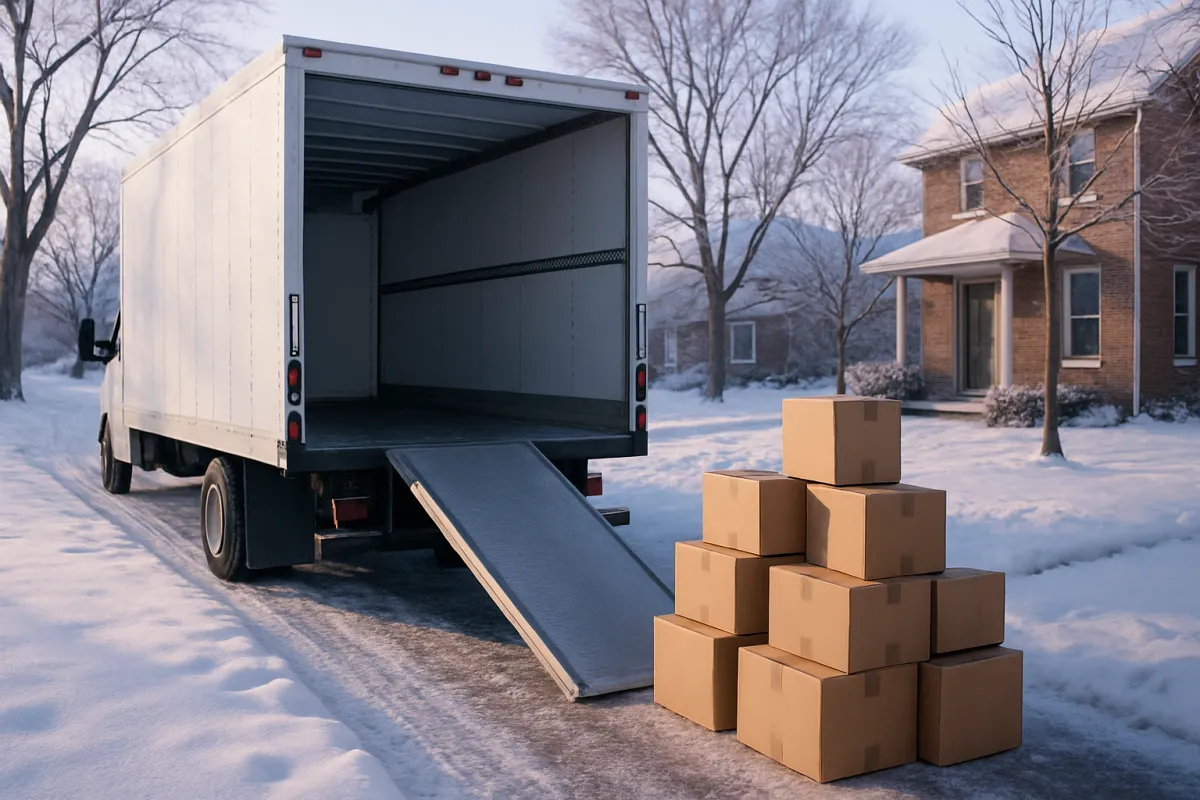
Every winter move has a threshold problem. Outside is wet, gritty and cold; inside is dry, finished, and about to have a hundred heavy trips walked across it. The whole job of protection is managing that boundary, and it is done at both properties, not just the one you care about most.
Start outside. Clear one defined path from where the truck will stop to the door, wide enough for two people carrying a sofa to walk abreast, and treat the whole of it. One good path beats three half-cleared ones, because crews will use whatever route is easiest and you want that route to be the safe one. Re-clear it during the day; a path shoveled at dawn will have been walked into packed ice by midday.
Inside, lay continuous protection from the threshold through every room the crew will cross. Adhesive floor film or ram board over hard floors, carpet film or old blankets over carpet, taped at the seams so nothing shifts underfoot. Loose flooring protection in winter is worse than none, because a sliding sheet under a loaded person is precisely the accident you are trying to prevent. Put a heavy absorbent mat on both sides of the door and swap it when it is saturated rather than when it looks bad.
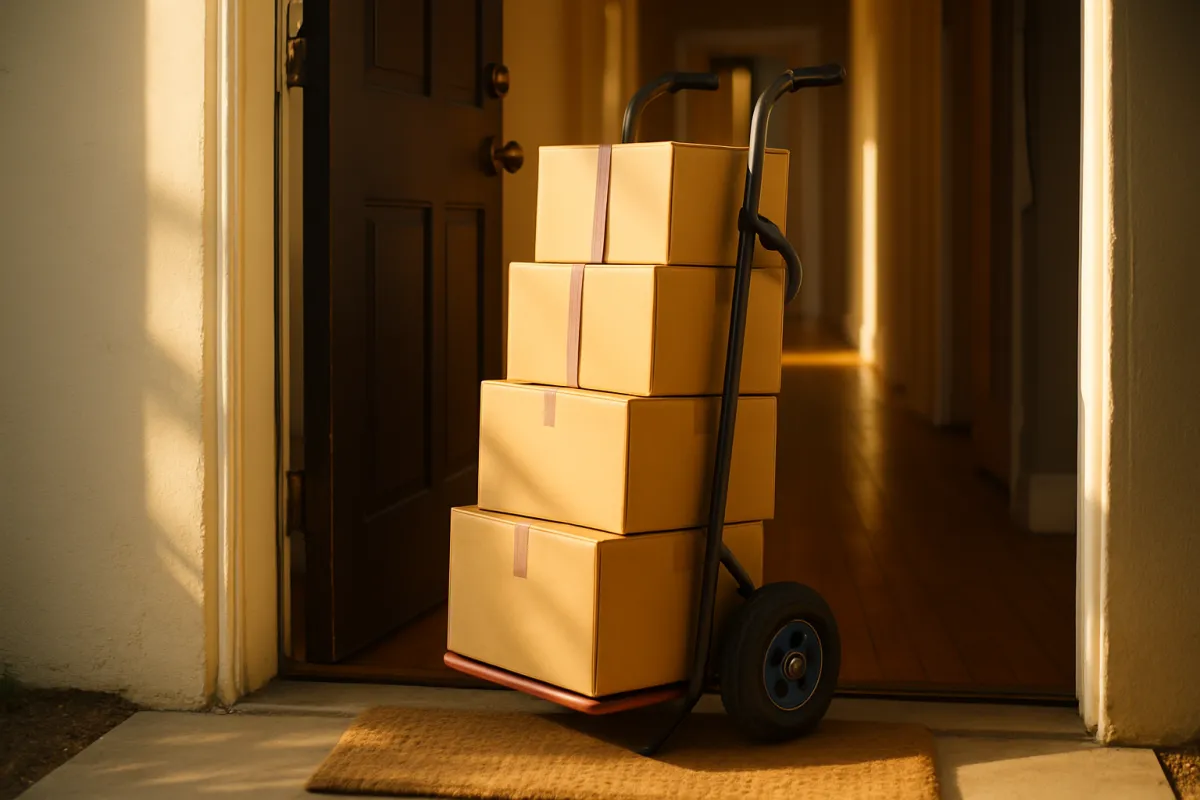
Protect the doorway itself while you are at it. Door jamb protectors and a blanket over the threshold stop the scrapes that happen when a wet, gloved grip slips. And decide in advance whether crews will work in boots with covers or swap footwear, because a crew improvising that decision at the door loses time on every trip.
The salt and grit problem
Water on a floor is a nuisance. Salt and grit in that water is damage, and this is the part of winter protection that people discover afterwards. Ice melt is designed to stay on surfaces and keep working, which means it clings to boot treads and wheels and comes indoors with every load. On finished wood it leaves a white haze that can etch the finish. On carpet it dries into a crust that abrades fibers every time someone walks over it. On stone and tile it is mostly cosmetic but stubborn. And on the underside of a hand truck it becomes a grinding compound that scratches any hard floor it crosses.
The countermeasures are ordinary and they work. Use ice melt sparingly and only where footing genuinely requires it, rather than broadcasting it across an entire driveway. Sand or grit gives traction without the chemistry, at the cost of tracking dirt instead of salt. Put a stiff bristle mat outside the door for knocking boots off and an absorbent mat inside for what gets through. Wipe hand truck and dolly wheels before they come inside, and keep a towel by the door for the purpose.
Clean up the same day rather than the next one. Salt residue is far easier to remove before it dries and bonds, and a quick pass with a damp mop over hard floors at the end of the day prevents the haze entirely. On carpet, vacuum once the grit is dry rather than rubbing wet salt deeper into the pile.
There is a budget angle too, especially if you are renting. Salt damage to a hallway, a lobby, or a shared stairwell is exactly the kind of thing a landlord charges against a deposit, and it is preventable for the price of two mats. Our roadmap on getting your security deposit back covers how those charges get documented and disputed.
Ice underfoot with a heavy load is the real hazard
If you take one safety point from this roadmap, take this one. The characteristic winter moving injury is not frostbite and it is not a strained back from the cold. It is a fall while carrying weight, and it is worse than an ordinary fall for three specific reasons that are worth understanding rather than just noting.
A person carrying one end of a dresser cannot see their own feet. They cannot put a hand out to catch themselves, because both hands are committed. And they cannot drop the load safely, because there is another person at the other end of it and the instinct to protect the furniture fires before the instinct to protect the body. That combination turns a patch of black ice that would cause a stumble in ordinary life into a genuine injury.
Which is why clearing and salting is a safety measure rather than a courtesy. Treat the path, then walk it yourself before anyone carries anything, paying attention to the places ice hides: the bottom of a slope, the shaded side of a house, under a downspout, at the lip of a step where snow melts and refreezes, and on a metal truck ramp, which is the single slickest surface on the whole job. Ramps ice over fast and invisibly, and they are also where the load is heaviest and the angle is worst.
Then slow the work down deliberately. Shorter carries with more rest points, smaller loads per trip, and a rule that nobody walks backwards down a ramp. Sand the ramp itself if you have grit. And accept that a winter move takes longer than a summer one; the extra time is not inefficiency, it is the safety margin doing its job.
Space heaters near packing materials are a fire risk
The second hazard is one people create themselves, usually with good intentions. A house being moved out of has no heat on, or a house being moved into is cold, so somebody brings in a portable heater to make the day bearable. That heater is now standing in a room that has been converted into an unusually good fuel load: flattened and stacked cardboard, loose packing paper, bubble wrap, plastic sheeting, furniture blankets, and a floor covered in protection film.
Portable heating devices are a well known cause of home fires, and the mechanism is the boring one rather than a dramatic malfunction. Something combustible ends up too close, or gets knocked over onto the unit, or a heater gets placed on a covered floor and left running in a room nobody is in because everyone is out at the truck. On a moving day, all three of those are more likely than usual, because the room’s contents change every ten minutes and nobody is really supervising anything.
The practical rules are simple. Keep a generous clear radius around any heater and enforce it as a no-stacking zone, because packing material migrates. Never run a heater unattended in a room, and switch it off when the last person leaves it rather than when the day ends. Plug it directly into a wall outlet rather than into an extension lead or a power strip, since heaters draw heavily. Keep it off the protection film and off anything that can slide. And follow the manufacturer’s own instructions for the specific unit, which will be more specific than any general advice here.
Fuel-burning heaters deserve a separate line. Anything that burns propane or kerosene produces combustion gases and belongs outdoors or in a genuinely ventilated space, never in a sealed-up house full of paper. If the new home is cold, the right answer is to have the actual heating system running before you arrive, which is a scheduling problem rather than an equipment one.
Carbon monoxide from a running truck near an open door
The hazard almost nobody plans for is exhaust. On a cold day there is a strong temptation to leave a vehicle running: the truck idling to keep the cab warm, a car running in the driveway so someone can sit in it, or an engine warming up in an attached garage while the door between the garage and the house stands open because people are carrying boxes through it.
Carbon monoxide is colorless and odourless, which is the entire problem. It does not announce itself, and early symptoms, a headache, dizziness, nausea, and fatigue, are easy to mistake for the ordinary state of someone who has been lifting furniture in the cold since dawn. On a moving day the house is also full of open doors and unusual airflow, and the alarms that would normally warn you may have been packed, unplugged, or taken down along with everything else on the walls.
The rules follow from that. Do not run an engine inside a garage, attached or not, even with the garage door open. Position the truck so its exhaust is not pointing at an open doorway, and shut it off rather than idling it while loading. Keep a working carbon monoxide alarm accessible rather than packed, and put one in service at the new home on the first day rather than the first weekend, especially if the property has fuel-burning appliances that have been sitting unused.
If anyone on the job develops a headache, dizziness, or nausea that a break outdoors does not clear, treat it as a possible exposure rather than tiredness, get everyone into fresh air, and seek medical advice. This is the one item on the winter list where the failure mode is genuinely serious and the prevention is genuinely free.
Which belongings are genuinely cold-sensitive
Most of what you own does not care about cold. Plates, pans, clothes, books, most metal and plastic goods, and the majority of upholstered furniture will sit in an unheated truck overnight and be fine. Knowing that matters, because the winter packing job is not “protect everything,” it is “identify the short list and treat it properly.” A short list gets done; a vague sense that cold is bad does not.
The short list divides into three families by failure mode, which is a more useful way to think about it than a list of objects. Things that freeze and burst are anything holding a water-based liquid, because water expands as it freezes and containers split. Things that condense and short are anything with electronics or a battery, because a cold device carried into a warm room grows moisture on and inside its surfaces. Things that shrink and crack are anything made of wood, glue, or a finish that moves with humidity, because winter air is not just cold, it is extremely dry.
The rule that covers all three is the same, and it is refreshingly simple: the short list rides in the heated cabin of your own vehicle, not in the truck. That is usually one or two boxes plus an instrument case, which is a small enough imposition that it actually happens. Our packing roadmap covers the general system; this is the winter overlay on top of it.

The one qualifier worth adding: a long-distance winter move means days in transit, not hours, and time multiplies every one of these effects. A two-hour local move in an unheated van is a very different exposure from a four-day interstate haul through a cold corridor.
Electronics and screens in freezing temperatures
Electronics are the category people worry about most and handle worst, because the danger is not the cold itself but what happens on the way back to warm. A television, laptop, monitor, games console or router that has spent a night at freezing temperatures is generally unharmed while it is cold. The damage comes from condensation: when a cold object is carried into a warm, humid room, moisture forms on and inside it exactly as it does on a glass of iced water, and powering the device on while that moisture is present is what causes problems.
So the handling rule is about patience rather than protection. Bring the device into the new home, leave it sealed in its packaging or its bag while it warms, and give it several hours at room temperature before plugging it in. A full day is better if you can stand to wait. Unwrapping a cold television immediately and switching it on is precisely the wrong sequence, because the wrapping is what stops warm room air from reaching the cold surfaces too fast.
Screens deserve their own note. Liquid crystal displays genuinely do not like extreme cold, and manufacturers publish storage temperature ranges for a reason. A phone or laptop screen may behave oddly at low temperature and recover, but a large panel that has been very cold and is then handled or powered up in a hurry is the one that fails. Televisions and monitors also prefer to travel upright, which is unrelated to winter but easy to get wrong when a truck is being packed for space.
Batteries are the third piece. Lithium cells lose capacity in the cold and can be damaged by charging while frozen, so a laptop or a battery-powered tool that has been in the truck should warm up before it goes on a charger. If you have room for one box in the car, this is a strong candidate for it.
Liquids that freeze and burst
This is the category that ruins other things, which is what makes it more important than its own value suggests. A bottle that splits in a cold truck does not just lose its contents; it soaks whatever is packed around and beneath it, and by the time the truck is unloaded the spill has spread through cardboard into fabric.
Take a walk through the house with this specifically in mind, because the offenders are scattered. Cleaning products and detergents under the sink. Paint, stains, and anything left over from a project in the garage. Drinks: bottled water, wine, beer, and anything in a can. Cooking liquids and condiments. Toiletries and anything with an aqueous base. The water in a humidifier, a coffee machine, a kettle, a steam iron, or an aquarium. Windshield washer fluid is fine; the tank of water you filled a garden sprayer with is not.
The handling has three tiers. Small quantities of things you genuinely need go in a clearly labeled box that rides in the car. Bulk liquids you do not need get used up, given away, or disposed of properly before the move, which is the cheapest option and also the one that saves weight on a long-distance quote. Appliances that hold water get drained and dried in advance, including the hoses, because a residual cupful in a washing machine line will freeze and split it just as readily as a full bottle.
Note also that many movers will not carry certain liquids at all, regardless of season. Flammable, corrosive and pressurized items are commonly excluded from what a carrier will load, so this list overlaps heavily with the list you were going to have to deal with anyway. Ask your company for its own exclusions in writing.
Musical instruments and wood furniture in cold, dry air
Wood does not mind cold as much as it minds change, and winter delivers change in two directions at once. Outdoor air in a cold snap holds very little moisture, and heated indoor air is drier still, so a wooden object moving between a freezing truck and a heated room experiences both a temperature swing and a humidity swing in the space of an hour. Wood responds by shrinking, and shrinking is what opens joints, lifts veneers, and cracks finishes.
Stringed instruments are the acute case, because they are built from thin wood under tension and are glued rather than screwed. A guitar, violin, or cello left in a cold truck can suffer separated seams, a cracked top, or finish checking, and the strings themselves change tension enough to add stress. If you own one, it travels in its hard case, in the heated part of your vehicle, and it stays in the closed case for hours after arrival so it warms slowly. Loosening string tension slightly before a long cold journey is a common precaution, though what is right for a specific instrument is a question for whoever maintains it.
Pianos are the extreme version and are a specialist job in any season. Cold and dryness affect the soundboard, the pinblock and the tuning directly, and a piano moved in winter will need tuning after it has settled into the new home’s climate rather than immediately on arrival. Our roadmap on moving a piano covers the mechanics of the move itself.
For ordinary wood furniture, the practical steps are modest: wrap pieces in moving blankets rather than plastic alone, since plastic traps condensation against the finish; let items settle before you put weight or heat near them; and expect solid wood pieces to need their joints checked and possibly retightened a few weeks after the move rather than on day one. Our roadmap on moving heavy furniture covers the lifting side.
Houseplants on a freezing moving day
Houseplants are the most reliably killed category in a winter move, and they die from short exposures rather than long ones. Most common indoor plants are tropical in origin and suffer visible cold damage after a surprisingly brief spell below about the middle of the temperature range they are used to. A tray of plants carried out to a truck, left standing on a snowy driveway for twenty minutes while the crew rearranges the load, and then driven in an unheated trailer will often arrive blackened at the leaf edges even on a short move.
The plan that works is boring and effective. Water them a day or two before the move rather than on the morning, so the soil is damp but not saturated, because wet soil freezes faster and heavier. Wrap each pot and the plant itself loosely in paper or a light blanket for the walk out, treating it as a two-minute exposure problem rather than a transport problem. Carry them out last and bring them in first, and put them in the heated car with you, never the truck.
On arrival, unwrap them promptly and give them light, but do not put them straight next to a radiator or a heat vent, because a plant that has been chilled and is then blasted with dry heat gets a second shock. Expect some leaf drop over the following weeks regardless; that is a normal response to the move itself, and a plant that keeps its stems firm is usually recovering.
Two constraints to check before you plan any of this. Some carriers will not transport live plants at all, and some states restrict bringing certain plants across their borders for agricultural reasons. Confirm both with your mover and with the destination state’s agriculture authority rather than assuming, and treat any large plant collection as a decision about what to rehome rather than a packing problem.
Candles, cosmetics, and the things that ruin quietly
There is a middle category that neither freezes dramatically nor breaks visibly, but arrives quietly ruined, and it is worth a short section because it is the one people forget entirely.
Candles are the odd case, because winter can damage them at both ends. Wax becomes brittle when very cold, so a candle that is knocked in a freezing truck can crack or shatter rather than dent. And a truck that sits in sun or a home that is being warmed aggressively can soften wax enough to deform a pillar or let a container candle slump. Pack them flat, padded, and away from anything they would stain if they did soften.
Cosmetics and skincare are chemistry rather than structure. Emulsions, which is most creams and lotions, can separate when frozen and never recombine properly, leaving a grainy or watery product. Liquid foundations and anything water-based can freeze and split its container. Nail polish thickens. None of that is dangerous, but replacing a bathroom cabinet’s worth of product is a real cost for something that would have fit in one small box in the car.
Medication is the item on this list that genuinely matters, and it belongs in the car for several reasons at once. Many medicines have storage temperature ranges, some are unusable if frozen, and all of them are things you do not want inaccessible in a truck that slips a day. Keep prescriptions with you along with the documents, and follow the storage instructions on the packaging or from the pharmacy rather than any general rule.
Wine and other bottled drinks round the category out. Freezing pushes corks and can crack bottles, and even where the bottle survives, a hard freeze and thaw is not kind to what is inside. If a collection matters to you, it travels with you or it goes into climate-controlled storage rather than into a winter truck.
Keep the utilities on at both properties
This is the winter item with the largest downside and the smallest cost, and it is the one most likely to be got wrong by someone trying to be tidy about cancellations. Utilities at both ends stay live across the handover.
At the destination, schedule electricity, heat and water to be active at least a full day before you arrive. The reason is not comfort on arrival, though that matters when you are unloading at four in the afternoon in the dark. The reason is that a furnace or boiler in an empty house may not work, and discovering that at eight in the evening with a truck outside is a different problem from discovering it the day before while a technician can still be called. Walk in, turn the heat on, and confirm it actually produces heat before the truck arrives.
At the origin, resist switching everything off the moment you leave. A property left without heat in freezing weather risks frozen pipes, and a burst pipe in an empty house is the kind of damage that runs for hours before anyone notices. Keep heat on at a low setting until the sale completes or the tenancy formally ends, and if the property will stand empty through the cold, ask the owner, the agent, or the buyer’s side what winterizing steps are expected. Where responsibility sits is a contractual question and worth confirming rather than assuming.
Budget it as an overlap rather than a surprise: a few extra days of heat and power at two properties, an illustrative $90 in the add-back chart above. Our roadmap on changing your address covers the sequencing of utility transfers alongside everything else that has to be told you moved.
The shorter daylight window compresses the whole schedule
In midsummer a move can start at eight and finish at seven with light to spare. In midwinter, usable daylight in many places runs from mid-morning to mid-afternoon, and that single fact reorganizes the whole day. The hours you have are fewer, and the ones at the end are the worst ones: colder, darker, with a driveway that has been refreezing since the sun dropped and a crew that has been working since dawn.
Plan against it in three ways. Start earlier than feels necessary, even if it means the first hour is done in half-light with the lights on, because the value of an early start is entirely in what it buys at the other end. Front-load the difficult work: the heavy, the awkward, the items that need two people and careful footing all belong in the bright middle of the day, not in the tired dark of it. And set up lighting before you need it, not after, because rigging work lights while holding a flashlight in your teeth is nobody’s plan.
Lighting deserves a little thought. The truck interior goes dark long before the street does, and a loaded trailer with no interior light is where fingers get caught. Battery work lights at the tailgate, at the door, and on the path are cheap and change the last two hours completely. Check that exterior lights at both properties actually work in advance, since a burned-out porch bulb is a five-minute fix beforehand and an impossibility on the day.
The scheduling consequence is that a winter move often wants a two-day shape rather than a one-day heroic. Load on one short day, drive and unload on the next, rather than trying to compress a summer-length job into a winter-length day. Our moving checklist sets out the runway that makes that possible.
Driving and parking in snow: where the truck can stop
The question that decides how a winter move actually goes is not how the truck drives. It is where it can stop. A loaded box truck needs a long, flat, clear place to park with room to open a ramp, and winter removes most of the usual options. Snow banks left by plows narrow streets and bury the curbside space a truck would use. Parking restrictions during declared snow emergencies can make a legal spot illegal overnight. And a driveway with any slope at all becomes a place where a heavy vehicle should not be.
Work the parking problem days ahead rather than on the morning. Find out whether your city or building requires a permit or a reserved space for a moving truck, and whether winter parking rules change the answer. Clear the space yourself if it is yours to clear, and clear it wider than the truck, because the crew needs to walk beside the vehicle with a load. Confirm at the destination too, which is the end people forget because they have never seen it in winter.
Then think about the carry distance, because that is what parking failure converts into. If the truck cannot get close, the crew walks further with every item, the job takes longer, and on a local hourly job that is money. On a long-distance job it may trigger a long carry fee, commonly billed per 50 or 75 feet beyond a free allowance, or a shuttle charge if a smaller vehicle has to ferry loads from a truck that cannot reach the door at all. Our mover-cost roadmap covers those accessorial charges in detail.
The driving side is mostly a matter of respecting the vehicle. A loaded truck stops far more slowly than a car, handles badly on ice, and is tall enough that wind on an open road is a real factor. If you are driving it yourself, leave enormous following distances, brake early and gently, avoid the temptation to make up a lost hour, and be willing to stop for a storm rather than push through one. Our truck-loading roadmap covers how load order affects handling, which matters more on winter roads than dry ones.
How the crew works in the cold, and how you help
A crew working in the cold is a slower crew, and understanding why makes the day go better for everyone. Grip is the main constraint. Bare hands lose dexterity and go numb; thick gloves restore warmth but cost grip on smooth surfaces and box edges. Most people who work outdoors in winter settle on thin, grippy gloves with a warmer pair to swap into during breaks, which is a good model for you too if you are carrying anything yourself.
Layering matters more than a heavy coat. Moving furniture is hard physical work and people overheat inside bulky outerwear, then chill hard the moment they stop. Layers that can come off during a carry and go back on during a wait are what actually keeps someone comfortable across a whole day. Footwear is the other half: boots with genuine tread and a stiff sole, not smooth-soled sneakers, and certainly not anything with a slick sole on a metal ramp.
Your job as the person whose house it is comes down to three things. Keep one heated room available where people can warm up, out of the traffic route, and let them use it. Provide hot drinks rather than cold ones, which is the winter version of the cold water you would put out in July, and be relaxed about breaks, because a crew that warms up for five minutes works faster for the next hour. And keep the path clear all day rather than once at dawn.
On tipping, the norms do not change with the weather, but the case for the upper end of them does. The common convention runs roughly $5 to $10 per mover per hour, or 10 to 20 percent of the labor portion split across the crew, both illustrative, with the higher end for a long, heavy, or difficult day. A freezing day with icy carries is a difficult day by any reading. Our mover-tipping roadmap works the etiquette through in full.
The winter first-night box
Every move needs a first-night box. The winter version has a different list, because the failure modes on the first night in February are cold, dark, and wet rather than merely inconvenient.
Start with the things that make an unheated or barely heated house survivable. Blankets and a sleeping bag or two. A full change of dry clothes each, including socks, because somebody will get wet. Hats and gloves, which sounds absurd until the heat has been on for two hours and the house is still cold. Towels, and specifically an old towel by the door for boots and wheels.
Then the things that make the dark manageable. A flashlight and a battery work light, spare batteries, and a phone charger that is in your hand rather than in a box. A basic tool kit for reassembling one bed. And the paperwork: lease or closing documents, mover paperwork, identification, and medication, all of which travel with you rather than on the truck for reasons that have nothing to do with weather.
Then the small comforts that are genuinely load-bearing on a cold night. A kettle and something hot to put in it, mugs, a roll of paper towels, hand soap, toilet paper, and a first aid kit. If the utilities somehow are not on, the difference between a miserable night and a manageable one is usually a hot drink and dry socks.
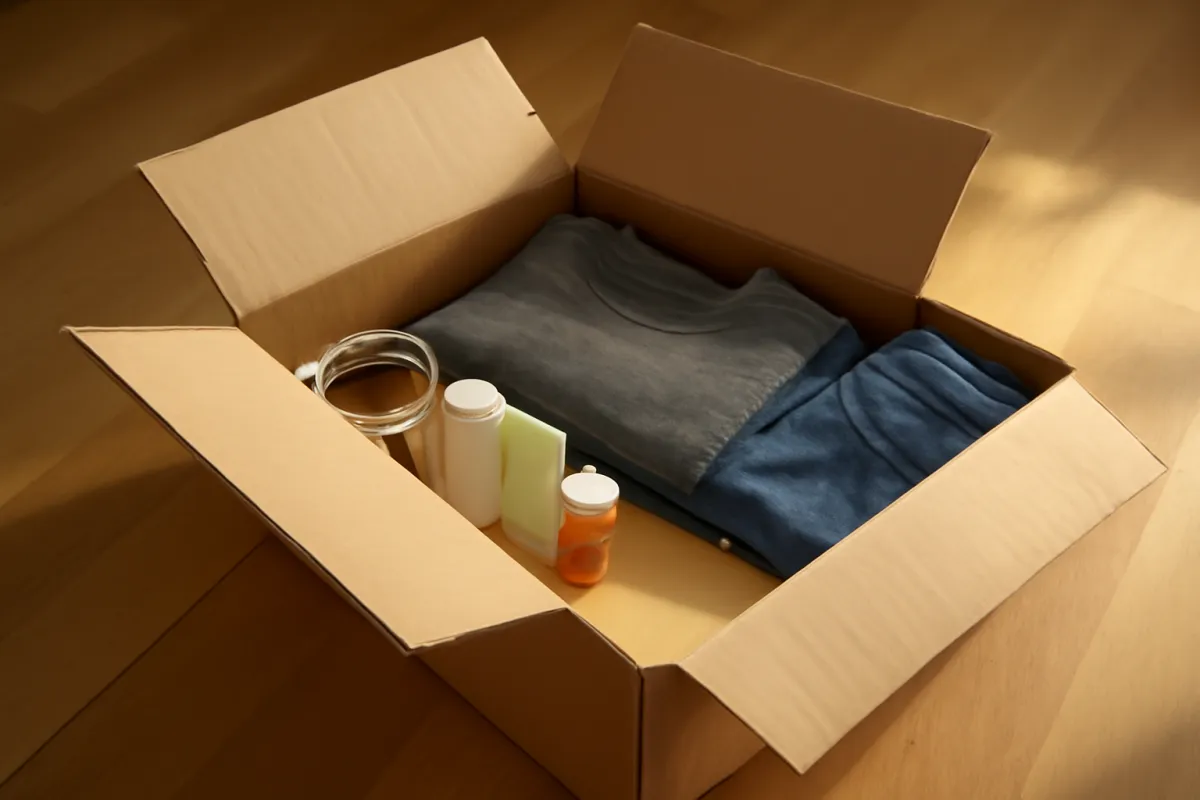
Label it unmistakably and put it in the car, not the truck. A first-night box that is on the truck is not a first-night box; it is a box. Our packing checklist has the room-by-room version of what goes where.
Pets and children on a cold moving day
Winter narrows the options for both, in the same way and for the same reason: the fallback of “put them outside in the yard for an hour” does not exist, and neither does “leave them in the car.”
For children, the plan is care elsewhere if it can be arranged, which is true in any season and more true when the house is going to be cold and full of open doors. If they are with you, the answer is one warm room with the door shut, set up first and dismantled last, with their own things in it and someone assigned to it. Dress them for a house at outdoor temperature rather than a house at indoor temperature, since the front door will be open most of the day. And plan food and drink deliberately, because a moving day eats hours and cold makes hunger arrive faster.
For pets, the same logic applies with an additional hazard: an open front door and a stream of unfamiliar people is how animals get out, and a lost pet in freezing weather is a serious situation. A closed room with water, a litter tray or a walked schedule, and a sign on the door is the standard answer. Confirm identification and microchip details are current before the day rather than after. Our pet-move roadmap works the whole plan through, from crate training to the settling-in period.
Two winter-specific pet notes are worth adding. Ice melt is an irritant to paws and is not something you want an animal licking off its feet, so wipe paws after every walk on a treated path and keep the bag itself well out of reach. And never leave an animal in a parked vehicle in the cold, which carries the same logic as the summer warning everyone knows, in the opposite direction.
A worked example: an illustrative winter move, priced
Put the whole roadmap on one household. The example is a two-bedroom home, roughly 5,000 pounds, moving about 1,000 miles with a full-service carrier, on a Tuesday in mid-January. Every figure is illustrative and chosen to show the structure of the decision rather than to predict a price.
The peak-season version of this job, in late June on the last Saturday of the month, prices near $6,000. Three written estimates collected for the January Tuesday come back clustered near $4,800, which is the 20 percent middle of the illustrative off-peak band. Gross saving: about $1,200. That is the number that makes people book winter, and it is only half the calculation.
Now the add-backs. Clearing and salting at both ends, about $180. Extra floor film, mats, blankets and wrap, about $120. A three-day utility overlap keeping heat live at both properties, about $90. One contingency night of lodging and meals budgeted against a weather delay, about $150. And roughly $60 of extra time on the clock for slower carries and a shorter working day. Total: about $600, exactly the 10 percent hurdle the chart above describes.
Net advantage: about $600, or 10 percent of the peak quote, plus the non-financial gains of better availability and a crew that had time to survey the house properly. If the contingency night is not needed, the advantage is nearer $750. If the discount had come in at 10 percent rather than 20, the advantage would have been zero, and the honest conclusion would have been that this particular winter move was not worth the trouble. That is the point of doing the subtraction rather than the headline. Run your own version in the companion beside this section, and put the result into the moving-budget roadmap where the rest of the relocation’s costs live; the calculator handles the income side of the same decision.
Run your own winter move plan
The whole roadmap, compressed into the order you would actually work it.
- Price the season, do not assume it: collect three written estimates for your specific quiet-corner date, mid-month, midweek, away from holidays, and compare them against a peak-date quote for the same inventory.
- Compute your own hurdle: add up clearing, protection materials, utility overlap, contingency and extra clock time, divide by the quote, and only take the winter date if the discount beats it.
- Write the weather terms into the estimate: reschedule policy, deposit treatment, replacement-date availability, and what happens to a delivery window if the truck is held up.
- Buy overlap: a day or two with access to both properties is the cheapest insurance in a winter move, and it converts a delay from a crisis into an inconvenience.
- Keep heat and power live at both ends, with the destination's utilities starting a day early so a dead furnace is found while it can still be fixed.
- Clear and salt one wide path at each property, re-clear it during the day, and grit the truck ramp, which is the slickest surface on the job.
- Lay taped-down floor protection from the threshold through every room the crew crosses, with absorbent mats on both sides of the door and a same-day salt cleanup.
- Pack the cold-sensitive short list for the car: liquids, electronics and batteries, instruments, medication, cosmetics, candles, and every houseplant.
- Start early and light the site: heavy items in the bright middle of the day, battery work lights at the tailgate and the door before dusk rather than after.
- Enforce the three safety rules: nobody carries on untreated ice, heaters keep a clear radius and are never left running unattended near packing materials, and no engine idles near an open door or inside a garage.
- Set up the warm room first: one heated space for breaks, for children, and for a pet behind a closed door, established before the first box moves.
- Put the winter first-night box in the car, labeled, with dry clothes, blankets, a light, a kettle, tools for one bed, and the documents.
Work it in the companion, print it, or keep it on a phone; what matters is that the subtraction happens before the booking and that the path is cleared before anybody carries anything.
The bottom line
Winter is the honest bargain of the moving calendar. The quiet season prices identical work at an illustrative 10 to 30 percent below a peak-season, month-end Saturday, which on a $6,000 two-bedroom interstate move is worth roughly $600 to $1,800. Winter then charges some of it back through clearing, protection, a utility overlap, a delay contingency and slower carries, an illustrative $600 that sets a 10 percent hurdle the discount has to clear. Do that subtraction with your own quotes rather than a headline, write the weather terms into the estimate before you book, keep heat live at both properties, put the liquids, electronics, instruments, medication and plants in the heated car, clear and grit one wide path at each end, and treat ice underfoot, unattended heaters near packing paper, and a running engine near an open door as the three things that can turn a cheap move expensive. Price the move itself with our mover-cost roadmap, vet the company with our mover-hiring roadmap, sequence the runway with our moving checklist, and let this one make sure the season you chose for its price does not quietly take the saving back.
ReloPeak offers this roadmap as relocation education, not as a moving contract, a weather forecast, or professional safety, legal or medical advice. Every dollar figure in it, including the seasonal price bands, the add-back budget, the contingency line and the worked example totals, is illustrative and exists to show how the winter decision is structured rather than to predict what your move will cost; real prices move with the market, the company, the route and the year. Cold-weather guidance here is general: follow the manufacturer’s instructions for any heater, appliance or electronic device, follow the storage directions on any medication, and confirm carrier restrictions on liquids, plants and other excluded items with your own mover in writing. Where property responsibility, utility obligations or winterizing duties are contractual, check the documents that govern your specific transaction and consult a qualified professional before relying on any interpretation of them.
Frequently asked questions
Is winter really the cheapest time to move?
Winter falls in the moving industry's quiet season, and quiet seasons price differently. Demand for household moves peaks in summer, when leases turn over and school calendars free families, and it peaks again at every month's end and on weekends. A mid-January move on a Tuesday in the middle of the month sits at the opposite corner of all three cycles, which is why off-peak timing commonly saves somewhere in the range of 10 to 30 percent against a peak-season, month-end Saturday, an illustrative spread rather than a promised one. The discount is real but it is not automatic: it shows up in quotes you actually collect for that specific date, and a company quoting summer prices for a February Tuesday is simply testing whether you will notice.
How much does a winter move actually save after the extra costs?
Work it as a subtraction rather than a headline. On an illustrative $6,000 peak-season quote for a two-bedroom interstate move, a 20 percent off-peak discount is worth about $1,200. Against that, winter adds costs the summer version of the same move does not carry: clearing and salting walkways at both ends, extra floor and furniture protection, keeping heat on at two properties during an overlap, a contingency night in case the truck slips a day, and a little extra time on the clock because carries are slower. Budgeted generously, those add-backs come to roughly $600, which still leaves about $600 of genuine advantage. The number that matters is your own: if the add-backs come to 10 percent of the quote, the discount has to beat 10 percent before winter pays.
What should you never leave in a cold moving truck overnight?
Anything that holds liquid, anything with a screen or a battery, and anything made of glued wood. Water-based liquids expand as they freeze and can split a container: paint, cleaning products, drinks, sealed cosmetics, and the water in a fish tank or a humidifier all belong in the car with you rather than in an unheated trailer. Electronics are a slower failure, because condensation forms inside a cold device brought suddenly into a warm room and can damage it when it is powered on too soon. Instruments and solid wood furniture react to cold, dry air by shrinking and cracking at glue joints and finishes. If it would bother you to replace it, it rides in the heated cabin.
How do you protect floors during a winter move?
Assume that everything walked in from outside will be wet, gritty, and abrasive, and build two lines of defense. Outside, clear and salt a single defined path from the truck to the door so crews are not tracking snow in from four directions. Inside, lay a continuous run of protection from the threshold through every room the crew will cross: adhesive floor film or ram board over hard floors, carpet film or old blankets over carpet, taped down so nothing slides underfoot. Add a heavy absorbent mat inside and outside the door and swap it when it becomes saturated. The real enemy is not water but the salt and grit carried in with it, which acts like sandpaper on finished floors and leaves a white residue that dries into wood and carpet fibers.
Do movers work in snow, and what happens if the weather is bad?
Most companies work through ordinary winter weather and stop for genuinely dangerous conditions, which is a judgement call made on the morning rather than a fixed rule. What matters far more than the policy is what your paperwork says about it. Before booking, ask in writing what happens if a storm forces a delay: whether the date can be moved without a fee, how quickly a new date can be found in the quiet season, what happens to your deposit, and who pays for a delivery window that slips. Ask the same question about your own side, because a road closure on your route is your problem too. Get the answers on the estimate rather than over the phone.
What are the real safety hazards of moving in winter?
Three stand out, and none of them is the cold itself. The first is ice underfoot while carrying weight: a person holding one end of a dresser cannot see their feet, cannot catch themselves, and cannot drop the load safely, which is why clearing and salting the path is a safety measure and not a housekeeping one. The second is fire risk from portable heaters used to warm a space that is full of cardboard, packing paper, plastic wrap and furniture blankets, all of which burn readily. The third is carbon monoxide, which people forget entirely: a truck or car left running near an open door or in an attached garage can push exhaust into a house. Treat all three as planning items rather than move-day improvisation.
Should you keep utilities on at both homes when moving in winter?
Yes, and this is the one winter item that is genuinely non-negotiable. Arriving at an unheated house on a freezing evening is unpleasant at best, and a property left without heat can suffer frozen and burst pipes, which turns a moving inconvenience into a serious repair. Schedule the new home's heat and electricity to be live at least a day before you arrive, so you can confirm the system actually works while someone can still be called. Keep the old home's heat on until the sale or handover completes rather than switching it off the moment the truck leaves, and if the property will sit empty, ask whoever is responsible for it what the winterizing expectations are. A short utility overlap at both ends is a small line in the budget and a large piece of insurance.
How does shorter winter daylight change the moving schedule?
It compresses everything, and people plan as though it does not. In midwinter many places have usable daylight from roughly mid-morning to mid-afternoon, so a job that would run comfortably from eight in the morning to six in the evening in July has to fit into a much narrower window or finish under headlights. The practical effect is that the loading start time matters more than the total hours, and that the last hour of a winter move is the one where the driveway freezes over, the crew is tired, and visibility drops. Start earlier than feels necessary, front-load the heavy and awkward items into the bright part of the day, and set up work lights before you need them rather than after.