
What's in this roadmap
- How much does it cost to live alone: the short answer
- How much money do you need to live alone
- What is the average cost of living alone per month
- The monthly line items of living alone
- What are the monthly expenses of living alone
- Rent: the line that dominates a solo budget
- Utilities, internet, and phone
- Groceries and food for one
- Transport, insurance, and the rest
- Is it cheaper to live alone or with roommates
- The hidden costs of solo living
- How much should I make to live alone
- City vs a cheaper area
- Studio vs one-bedroom: the cost gap
- Building in savings and an emergency fund
- Can you live alone on minimum wage
- Can you live alone on a modest income
- How to lower the cost of living alone
- Comparing your own city
- A worked example: living alone in a mid-cost city
- The bottom line
Short answer: Living alone commonly costs an illustrative $2,200 to $4,000 a month in the United States once every line is counted, with rent taking 40 to 50 percent, followed by utilities, groceries, transport, a phone and insurance. The range swings hard by city: a careful solo budget can dip under $2,000 in a low-cost metro and pass $4,500 on an expensive coast. At the 30 percent rent guideline, $1,500 rent points to roughly $60,000 a year.
How much does it cost to live alone, the question behind every cost of living singles search, usually runs somewhere between roughly $2,200 and $4,000 a month in the United States once every line is counted, with rent taking the largest bite by far, followed by utilities, groceries, transport, a phone, and insurance. The figure swings enormously by city, so treat any single number as a starting point rather than a quote: in a low-cost metro a careful solo budget can dip under $2,000, while an expensive coastal city can push a modest one-bedroom life past $4,500 before a dollar of savings is set aside. Solo living is not one price; it is your rent plus a stack of smaller bills, all carried by a single income.
This roadmap builds the costs of living on your own from the ground up, one line at a time. It starts with the direct answer and the income a solo budget needs, then walks the monthly line items one at a time, weighs living alone against roommates (the single biggest lever on the cost), prices the hidden costs of having no one to split with, and closes with a worked example for a mid-cost city. It sits beside our roadmap on how much to save before moving out, which prices the one-time deposit and setup pile you need before month one, our roadmap on the true cost of relocating, our roadmap on whether it is cheaper to live in the suburbs or the city, our cost-of-living comparison roadmap, and our cheapest-states roadmap for finding a structurally cheaper metro. The calculator handles the salary side, and the companion beside this roadmap totals your own solo budget live.
Key takeaways
- Living alone commonly costs an illustrative $2,200 to $4,000 a month all-in, but the range swings hard by city because rent, the largest line, is set by where you live.
- Rent usually eats 40% to 50% of a solo budget, so the metro and the unit size move the total far more than any spending habit.
- Roommates are the single biggest lever: splitting rent and utilities can save several hundred to over a thousand dollars a month, and living alone is the premium you pay for privacy.
- A common guideline keeps rent near or under 30% of gross income, so a $1,500 rent points to roughly $60,000 a year as a comfortable floor.
- Every bill is carried by one income with nothing split, which is the structural reason solo living costs more per person and why a savings line has to be built in, not left over.
How much does it cost to live alone: the short answer
How much does it cost to live alone comes down to one dominant line and a stack of smaller ones, and the honest short answer is a range rather than a figure: for most solo renters in the United States the all-in monthly total lands somewhere around an illustrative $2,200 to $4,000, with rent alone accounting for close to half of it. The spread is that wide because rent is set by the metro, not by you, and rent between a low-cost interior city and an expensive coastal one can differ by two or three times for a comparable unit. Everything else in the budget moves in a much narrower band.
That is why any single headline number is close to useless without a city attached. A $2,000 solo budget and a $4,500 solo budget can describe the same person with the same habits living in two different places, and the difference is almost entirely housing. The productive way to read the rest of this roadmap is to hold the structure fixed (rent is biggest, then a predictable set of smaller lines) and let your own rent and city set the level. The companion below does exactly that: enter your rent and a few bills and it totals the monthly cost and the income it implies.
How much money do you need to live alone
How much money do you need to live alone is really two questions: how much income per month, and how much saved before you start. On income, you need take-home pay that covers the whole monthly total with a margin left over, which for many solo renters means an illustrative $2,500 to $3,800 a month in the hand depending on the city. On savings, you need a lump sum in the bank before month one, because the deposit, the first month’s rent, and the furniture and setup all arrive at once, before a single paycheck from the new place has landed.
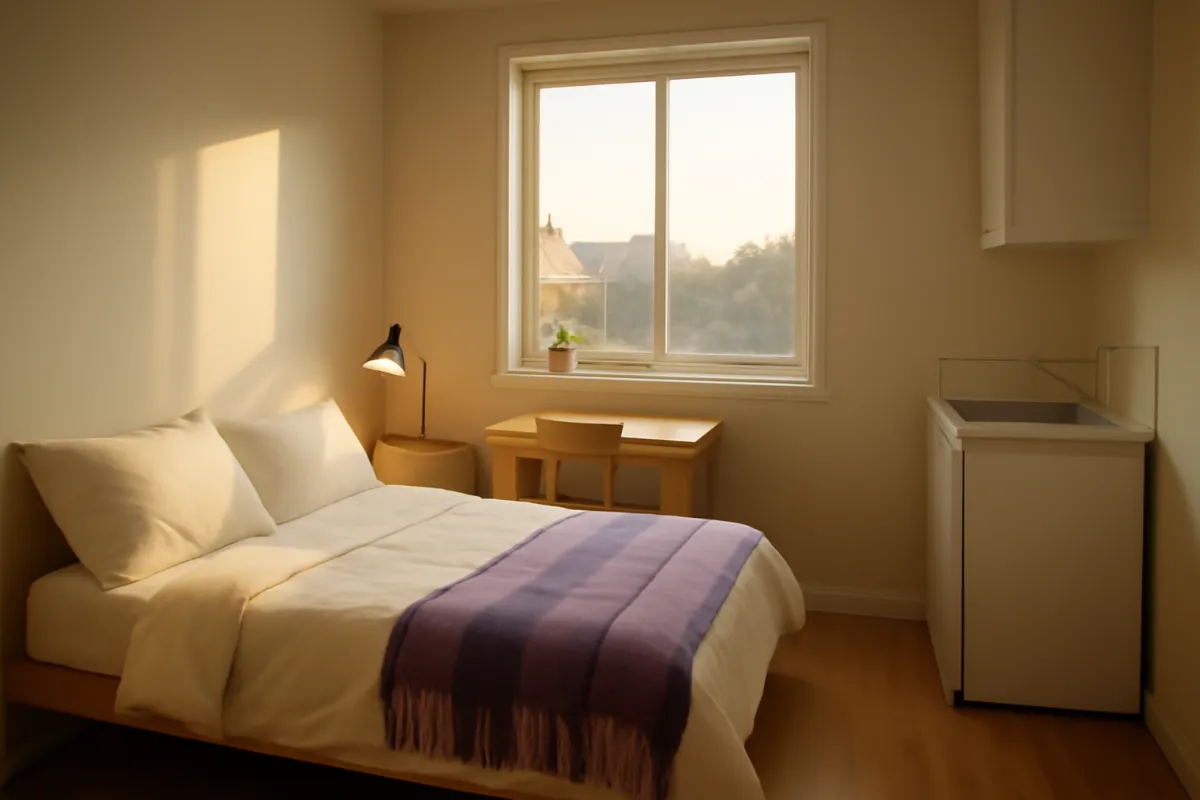
People routinely underestimate the second half. The monthly budget is what most first-time solo renters plan for, but it is the upfront pile that most often derails the move, because it demands a few thousand dollars before the lifestyle even begins. Our roadmap on how much to save before moving out prices that pile line by line: move-in cost, an emergency buffer of a few months of expenses, plus moving and furnishing. Get both halves right, the monthly income and the upfront cushion, and living alone is stable; get only the income right and the first surprise can break it.
What is the average cost of living alone per month
What is the average cost of living alone per month is a fair question with a slippery answer, because a true national average blends a $1,700 studio in a small city with a $3,000 one-bedroom in a major metro into a single figure that describes neither. As a rough illustrative anchor, a solo renter across much of the country might spend somewhere near $2,800 a month all-in, but the median hides how much the housing line pulls the total in either direction. Averages are useful for a sanity check and misleading as a budget.
A better mental model than the average is the tier. A low-cost metro puts a solo budget near the bottom of the range, a mid-cost metro near the middle, and a high-cost coastal city near the top, and the distance between tiers is almost entirely rent. The chart below shows that tiered pattern, which is far more useful for planning than one blended average, because you do not live in the average, you live in a specific tier. Once you know roughly which tier your target city sits in, you can anchor your own number and then adjust the smaller lines around it.
Illustrative solo monthly cost by city tier
All-in monthly cost of living alone, one person, one-bedroom or studio. Illustrative, not quotes.
The gap between tiers is almost entirely rent. Everything else in the budget moves in a much narrower band, which is why the city you pick sets the level and your habits only fine-tune it. Your own tier anchors the number better than any national average.
The monthly line items of living alone
The monthly line items of living alone are predictable, and writing them out is the whole exercise, because a budget you can see is a budget you can defend. The standard solo stack is rent, electricity and gas, water and trash, internet, a phone plan, groceries, transport, insurance, and a miscellaneous line for household goods, subscriptions, and going out. Some of these arrive as one bill, some as several, but together they are the monthly cost of living alone, and none of them is split with anyone.
The useful thing about the list is its shape. Rent is one large line, food and transport are two medium ones, and the rest are a cluster of small ones that individually round to nothing and collectively add up to real money. That shape is why trimming the small lines feels productive but barely moves the total, while changing the rent line moves everything. Keep the full list in view as the next sections price each piece, because the discipline of living alone affordably is not heroic frugality on the small lines, it is getting the rent line right and then not letting the small ones sprawl.
What are the monthly expenses of living alone
What are the monthly expenses of living alone, in rough illustrative proportions, breaks down in a way that is remarkably stable across people even as the absolute numbers swing by city. Rent tends to dominate at close to half the budget, groceries and transport come next as the medium lines, and utilities, internet, phone, insurance, and miscellaneous fill in the rest. The stacked bar below shows where a representative solo dollar goes, which is often more clarifying than the dollar amounts themselves.
Where a solo-living budget goes
Illustrative share of a one-person monthly budget by category. Shares sum to 100%.
Rent is nearly half the budget on its own, which is why housing decisions dominate the cost of living alone. The savings slice is small but deliberate: built in, not left over, so the budget survives a surprise.
The proportions carry a lesson. Because rent is roughly half, a 10% change in rent moves the whole budget by about 5%, while a 10% change in the phone bill moves it by a fraction of a percent. That is the math behind every piece of solo-budget advice worth having: win the housing line and the rest is fine-tuning. The companion below rebuilds this split from your own rent, utilities, food, and transport so you can see your personal proportions rather than these illustrative ones.
Rent: the line that dominates a solo budget
Rent is the line that dominates a solo budget, and everything else in this roadmap is a footnote next to it. For one person renting a studio or a one-bedroom, rent commonly sits near 40% to 50% of the entire monthly total, which means the single decision of what and where you rent sets the level of your whole cost of living alone. It also sets the deposit, since the move-in cost is a multiple of the rent, so a higher rent is a higher upfront barrier as well as a higher monthly one.
This is why the honest advice on affording solo living is almost always about rent first. A roommate saves money by cutting the rent line. A cheaper metro saves money by cutting the rent line. A studio instead of a one-bedroom saves money by cutting the rent line. The smaller categories reward attention, but none of them has the leverage of the one that is half the budget. When you weigh two apartments, you are not choosing between two rents; you are choosing between two entire budgets, because the rent difference echoes through the deposit, the utilities that scale with space, and the savings you have left over. Our cost-of-living comparison roadmap is built around exactly this line, because it is the one that decides the answer.
Utilities, internet, and phone
Utilities, internet, and a phone plan form the first cluster of smaller lines, and while none of them rivals rent, together they are a real slice of the budget that a solo renter carries entirely alone. Electricity and gas depend on the size of the unit, the climate, and the season, and for one person in a modest apartment they often land in an illustrative $80 to $180 a month combined, higher in an extreme summer or winter. Water and trash are sometimes bundled into rent and sometimes billed separately for another modest sum. Internet is typically a flat $50 to $80 a month, and a phone plan another $30 to $70.
The thing to notice is that these lines barely shrink when you live alone rather than with roommates, which is part of why solo living costs more per person. A two-person household pays roughly the same internet bill as a one-person household but splits it, so the per-person internet cost halves. The same is true of the base cost of keeping the lights on in a shared space. Living alone means paying the whole utility and connectivity stack yourself, and while each line is small, the absence of anyone to split them with is a quiet, permanent premium that runs across every one of these categories.
Groceries and food for one
Groceries and food for one are usually the second-largest line after rent, and cooking for a single person carries a small, awkward inefficiency that inflates the per-person cost. Food commonly runs an illustrative $300 to $500 a month for a solo person who cooks most meals, and considerably more once regular takeout and restaurants enter the picture. The inefficiency is real: packaging, produce, and bulk items are sized for households, so a person cooking for one either buys more than they can use before it spoils or pays a premium for smaller portions.

Food is also the line where habits move the number most, which makes it the most controllable medium-sized category in the budget. The difference between cooking most nights and ordering most nights can be several hundred dollars a month for one person, a swing large enough to rival a modest rent difference. That does not make eating out wrong; it makes it a visible, optional line rather than a fixed one. For a solo renter trying to hold the budget down, groceries are where discipline pays real dividends, precisely because there is no one else’s preferences to accommodate and the whole line is yours to set.
Transport, insurance, and the rest
Transport is often the third-largest line, and its size depends almost entirely on whether solo life requires a car. In a walkable, transit-rich city a solo person might spend an illustrative $80 to $150 a month on a transit pass and occasional rideshare, while a car-dependent area turns transport into a several-hundred-dollar line covering a payment, insurance, fuel, and maintenance for one. Because you live alone, there is no one to share a vehicle or split a ride with, so the full transport cost, whatever form it takes, sits on one budget.
Insurance and the miscellaneous line round out the stack. Renters insurance is usually cheap, often $10 to $25 a month, and worth it for the protection it buys, while health insurance, where it is not covered by an employer, can be a large line of its own that is highly personal and outside the scope of a general budget. The miscellaneous category (household goods, subscriptions, a haircut, a night out) is small per item and easy to let sprawl, so it deserves a deliberate cap rather than a shrug. None of these lines is large on its own, but living alone means each is unsplit, and the unsplit small lines are exactly where solo living quietly costs more than sharing.
Is it cheaper to live alone or with roommates
Is it cheaper to live alone or with roommates is the question with the biggest dollar answer in this entire roadmap, and the answer is unambiguous: roommates are almost always cheaper per person, usually by a wide margin. Sharing splits the two largest lines of the budget, rent and utilities, across two or more people, and since those lines are more than half the total, splitting them roughly halves the part of the budget that matters most. The saving frequently runs several hundred to over a thousand dollars a month compared with a solo one-bedroom, which makes a roommate the single most powerful cost lever available to a young adult.
What living alone buys with that premium is privacy, quiet, control of the space, and the absence of anyone else’s schedule and habits, and those are genuine goods that many people rationally pay for. The point is not that solo living is a mistake; it is that solo living is a purchase, and the price of the purchase is exactly the gap between the shared budget and the solo one. The honest way to decide is to build both budgets, the solo version and the with-a-roommate version, and read the monthly difference as the cost of solitude, then ask whether privacy is worth that specific number to you right now. Framed that way, the choice is clear rather than vague, and the companion below flags the roommate saving on your own rent so the premium is a number, not a feeling.
The hidden costs of solo living
The hidden costs of solo living are not exotic; they are the ordinary costs of having no one to split with, which never appear as a line item because they are an absence rather than an expense. Every fixed cost that a shared household divides, the base utility bill, the internet, the cost of furnishing a common space, the subscription that two people could share, is carried whole by a solo renter. None of these shows up as a surcharge labeled “living alone,” but collectively they are exactly why the per-person cost of a solo home exceeds the per-person cost of a shared one.
There is also a thinner margin for error when you live alone, which is a cost in risk even when it is not a cost in dollars. In a shared household, a job loss or a big surprise bill can sometimes be absorbed or bridged by the other people in the home, at least briefly. Living alone, the full rent and every bill fall on one income with no backstop, so the same shock hits harder and faster. This is why the savings line matters more for a solo renter than for a shared one: the emergency fund is the roommate you do not have, and building it in is not optional caution but structural necessity. Our roadmap on how much to save before moving out sizes that buffer against exactly this risk.
How much should I make to live alone
How much should I make to live alone has a widely cited rule of thumb behind it: keep rent near or under 30% of your gross income. Run backward, that rule turns a rent into a target salary. A $1,200 solo rent points to roughly $48,000 a year in gross pay, a $1,500 rent to about $60,000, and a $2,000 rent to around $80,000, all illustrative anchors rather than hard requirements. The rule is a heuristic, not a law, and it exists to leave enough of the paycheck for the rest of the budget and for savings after housing is paid.

The rule strains in expensive cities, where renters routinely spend 40% or more of gross income on housing simply because the local floor for a solo apartment is high relative to local wages. That does not break the math; it just means the rest of the budget has to give, usually through a tighter food and transport line or a thinner savings rate. The safer personal test is not the 30% ratio in isolation but whether your take-home comfortably covers the whole monthly total with room to save. If it does, you can afford to live alone even at a higher rent ratio; if it does not, the 30% rule is warning you correctly. The calculator turns a target lifestyle into the salary it implies, our roadmap on how much rent you can afford works the ratio from both gross and take-home pay, and our cost-of-living comparison roadmap shows how far that salary stretches across cities.
City vs a cheaper area
City versus a cheaper area is the same lever as rent, viewed from higher up, and it is the fastest way to change the cost of living alone by a large amount without changing anything about how you live. Because rent is roughly half the budget and rent is set by geography, moving from a high-cost metro to a moderate one can cut the solo total by hundreds or over a thousand dollars a month for a comparable unit and lifestyle. Nothing about your habits changes; the ground under them does.
The catch is that a cheaper area often comes with lower local wages and sometimes with a car requirement that claws back part of the housing saving through transport, so the comparison has to be run on totals rather than rent alone. A metro where rent is low but a car is mandatory is not as cheap as its rent suggests, and one where rent is moderate but transit is strong can beat it. This is the same total-cost discipline our roadmap on whether it is cheaper to live in the suburbs or the city applies to the city-suburb choice. For the biggest structural savings, our cheapest-states roadmap maps where a solo budget goes furthest once housing and taxes are weighed together.
Studio vs one-bedroom: the cost gap
Studio versus one-bedroom is the cheapest lever available short of taking a roommate, and the gap is smaller but real. A studio in the same building or neighborhood as a one-bedroom typically rents for an illustrative $150 to $400 a month less, because you are paying for less square footage and one fewer separated room. Utilities usually run slightly lower too, since a smaller space costs a little less to heat, cool, and light, so the studio saves a touch on more than one line.
What you give up is separation, not much else. A one-bedroom puts a door between where you sleep and where you live, which matters more for some people than others, especially anyone working from home who wants the bed out of the office. The decision is a straight trade of a few hundred dollars a month against that separation, and it is genuinely personal: for someone optimizing the budget hard, the studio is where the solo number bottoms out without a roommate, while for someone who works from home and needs the boundary, the one-bedroom premium buys something worth paying for. Either way, both sit well above the shared-housing option, so the studio-versus-one-bedroom choice fine-tunes a solo budget rather than transforming it.
Building in savings and an emergency fund
Building in savings and an emergency fund is the line most first-time solo renters treat as leftover and the one that most determines whether living alone holds together. Because you have no roommate to bridge a rough month, the emergency fund is your only backstop, which makes it a structural part of a solo budget rather than a nicety. The common guidance is to hold several months of expenses in reserve, and for a solo renter the higher end of that range is the safer target precisely because there is no second income in the home.
The practical move is to treat savings as a fixed monthly line, paid like rent, rather than as whatever survives to the end of the month, because whatever survives is usually nothing. Even a modest automatic transfer builds the buffer that turns a surprise from a crisis into an inconvenience. This is also why the upfront number matters so much: our roadmap on how much to save before moving out sizes the cushion you should have before month one, so you begin solo living with a backstop already in place rather than hoping to build one before the first emergency arrives. A solo budget without a savings line is not cheaper; it is just riskier.
Can you live alone on minimum wage
Can you live alone on minimum wage is a hard question with an honest, region-dependent answer: in much of the country it is extremely difficult and in many expensive metros not realistic on a single full-time minimum-wage income. The arithmetic is blunt. If a solo apartment rents for more than roughly 30% of a full-time minimum-wage paycheck, and in most metros it does, then rent alone consumes an unsustainable share of income before any other bill is paid, leaving nothing for the emergency fund a solo renter especially needs.
Where the local minimum wage is higher and rents are genuinely low, living alone on it can be possible but tight, usually with little or no room for savings and a thin margin against any surprise. This is not a comment on anyone’s work ethic; it is a statement about how far a fixed hourly wage stretches against local rent, and rent is the variable that decides it. The realistic paths when the solo math does not close are the same ones this roadmap keeps returning to: a roommate to split the two big lines, a lower-cost area, subsidized housing where available, or additional income. Because the answer swings so much by city, run it on your own metro’s rent and wage rather than a national figure, and treat any general claim that it is or is not possible with skepticism.
Can you live alone on a modest income
Can you live alone on a modest income, above minimum wage but well short of comfortable, is where most of the real decisions actually happen, and the honest answer is often yes, but only in the right city and the right unit. On a modest income the 30% rent guideline stops being a comfort and becomes a constraint: it points you toward a cheaper metro, a studio rather than a one-bedroom, or a modest neighborhood, because those are the choices that bring the dominant line within reach of the paycheck. Living alone on a modest income is less about frugality on the small lines and more about being honest that housing has to fit first.
The tradeoffs are real and worth naming rather than glossing. A modest income living alone usually means a smaller space, a less central location, a thinner savings rate, or all three, and for many people that trade is worth it for the privacy and independence it buys. For others, the same money buys a much better life with a roommate in a nicer place, and choosing solitude means accepting a plainer version of everything else. Neither choice is wrong; both are purchases. The value of running the numbers is that it turns a vague worry about whether you can afford it into a specific picture of what living alone on your income actually looks like, so you choose it with open eyes rather than discover the constraints after the lease is signed.
How to lower the cost of living alone
How to lower the cost of living alone follows directly from the budget’s shape, and the levers rank cleanly by size. First and largest is rent: a smaller unit, a cheaper neighborhood, or a lower-cost metro moves the total more than anything else because it moves the line that is half the budget, and it lowers the deposit at the same time. Second, if you are willing to give up sole occupancy, a roommate is the biggest single saving of all, which is why it sits just outside the definition of living alone. Third is transport, where cutting or downsizing a car in a place that supports it removes the third-largest line.
- Rent smaller or cheaper. The one lever with real leverage, since rent anchors both the monthly budget and the move-in cost. A studio, a modest neighborhood, or a lower-cost city each pulls the whole total down.
- Weigh a roommate honestly. Not living alone, but the largest saving on the board, and worth pricing so you know exactly what solitude costs.
- Cut the car where you can. In a transit-rich or walkable area, dropping a vehicle removes a several-hundred-dollar line that one person otherwise carries whole.
- Cook more than you order. Food is the controllable medium line, and the gap between cooking and takeout for one can rival a small rent difference.
- Right-size the small bills. A modest phone plan, a pruned list of subscriptions, and a capped miscellaneous line each save a little, and together they add up over a year.
Because so much scales with rent and location, our cost-of-living comparison roadmap and cheapest-states roadmap are usually the fastest route to a structurally cheaper version of the same solo life, since they move the line that dominates everything.
Comparing your own city
Comparing your own city is the step that turns this roadmap from a set of ranges into your actual number, and it matters because the illustrative figures here are national and your rent is not. Start with real local rent for the exact unit you would take, a studio or a one-bedroom in the neighborhood you would actually live in, because that single figure sets the level of everything else. Then layer the smaller lines on top, most of which move in a narrow band regardless of city, and you have a solo budget grounded in your place rather than an average.
The reason to compare cities rather than accept the first one is that the dominant line is the one that varies most between them, so shopping the metro is shopping the budget. A solo life that strains in one city sits comfortably in another at the same income, purely because of rent. Our cost-of-living comparison roadmap runs this side by side across places, and the calculator translates a target city into the salary it would take to live alone there without a drop in lifestyle. Do the comparison before you commit, because the cheapest time to change the biggest line is before you have signed a lease against it.
A worked example: living alone in a mid-cost city
Time to build one full solo budget for a mid-cost city, so the pieces add up to a number rather than a range. The renter: one person taking a one-bedroom at $1,500 a month in a metro that sits in the middle tier, cooking most meals and using a mix of transit and occasional rideshare rather than owning a car. Rent is $1,500, the dominant line. Utilities (electricity, gas, water, and trash) run about $170, internet about $65, and a phone plan about $50, so the connectivity and utility cluster is roughly $285.
Now the rest. Groceries land near $400 for a solo cook, transport near $150 on transit plus occasional rides, renters insurance about $18, and a miscellaneous line (household goods, subscriptions, the odd night out) capped near $250. Add a deliberate savings line of $200, treated as a fixed cost rather than leftover. Total it up: $1,500 rent, plus $285 in utilities and connectivity, plus $400 food, plus $150 transport, plus $18 insurance, plus $250 miscellaneous, plus $200 savings, and the all-in monthly cost of living alone lands near $2,800, with rent alone at 54% of it before savings and just over half of the whole.
Run the 30% rule backward on that $1,500 rent and the comfortable income floor is about $60,000 a year gross, which is the salary that keeps rent near 30% and leaves room for the rest of this budget. Change one input and the picture shifts: swap the one-bedroom for a $1,200 studio and the total drops toward $2,500 with a lower income floor, or add a car in a place that requires one and transport swells the total by a few hundred. Take a roommate and the two biggest lines roughly halve, pulling the whole budget under $2,000 per person. That single set of swaps, rent, car, and roommate, is the entire decision, which is exactly why the companion below asks for those inputs and totals your own solo budget, annual cost, and income needed live.
The bottom line
How much does it cost to live alone is, in the end, a question about one line and the discipline around it. The all-in monthly total for a solo renter commonly lands in an illustrative $2,200 to $4,000 range, but the range is wide because rent, close to half the budget, is set by the city rather than by you. Get the rent line right, through a smaller unit, a cheaper neighborhood, or a lower-cost metro, and the rest of the budget is fine-tuning; get it wrong and no amount of frugality on the small lines rescues it. Roommates remain the single biggest lever, and living alone is the premium you pay for privacy, so price that premium honestly rather than absorb it blindly. Keep rent near the commonly cited 30% of gross income where you can, build the savings line in rather than leaving it over, and remember that a solo budget has no second income to catch it, which makes the emergency fund structural rather than optional. Price the upfront pile with our roadmap on how much to save before moving out, the one-time move with our roadmap on the true cost of relocating, the city-versus-suburb question with our suburbs-or-city roadmap, and the level of the dominant line with our cost-of-living comparison and cheapest-states roadmaps, then let the companion below total your own solo budget in one screen.
This roadmap is published by the ReloPeak desk as education, not as a lease quote, a lending decision, or personal financial advice. Every dollar figure in it, from the rents and utility bills to the grocery, transport, and insurance lines and the salary anchors drawn from the 30% guideline, is illustrative, chosen to show how a solo budget is built and where its weight sits rather than to predict your own totals. Real numbers move with your exact city, your unit, the season, your health-coverage situation, and the year you sign, and rent in particular can differ by multiples between metros. Verify current local rents and bills for the specific place you are considering, and consult a qualified financial professional before making a housing or income decision that a move to living alone can turn out to be.
Frequently asked questions
How much does it cost to live alone per month?
Living alone commonly runs somewhere between roughly $2,200 and $4,000 a month in the United States once rent, utilities, internet, groceries, transport, a phone, insurance, and some miscellaneous spending are all counted, though the range is illustrative and swings hard by city. Rent is almost always the largest single line, often close to half the total, so the metro you choose moves the number more than any spending habit. In a low-cost area the total can dip well under $2,000, and in an expensive coastal city a modest solo life can clear $4,500 before savings. Treat any single figure as a starting point and rebuild it on your own rent and bills rather than a national average.
How much money do you need to live alone?
You need enough monthly income to cover the full budget with a margin left over for savings and surprises, which for many solo renters lands in the illustrative $2,500 to $3,800 a month range of take-home pay depending on the city. A widely cited rule keeps rent near or under 30% of gross income, so a $1,500 rent points to roughly $60,000 a year in gross pay as a comfortable floor. You also need a cushion in the bank before you start, not just income, because the deposit, first month, and setup costs arrive together. Our roadmap on how much to save before moving out prices that upfront pile in detail.
Is it cheaper to live alone or with roommates?
Living with roommates is almost always cheaper per person, and it is usually the single biggest lever on a young adult's housing cost. Splitting rent and utilities two or three ways can cut the two largest lines of the budget roughly in half or more, which often saves several hundred to over a thousand dollars a month compared with a solo one-bedroom. Living alone buys privacy, quiet, and control, which are real goods, but they are goods you pay a premium for, and that premium is the price gap between a shared place and a solo one. The honest way to decide is to total both versions of your budget and treat the difference as the cost of solitude.
How much should I make to live alone?
A common guideline is to earn enough that rent stays near or under 30% of your gross income, so if a solo apartment rents for $1,500 a month you would ideally gross around $60,000 a year, and a $1,200 rent points to roughly $48,000. These are illustrative anchors, not rules, and high-cost cities routinely push renters past the 30% mark out of necessity, which simply means the rest of the budget has to give. The safer test is whether your take-home comfortably covers the whole monthly total with room for savings, not just the rent. If it does not, a roommate, a cheaper metro, or a smaller unit usually closes the gap faster than a raise.
What are the monthly expenses of living alone?
The core monthly expenses of living alone are rent, electricity and gas, water and trash, internet, a phone plan, groceries, transport, and some form of insurance, plus a miscellaneous category for household goods, subscriptions, and going out. Rent is by far the largest, commonly landing near 40% to 50% of the whole budget, with food and transport usually the next two. Because you live alone, every one of these lines is carried by one income rather than split, which is what makes solo living structurally more expensive per person than sharing. Building a small savings line into the monthly plan, rather than treating it as leftover, is what keeps a solo budget from breaking on the first surprise.
Can you live alone on minimum wage?
In much of the country living alone on a single minimum-wage income is extremely difficult and in many expensive metros not realistic, because a full-time minimum-wage paycheck often does not cover a solo apartment while keeping rent near the commonly cited 30% of income. Where the local minimum wage is higher and rents are low, it can be possible but tight, usually leaving little room for savings or emergencies. This is not a judgment of anyone's effort; it is arithmetic about how far a fixed hourly wage stretches against local rent. The realistic paths tend to be a roommate, a lower-cost area, subsidized housing, or additional income, and the numbers are highly region-dependent, so run them on your own city rather than a national figure.
How much does it cost to live alone in a studio versus a one-bedroom?
A studio almost always costs less than a one-bedroom in the same building or neighborhood, often by an illustrative $150 to $400 a month, because you are renting less square footage and one fewer separated room. Utilities can also run slightly lower in a studio since there is less space to heat, cool, and light. The tradeoff is space and separation rather than money: a one-bedroom gives you a door between sleeping and living areas, which many people value enough to pay the gap. If the goal is the cheapest honest version of living alone, a studio or a small one-bedroom in a modest neighborhood is usually where the number bottoms out short of taking a roommate.
How can I lower the cost of living alone?
The biggest lever is rent, so choosing a smaller unit, a cheaper neighborhood, or a lower-cost metro moves the total more than trimming any other line, since rent anchors both the monthly budget and the deposit. After that, a roommate is the largest single saving if you are willing to give up sole occupancy, followed by cutting the car where transit or walkability allows, since transport is often the third-largest line. Smaller levers add up too: a modest phone plan, cooking rather than ordering, and pruning subscriptions each save a little, and together they matter. Because so much scales with rent and location, our cost-of-living comparison and cheapest-states roadmaps are usually the fastest way to find a structurally cheaper version of the same life.