
What's in this roadmap
- Why moving a piano is so hard
- Should you move a piano yourself or hire pros?
- Before you start: gear, crew, and a plan
- Step 1: Plan the route and recruit your crew
- Step 2: Protect the piano with blankets
- Step 3: Strap the piano onto a dolly
- Step 4: Move through doorways and tight turns
- Step 5: Take stairs slowly with a spotter
- Step 6: Ramp the piano into the truck
- Step 7: Secure the piano for transport
- Grand pianos need professional disassembly
- An illustrative pro cost by piano and route
- Where the danger concentrates in a piano move
- Which pianos to move yourself and which to hire out
- A worked example: moving an illustrative upright
- Common piano-moving mistakes that cost you
- Troubleshooting: when a piano move gets stuck
- Run your own piano move safely
- Your piano-moving checklist
- The bottom line
Short answer: How to move a piano safely, in one line: with a crew of three or four, never alone. Strap an upright to a piano dolly with moving straps, clear and measure doorways, take stairs one step at a time, push it up a rated piano ramp into the truck, and let it settle two to four weeks before tuning. A grand needs professional disassembly, and more than a few stairs is the clearest signal to hire specialists, illustratively around $200 to $400 for a local upright.
How to move a piano safely comes down to respecting three facts at once: it is extremely heavy, it is more fragile than it looks, and it can hurt the people carrying it. An upright can weigh as much as a small crew combined, a grand is an awkward shape that has to be taken apart, and the delicate action inside, the strings, hammers, and soundboard, can be knocked out of alignment by a hard bump or a bad angle. That combination is exactly why a piano is the one item in a move where the wrong shortcut costs a wrenched back, a cracked case, or a repair bill larger than a professional move would have been in the first place.
This roadmap walks you through moving a piano step by step, from deciding whether to do it yourself or hire specialists, to gathering the right gear, protecting the instrument, strapping an upright to a dolly, working it through doorways and stairs, choosing and setting a piano ramp to load it into the truck, and tuning it after it lands. It sits alongside our broader packing roadmap for the rest of the home, our note on what movers charge so you can weigh specialists against a self-move, and our take on moving with pets if a nervous animal complicates a heavy-lift day. The calculator handles the salary side of a relocation while you read, and the companion below turns your piano type, stairs, and distance into an illustrative cost and difficulty read.
Key takeaways
- A piano is heavy, top-heavy, and internally fragile, so the two real risks are injury to the crew and damage to the instrument, floors, and doorframes.
- Never move a piano alone: an upright needs a crew of three or four with a piano dolly and moving straps, and a grand needs professional disassembly.
- Stairs are the single most dangerous part of any piano move; more than a few steps is the clearest signal to hire specialist piano movers.
- Illustratively, pros might charge around $200 to $400 for a local upright and $600 to $1,000 or more for a grand or a stair-heavy move, often less than one bad outcome.
- Let the piano settle in its new room for about two to four weeks before you tune it, and photograph it beforehand in case you need to document damage.
Why moving a piano is so hard
Most heavy furniture is either heavy or awkward or fragile, and our heavy-furniture roadmap handles that ordinary class with sliders, dollies, and technique. A piano is all three at once, which is what puts it in a category of its own. Weight comes first: an upright commonly lands somewhere around 300 to 500 pounds, and a grand can run well past that, so it is far beyond what one or two people can control on a flat floor, let alone on a slope or a stair. That weight is also carried high and unevenly, which makes a piano top-heavy and prone to tipping the instant it is off balance, and a tipping piano moves faster than the people around it can react.
Then there is the fragility that the sturdy wooden case hides. Inside are thousands of moving parts under tension: strings pulled tight across a soundboard, hammers and dampers in a finely regulated action, and a cast-iron plate that is strong but not immune to a hard shock. A sharp drop or a bad twist can crack the soundboard, throw the action out of regulation, or damage the pedals, and some of that damage is expensive or impossible to fully undo. The finish scratches and dents easily too, and the keys and pedals are exposed pinch and snag points.
Finally, a piano is expensive, both to own and to repair, and it is often sentimental on top of that, an inherited or hard-saved instrument you cannot simply replace. Add the danger to the people moving it, and you have an object where careful method matters more than muscle. The rest of this roadmap is that method.

Should you move a piano yourself or hire pros?
The honest first question is not how to move your piano but whether you should move it yourself at all. For a small spinet or console upright, on a single level, with a short straight path to the truck and a crew of three or four capable helpers, a careful do-it-yourself move is realistic if you have a real piano dolly and straps. That is the narrow case where the savings can be worth it. Outside that case, the math tilts hard toward hiring specialists.
Hire professional piano movers, not general movers, whenever you have a grand piano, a full-size upright, any stairs beyond a step or two, tight doorways or turns, a long carry, or simply not enough strong, reliable helpers. Piano specialists bring the right dolly or skid board, stair equipment, trained technique for tipping and turning, and insurance that a group of friends does not. The illustrative cost, commonly a few hundred dollars for a local upright and more for grands or stairs, is small next to a herniated disc, a crushed finger, a destroyed instrument, or a torn-out doorframe. A single injury or a dropped piano usually costs far more than the quote.
Be especially wary of the DIY grand piano move; it requires disassembly and is genuinely a job for pros. If you find yourself unsure whether your move is safe to attempt, treat that uncertainty as the answer: hire it out. Our note on what movers cost breaks out how specialty items like pianos are priced so you can weigh a quote against the true cost and risk of doing it yourself. The steps that follow assume a do-it-yourself upright move, but the same safety logic tells you when to stop and call a professional.
Before you start: gear, crew, and a plan
This roadmap works best if you settle a few basics before anyone touches the piano, so the move is a controlled process rather than an improvised lift. None of it is complicated, but skipping it is where injuries and damage start.
- The right equipment. A four-wheel piano dolly or a set of piano skids, heavy-duty moving straps (forearm straps or a shoulder harness), several thick moving blankets, strong tape or stretch wrap, and a sturdy ramp or thick plank for loading into the truck. A household hand truck and a bath towel are not substitutes.
- A real crew. At least three to four able-bodied, sober helpers for an upright, wearing closed-toe shoes and work gloves, plus one person who acts as the spotter and caller. More for a grand or any stairs.
- A measured, cleared path. Measure the piano and every doorway, hallway, and turn on the route, then clear it completely of rugs, furniture, cords, and clutter so no one trips or has to stop mid-carry.
- A truck and time. A truck with a low deck or a good ramp, parked as close as possible, and enough unhurried time that no step gets rushed. Rushing a piano is how a piano gets away from you.
Difficulty for an upright is moderate to high and rises sharply with stairs; for a grand it is professional-level. The main skill is not strength but coordination and patience, everyone moving together on a count with a clear leader. With the gear staged, the crew briefed, and the path cleared and measured, the steps below turn all of it into a safe sequence. The companion can size the job and flag when your specific move is one to hand to pros.
Step 1: Plan the route and recruit your crew
Start with the route and the people, because a piano move is decided before anyone lifts. Walk the entire path from where the piano sits to where it will ride in the truck, and measure as you go: the piano’s height, width, and depth against every doorway, hall width, and turn, plus the truck opening. Pianos are often wider or taller than a standard door in one orientation, so you may need to tip or turn the instrument to clear it, and you want to know that in advance rather than while 400 pounds hangs in a doorway. Note every step, threshold, tight corner, and low fixture, and decide the exact orientation for each pinch point now.
Then build the crew. For an upright, line up at least three or four capable helpers plus a spotter who does not carry but watches the path, guides the piano, and calls the pace so everyone moves on the same count. Choose people who can genuinely handle heavy, awkward weight, brief them on the plan and the hand signals before you begin, and make sure everyone wears closed-toe shoes and gloves. Assign the strongest, most experienced people to the downhill or leading positions where the load concentrates.
Watch out for the two classic planning failures: too few people, and no single leader. A piano move with everyone shouting at once is a move about to go wrong. One calm caller, a rehearsed path, and a crew that knows the plan is what keeps 400 pounds under control. If, walking the route, you find stairs, a tight turn you cannot clear, or you simply cannot field enough strong helpers, stop here and call professional movers; recognizing that now is a success, not a failure.
Step 2: Protect the piano with blankets
Before the piano moves an inch, wrap it, because the finish and the exposed parts damage the moment they touch a doorframe or a strap. Close and, on an upright, secure the keyboard lid so the keys are covered and cannot be struck, and lock or tie the keyboard cover if it has one. Lower and secure any music desk or fragile trim. The goal is a smooth, padded exterior with nothing sticking out to catch or snap.
Drape thick moving blankets over the entire instrument: the front, the back, both sides, the top, and especially the corners and the keyboard end, which take the most contact. Hold the blankets in place with tape applied to the blankets themselves or with stretch wrap around the whole piano, and never put tape directly on the piano’s finish, because it can lift the lacquer when removed. Pay extra attention to the legs, the pedals, and the corners on an upright, and pad the casters if the piano has them so they cannot gouge a floor or a wall.
Watch out for skimping here to save a few minutes; an unpadded piano scrapes a doorframe or dings a corner on the first tight turn, and the finish is costly to repair. Also protect the house on the same pass: lay down floor runners or cardboard over hardwood, and pad doorframes and stair rails at the tight points, because a piano damages walls and floors as readily as it damages itself. Our packing roadmap covers protecting the rest of your fragile items, but the piano earns its own careful wrap.

Step 3: Strap the piano onto a dolly
With the piano wrapped, the crew lifts it just enough to get it onto a piano dolly, and this lift is where teamwork and straps matter most. Position the four-wheel dolly or skids beside the piano, and with helpers evenly spaced and lifting together on the spotter’s count, raise the piano only high enough to slide the dolly underneath and center it. Lift with your legs, keep your back straight, and keep hands on the padded body rather than on the keyboard, the trim, or any pinch point. Never lift a piano by its legs on an upright or by a single handhold; the weight is unevenly distributed and a leg can break off under load.
Once the piano is on the dolly, secure it to the dolly with the moving straps so it cannot shift, tip, or roll off. On the flat sections, the dolly carries the weight and the crew’s job becomes guiding and stabilizing the top-heavy load, not carrying it, one person steering while others keep it from tipping. Move slowly, keep the piano balanced over the dolly, and watch that the casters or wheels do not catch a threshold or a floor transition.
Watch out for the moment of the initial lift and the moment the dolly first rolls; both are when a piano is most likely to tip or pinch a hand. Keep fingers clear of the underside as the dolly slides in, keep the load low and centered, and never let the piano get ahead of the crew’s control. A four-wheel dolly is for flat ground only; it is never used to roll a piano down or up stairs, which the later steps handle differently. If the dolly feels unstable or the piano wants to lean, stop, reset, and re-strap before continuing.
Step 4: Move through doorways and tight turns
Doorways and turns are the next hazard, because a piano that just cleared a hallway can wedge in a frame or trap a hand on the jamb. Approach each doorway in the orientation you decided during Step 1, and move slowly with the spotter watching both the leading edge and the trailing corner. Often a piano has to be tipped or angled to clear a standard door, so the crew tilts it in a controlled way while others steady it, then eases it through with someone watching every point of near-contact. Padding on the doorframe and on the piano’s corners buys the margin that saves both.
Communication is everything at a pinch point. The spotter calls the direction and the pace, and no one pushes or pulls independently; the piano moves only on the agreed count so the whole crew acts as one. Keep hands on the padded body and away from the frame side of the instrument, where a shifting piano can crush fingers against the jamb. If the piano does not fit in the planned orientation, stop and re-measure or re-angle rather than forcing it, because forcing is how frames splinter and finishes gouge.
Watch out for the temptation to muscle a stuck piano through a tight spot. A piano that will not clear a doorway in any orientation is telling you the route is wrong, and forcing it damages the instrument, the doorframe, or a hand. Reset, try a different angle, remove the door from its hinges to gain an inch or two, or reconsider whether this is a move for professionals with the experience to read tight spaces. Slow and deliberate beats fast and forced every time with a load this heavy.
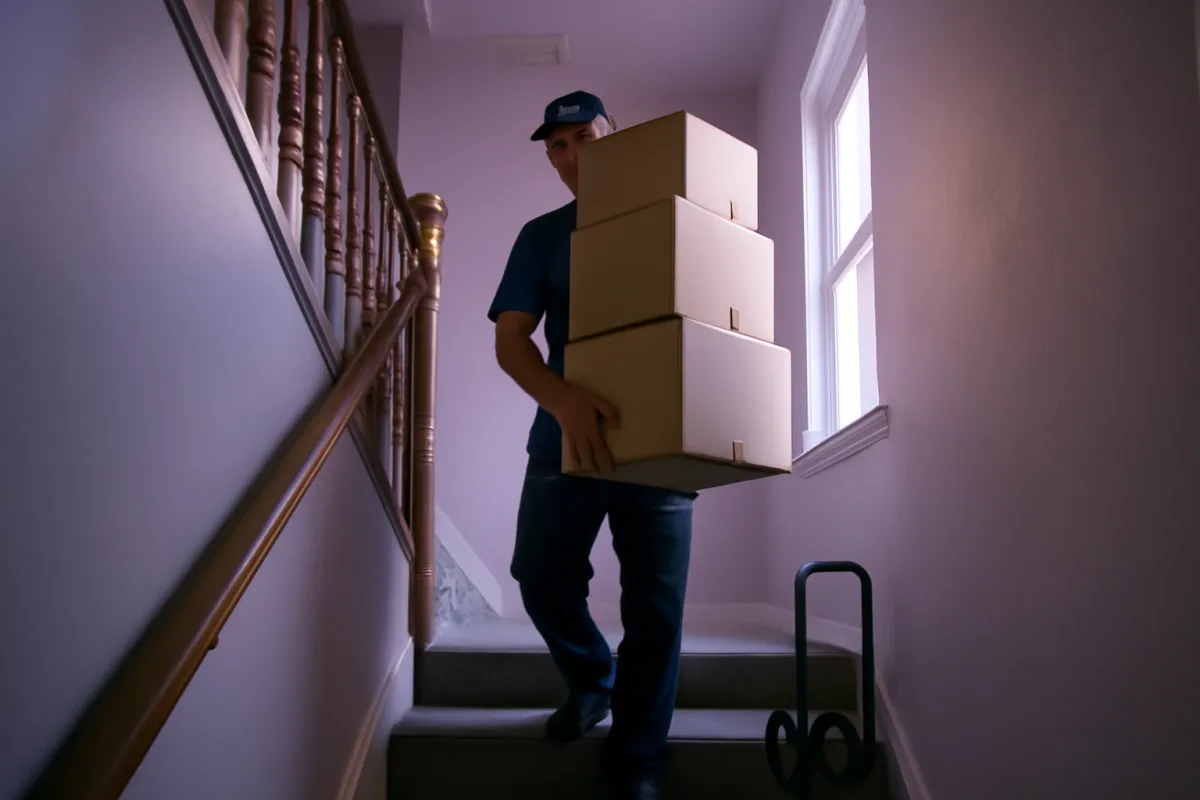
Step 5: Take stairs slowly with a spotter
Stairs are the most dangerous moment in any piano move, the point where a piano move is most likely to injure someone or wreck the instrument, so this step earns the most caution and is the clearest reason to consider hiring pros. A piano is never rolled down or up stairs on a dolly. Instead the crew controls it by hand, one step at a time, with the strongest, most experienced people positioned on the downhill side to bear and hold back the weight, and a spotter calling every single step. The piano is kept tipped slightly back so its weight stays over the movers below rather than pitching forward down the stairs.
Move on a count, one step per call, with everyone pausing to reset their footing and grip between steps and no one ever getting into a position where a slip would pin them under the piano. Keep the load as low and controlled as the stairwell allows, watch for turns and landings where the piano has to pivot, and stop completely if anyone loses grip or footing. Specialty stair-climbing equipment and trained crews exist precisely because the weight can accelerate in an instant on a stair, and once it starts to run, people cannot stop it.
Watch out for treating a flight of stairs as just a few more steps; it is a fundamentally different and far riskier job than flat ground. If your move involves more than two or three steps, a full flight, a turn in the stairwell, or a curved staircase, the safest and often the cheapest decision is to hire professional piano movers, because one dropped piano or one injured helper costs more than the entire move. There is no shame and much sense in drawing the line at the stairs; it is the single best risk decision in a piano move.
Step 6: Ramp the piano into the truck
Getting the piano from the ground into the truck is its own controlled push, and the piano ramp decides whether it is a smooth load or a runaway. A piano ramp is less a special product than a specification: a ramp rated well above the weight of the piano plus the dolly and the people pushing, wide enough that all four dolly wheels ride on it with margin, with a non-slip surface and a lip or hooks that lock onto the truck bed. The ramp built into a rental truck often meets that bar for an upright, a rented loading ramp or a thick plank rated for the weight can do the job, and a household board or a pair of loose planks cannot. Park the truck as close as possible on level ground, set the piano ramp at as shallow an angle as you can manage, since every degree of slope adds rollback force and a longer ramp beats a short steep one, and make sure its footing is solid at both ends so it cannot slip. Roll the dollied piano to the base of the ramp, then push it up slowly with the crew evenly spaced, the strongest people at the back doing the pushing and a spotter guiding from the sides, never with anyone directly below the piano on the ramp where a slip could pin them.
Keep steady, even pressure so the piano never stalls or rolls back, and move on the count just as on the stairs. If the ramp is long or steep, work in short controlled pushes with the crew resetting their footing between each, and consider a second strap held by a person at the top as a backstop rather than relying on push alone. A liftgate, if the truck has one, is often safer and easier than a ramp for a load this heavy, so use it if available and rated for the weight.
Watch out for a piano ramp that is too steep, too flimsy, too narrow for the dolly, or poorly footed; these are the setups where a piano gets away and rolls back onto the crew. If the only ramp you have is steep, a liftgate or a different truck is the better answer than a harder push. Never position yourself downhill of the piano on the ramp, never rush the push, and stop instantly if the load stalls rather than trying to muscle it the last few feet. Loading is the last big lift of the move, and it deserves the same slow, coordinated discipline as the stairs.
Step 7: Secure the piano for transport
A piano that is loaded but not secured can shift, tip, or fall during the drive, damaging itself and everything around it, so the final step is tying it down properly. Stand the upright against a flat wall of the truck box, ideally the front wall behind the cab, keep it in its blankets, and strap it firmly to the truck’s tie-down rails with ratchet straps so it cannot roll, tip, or slide. The piano should be snug against the wall and immobile, with the dolly either strapped in place beneath it or removed and secured separately depending on your setup and the mover’s guidance.
Load the piano so its weight is distributed sensibly and it is not free to move even if the truck brakes hard or turns sharply, and pack other items around it so nothing can fall against it or work a strap loose. Double-check every strap before you close the truck, and re-check them after the first few miles, because straps can settle and loosen once the load takes the road. Keep the piano upright for an upright and on its proper side on the board for a grand, never laid flat in a way that stresses the case.
Watch out for treating the tie-down as an afterthought at the end of a long day. A piano that shifts in transit can be damaged as badly as one that is dropped, and it can crush the boxes and furniture around it. Give the securing step the same attention as the lift, and for a long haul where the load is handled more and driven farther, our long-distance roadmap covers the extra care that longer trips reward. A well-secured piano is a piano that arrives in the condition it left.
Grand pianos need professional disassembly
Everything above describes an upright, because a grand piano is a different and more demanding job that is genuinely built for professionals. A grand cannot simply be tipped onto a dolly and rolled out; it must be partially disassembled first. Movers close and secure the lid, remove the pedal lyre, take off the three legs, and carefully lower the body onto its long, straight side onto a padded piano board or skid, which is then strapped and moved on a dolly. Only in that orientation, on the board, is a grand safe to move through a home and onto a truck.
This is precise work with real consequences. Lowering a grand onto its side without cracking the case or stressing the plate takes technique and enough trained hands, removing and later refitting the legs and lyre must be done so the pedals and action work correctly, and the reassembly at the far end is as exacting as the disassembly. Done wrong, the case cracks, a leg snaps, or the pedal mechanism is damaged, and the repair can rival the value of the instrument. The number of people, the specialized board and straps, and the skill required all sit outside what a typical household can safely manage.
For those reasons, a grand piano is one of the clearest hire-a-professional items in an entire move. If you own a baby grand or a concert grand, plan and budget for specialist piano movers from the start, and treat the disassembly, the padded transport, and the reassembly and reinstatement of the legs and pedals as part of the service you are paying for. Attempting it yourself risks both serious injury and the instrument itself, which is why this roadmap’s do-it-yourself steps stop at the upright.
An illustrative pro cost by piano and route
Cost is one of the biggest reasons people weigh a self-move, so it helps to see roughly how professional piano movers price the job, framed as an illustrative model rather than a quote. The two things that move the price most are the type of piano, which sets the weight and whether disassembly is needed, and the difficulty of the path, above all stairs and distance. The chart below shows a rough illustrative price for four common scenarios on this roadmap’s model, the same model the companion below runs on your own inputs.
Illustrative pro piano move cost by scenario
A rough illustrative price for a professional piano move in four common situations, on this roadmap's model. Illustrative, not a quote; your price depends on your piano, path, stairs, and mover.
In this model each flight of stairs adds a surcharge, distance multiplies the whole price, and a grand adds disassembly, so a long-distance grand can run into the low thousands. These are the same midpoints the companion below uses. Get written specialist quotes.
Set against those numbers, the case for hiring pros on anything but the simplest upright is mostly a comparison of a few hundred dollars against the cost of a bad outcome. A single injury, a cracked soundboard, a snapped leg, or a torn-out doorframe can each exceed the entire cost of a professional move, and the instrument may be irreplaceable. Our note on what movers cost puts these specialty figures in the context of a whole move so you can budget the piano as its own line. Whatever you decide, get the piano priced by movers who specialize in instruments, not just general movers, and get it in writing.
Where the danger concentrates in a piano move
It is worth seeing where the risk actually sits, because it tells you where to concentrate your caution and where the decision to hire pros pays off most. The danger in a piano move is not spread evenly across the job; it clusters heavily around a few moments, above all the stairs. The breakdown below is an illustrative share of where injuries and damage tend to happen in a typical piano move.
Where the risk concentrates in a piano move
An illustrative share of where injuries and damage tend to happen during a piano move, to show where caution matters most. Illustrative model; your risk shifts with your specific path and piano.
In this illustrative model stairs take the largest share of the risk, which is why more than a few steps is the clearest signal to hire specialists rather than attempt it yourself.
Which pianos to move yourself and which to hire out
When you are standing in front of your own instrument deciding, it helps to have the call laid out by piano type in one place. The table below collects an honest read on whether each kind of piano is a realistic do-it-yourself job, the recommended approach, and an illustrative professional cost on this roadmap’s model, so you can match your situation to a plan.
| Piano type | DIY realistic? | Recommended approach | Illustrative pro cost |
|---|---|---|---|
| Spinet or console upright, one level | Possibly, with a real crew and gear | Piano dolly, straps, blankets, crew of 3 to 4, cleared flat path | ~$200 to $300 local |
| Full-size studio upright, one level | Borderline, only with experience | Same as above, but the weight leaves little margin for error | ~$200 to $350 local |
| Any upright with stairs | Not recommended | Hire specialist piano movers with stair equipment | Add a per-step or per-flight surcharge |
| Baby grand | No | Professional disassembly onto a piano board | ~$350 to $600 local |
| Concert grand | No | Professional crew, disassembly, and reassembly | ~$500 to $850 local, more with stairs |
| Any piano, long-distance | No | Specialist mover, secured for a long haul | Several hundred into the low thousands |
A worked example: moving an illustrative upright
Run one realistic move through the whole method. The mover: a household relocating a console upright, roughly 400 pounds, from a first-floor living room to a rented truck, with one three-step porch stoop but no interior stairs, and four capable friends plus one person to spot and call.
They start by walking and measuring the route: the living room door, the front hall, the front door, the three porch steps, and the truck ramp, deciding to tip the piano slightly to clear the front doorframe. They wrap the piano fully in blankets, securing them with stretch wrap, cover the keyboard, and pad the doorframes and the porch rail, then lay runners over the hardwood. On the spotter’s count, the four lift just enough to slide a four-wheel piano dolly underneath, center it, and strap the piano to the dolly. Across the flat living room and hall the dolly carries the weight while the crew guides the top-heavy load and eases it, tipped, through the front door.
At the three-step stoop they take the piano off the roll-and-guide approach and control it by hand, the two strongest on the downhill side holding the weight back, the piano tipped slightly back, moving one step at a time on the call, with no one below it. At the truck they set a sturdy ramp at a shallow angle, push the dollied piano up slowly with the crew behind it and a strap backstop at the top, then stand it against the front wall of the box and ratchet-strap it tight, re-checking the straps after the first few miles.
On this roadmap’s illustrative model, a local upright move like this, done by pros, would land somewhere around $200 to $400, and the household’s decision to do it themselves turned on the fact that the only stairs were three shallow porch steps. Had there been a full interior flight or a grand piano, the same reasoning would have pointed straight at hiring specialists. That is the shape of the charts above: the stairs are where the risk lives, so the number and kind of stairs decide the whole call.
Common piano-moving mistakes that cost you
The expensive errors in a piano move cluster around the same roots: too few people, the wrong gear, and rushing the dangerous moments. Collected in one place, the mistakes that most often injure someone or damage the instrument.
- Trying to move it with too few people, or alone. A piano is far too heavy and top-heavy for one or two people to control. Line up a real crew of three or four for an upright, more with stairs, and never attempt it solo.
- Using the wrong equipment. A household hand truck, a furniture dolly, and a bath towel are not piano gear. Use a real piano dolly or skids, wide moving straps, and thick blankets, or hire movers who have them.
- Rolling a piano down stairs on a dolly. Stairs are controlled by hand, one step at a time, never rolled. Rolling a piano on stairs is how it runs away and injures the crew below.
- Lifting by the legs or a single handhold. An upright’s weight is uneven and its legs can snap under load. Lift the padded body with straps and legs, not the legs of the piano.
- Skipping the blanket wrap or taping the finish. An unpadded piano scrapes at the first doorway, and tape on the finish lifts the lacquer. Pad everything and tape only the blankets or wrap.
- Forcing a piano through a doorway that will not fit. Forcing splinters frames and gouges finishes. Re-measure, re-angle, remove the door, or accept that the route needs a professional.
- Attempting a grand piano yourself. Grands need disassembly onto a board and trained hands. A DIY grand move risks both serious injury and a cracked, ruined instrument.
- Not securing the piano in the truck. A loose piano shifts and topples in transit. Strap it tight to the wall and re-check the straps after the first few miles.
Nearly every one traces back to underestimating the weight and the danger, which is exactly what a proper crew, the right gear, and a willingness to hire out the hard cases prevent.
Troubleshooting: when a piano move gets stuck
Even a careful plan meets surprises. Here is how to handle the common ones without abandoning safety.
What if the piano will not fit through a doorway? Stop and re-measure before you force anything. Try tipping or angling the piano to a different orientation, remove the door from its hinges to gain an inch or two, and check whether a different door or route is wider. If it truly will not clear any way you try, that is a strong sign the move needs professionals who read tight spaces for a living, and forcing it will only cost you a doorframe or a finish.
What if I cannot get enough strong helpers? Do not try to compensate with fewer people and more effort; that is how backs and fingers get hurt. Either postpone until you can field a proper crew of capable helpers, or hire professional movers for the piano specifically, even if you move the rest of the house yourself. The cost of specialist piano movers for one item is small next to an injury, and it may be the single smartest line in your whole moving budget.
What if there are stairs I did not plan for? Treat unplanned stairs as a full stop and a reassessment, not something to push through. Stairs are the highest-risk part of the move and demand the strongest people on the downhill side, a spotter calling every step, and often specialist equipment. If the stairs are more than a few steps, a full flight, or turned, the safest and frequently the cheapest choice is to bring in pros rather than improvise on the most dangerous part of the job.
What if the piano is a family heirloom I cannot risk? For an irreplaceable or high-value instrument, the calculus tilts even harder toward professionals and insurance. Photograph its condition beforehand, hire specialist movers with proper coverage, ask about full-value protection, and consider a specialty policy for an antique or valuable piano. The peace of mind is worth the cost when the instrument cannot be replaced, and it lets you move the rest of your home, using our packing roadmap, without that one worry hanging over the day.
Run your own piano move safely
Everything above assembles into a method you can apply to your own instrument, and just as importantly into an honest decision about whether to apply it at all. Plan and measure the route; recruit a real crew with a single caller; wrap the piano in blankets and pad the house; strap it onto a piano dolly with the crew guiding rather than carrying; ease it through doorways in the right orientation; control stairs by hand one step at a time; ramp it into the truck slowly; and strap it down tight for the drive. The same safety logic that runs the upright steps also tells you clearly when a grand, a flight of stairs, or a shortage of helpers means it is time to hire specialists.
The companion beside this roadmap sizes the decision for you. Choose your piano type, the number of stair flights on your route, the distance, and how many helpers you can line up, and it returns an illustrative professional cost range and a plain read on whether your specific move is a reasonable do-it-yourself job or one to hand to pros. Change the stairs or the piano type and watch both the cost and the recommendation move. Pair it with the calculator for the salary side of a relocation and our note on what movers cost for the rest of the move, and a job that intimidates most people becomes a clear plan and a clear-eyed call.
Your piano-moving checklist
Use this as the save-this version, the compact list you can run before and during the move.
- Decide first: a small upright on one level can be DIY with a real crew and gear; a grand, any stairs, or too few helpers means hire specialist piano movers.
- Gear: a four-wheel piano dolly or skids, heavy-duty moving straps, thick blankets, tape or stretch wrap, and a sturdy ramp; no household hand trucks or towels.
- Crew: at least three or four capable, sober helpers for an upright plus one spotter and caller, all in closed-toe shoes and gloves.
- Route: measure the piano against every doorway and turn, clear and pad the whole path, and decide each orientation in advance.
- Protect: secure the keyboard lid, wrap the piano fully in blankets, tape the blankets not the finish, and pad floors, doorframes, and rails.
- Move: lift onto the dolly with straps and legs on a count, guide the top-heavy load, and take doorways and turns slowly in the planned orientation.
- Stairs: never roll on a dolly; control by hand one step at a time, strongest on the downhill side, spotter calling, no one below the piano.
- Load and secure: ramp up slowly with no one downhill, stand the piano against the truck wall, strap it tight, and re-check straps after a few miles.
- After: let the piano settle in its new room about two to four weeks, then have it tuned; photograph it beforehand for any insurance claim.
Print it, screenshot it, or rebuild it in the companion; the format matters less than staffing the move properly and drawing the line at the stairs.
The bottom line
Moving a piano safely comes down to respecting its weight, its hidden fragility, and the danger it poses to the people carrying it, then matching the method to the instrument. For a small upright on one level, a real crew of three or four with a piano dolly, straps, and blankets can do it: plan and measure the route, wrap the piano, strap it to the dolly, ease it through doorways, control any steps by hand, ramp it into the truck, and tie it down tight. For a grand, for stairs beyond a step or two, or when you cannot field enough strong helpers, the safest and frequently the cheapest decision is to hire professional piano movers, because a single injury or a dropped instrument costs more than the entire move. Illustratively, pros might charge a few hundred dollars for a local upright and more for grands or stair-heavy moves, a small price against the risk. Let the piano settle two to four weeks in its new home before you tune it, photograph it beforehand in case you need to document damage, and size the rest of the move with our packing roadmap and our note on what movers cost.
This roadmap is published by the ReloPeak desk as general education, not as a moving quote, a contract, or professional advice. The costs, weights, and shares in it are illustrative, chosen to show how a piano move fits together and where the risk sits rather than to predict your own figures; what you actually pay and face moves with your piano, your path, your stairs, and the mover you choose. Moving a piano carries real risk of serious injury and of costly damage to the instrument, floors, walls, and doorframes, so treat the do-it-yourself steps here as a starting point to adapt only for the simplest cases, and hire qualified professional piano movers for grands, stairs, long carries, or any move you are unsure about. Confirm insurance coverage and any mover’s terms in writing, and check tuning and care against your own technician’s guidance, before you rely on the guidance here.
Frequently asked questions
How much does it cost to move a piano?
There is no single price, but an illustrative range helps you budget. On the model this roadmap uses, professional movers might charge around $200 to $400 to move an upright piano locally, roughly $400 to $600 for a baby grand, and $600 to $1,000 or more for a concert grand or a move with several flights of stairs. Stairs are the biggest single surcharge, often added per step or per flight, and a long-distance piano move can run from several hundred dollars into the low thousands depending on weight and mileage. Get written quotes from movers who specialize in pianos rather than general movers, because the specialty gear and technique are what protect both the instrument and the crew. The companion below turns your piano type, stairs, and distance into an illustrative range you can sanity-check quotes against.
Can I move a piano myself?
Sometimes, but honestly less often than people think, and never alone. A small spinet or console upright on a single level with a smooth path to the truck can be a careful do-it-yourself job with a strong crew of three or four, a proper piano dolly, and moving straps. The moment stairs, tight doorways, a grand piano, or a long carry enter the picture, the risk of a crushed hand, a wrenched back, or thousands of dollars of damage climbs fast, and hiring specialists usually costs less than one bad outcome. Pianos are top-heavy, deceptively fragile inside, and heavy enough to pin a person against a wall or a stair rail. If you are unsure whether your specific move is safe to do yourself, that uncertainty is itself a strong signal to hire professional piano movers.
How many people does it take to move a piano?
Plan for at least three to four able-bodied helpers for an upright, and more for a grand or any move involving stairs. An upright piano commonly weighs somewhere around 300 to 500 pounds, which is far too much for one or two people to control safely, especially when it must be tipped, turned, or eased down a step. Extra hands are not just about lifting; you need a spotter to guide the piano, watch the path, and call the pace so everyone moves together. A grand piano, once legs and pedals are removed and it is placed on its side on a piano board, often needs four or more movers plus someone directing. If you cannot line up enough capable, sober, closed-toe-shoe-wearing helpers, that alone is a reason to hire a crew.
What equipment do you need to move a piano?
The core kit is a piano dolly, heavy-duty moving straps, thick moving blankets, and tape, plus a sturdy ramp or plank for the truck. A four-wheel piano dolly or a set of piano skids takes the weight so the crew guides rather than carries the instrument across the flat sections. Wide moving straps, either forearm-forearm straps or a shoulder harness, let helpers lift with their legs and keep hands free of pinch points. Blankets wrapped around the whole piano and secured with tape or stretch wrap protect the finish, the keys, and the pedals from dings. For a grand you also need a padded piano board or skid board and tools to remove the legs and pedal lyre. Do not improvise with a household hand truck and a bath towel; the wrong gear is how pianos and people get hurt.
How do you move a piano down or up stairs?
Stairs are the single most dangerous part of any piano move, so treat them with extreme caution or hand them to professionals. The piano is never rolled down stairs on a dolly; it is controlled step by step by a crew, with the heaviest, strongest people positioned on the downhill side to hold the weight back and a spotter calling every move. Keep the piano tipped slightly back so its weight stays over the movers below, take one step at a time with everyone moving on a count, and never let anyone get below the piano in a spot where a slip could pin them. Specialty stair-climbing equipment and experienced crews exist for exactly this because the load can accelerate in an instant. If your move has more than a few steps, especially a full flight or a turn in the stairwell, hiring piano movers is the safest and often the cheapest decision once you price a single injury or a destroyed instrument.
Do grand pianos have to be taken apart to move?
Yes, in almost every case a grand piano is partially disassembled before it moves, and that is specialist work. The lid is closed and secured, the pedal lyre and the three legs are removed, and the body is carefully lowered onto its straight side onto a padded piano board, which is then strapped and moved on a dolly. Done wrong, this step cracks the case, snaps a leg, or damages the pedal mechanism, and the reassembly has to be precise for the pedals and action to work. This is the main reason grand pianos are rarely a do-it-yourself job: the tools, the technique, and the number of trained hands required are beyond most households. If you own a grand, budget for professional piano movers and treat the disassembly and reassembly as part of what you are paying for.
Do you have to tune a piano after moving it?
Almost always, though not immediately. A piano does not usually go out of tune from the vibration of the truck ride itself; it drifts because the new room has a different temperature and humidity, and the soundboard and strings react to that change over a few weeks. The common guidance is to let the piano settle and acclimate to its new home for about two to four weeks before you call a technician to tune it. Tuning it the day it arrives often wastes the visit, because it will shift again as it adjusts. Budget for a tuning as a normal part of the move, and if the piano was significantly out of tune or has not been serviced in years, mention that so the technician can plan for a pitch raise.
Does insurance cover damage when moving a piano?
It depends on who is moving it and what coverage you have, so confirm the details before the piano leaves the room. Professional movers carry liability coverage, but the basic released-value protection included by default is often minimal (commonly cited at a small amount per pound), which does not go far on a valuable instrument, so ask about full-value protection or a separate valuation. If you move the piano yourself, your homeowners or renters policy may or may not cover damage in transit, and a dropped piano can also cause costly damage to floors, walls, and doorframes that you would be responsible for. Photograph the piano before the move to document its condition, get any mover's coverage terms in writing, and consider whether a high-value or antique instrument warrants a specialty policy. When in doubt, ask your insurer directly rather than assuming you are covered.