What's in this roadmap
- Why heavy furniture is a technique problem
- How much common furniture pieces weigh
- Before you start: gear, helpers, and an honest self-check
- Step 1: Measure the furniture and every doorway on the route
- Step 2: Empty and disassemble everything you can
- Step 3: Protect the piece, the floors, and the doorways
- Step 4: Lift with your legs and carry high-low
- Step 5: Slide furniture on sliders instead of carrying it
- Step 6: Roll the heaviest pieces on a dolly
- Step 7: Use lifting straps for the awkward bulky pieces
- Step 8: Take the stairs one tread at a time
- How to move heavy furniture by yourself
- Moving heavy furniture upstairs vs downstairs
- When to hire movers instead
- A worked example: three heavy pieces, one flight of stairs
- Where the moving-day effort goes
- Common heavy-furniture mistakes that cause injuries
- Troubleshooting: when the piece will not fit
- Run your own heavy-lift plan
- Your heavy-furniture moving checklist
- The bottom line
Short answer: Move heavy furniture with technique rather than muscle: measure the route including door diagonals, empty every drawer and disassemble what you can, then let sliders, dollies and straps carry the weight so hands only take the load at doorways and stairs. Use a two-person high-low carry, keep the stronger carrier downhill on stairs, and move one tread at a time. Illustratively 50 pounds per carrier is comfortable and past 300 is crew territory.
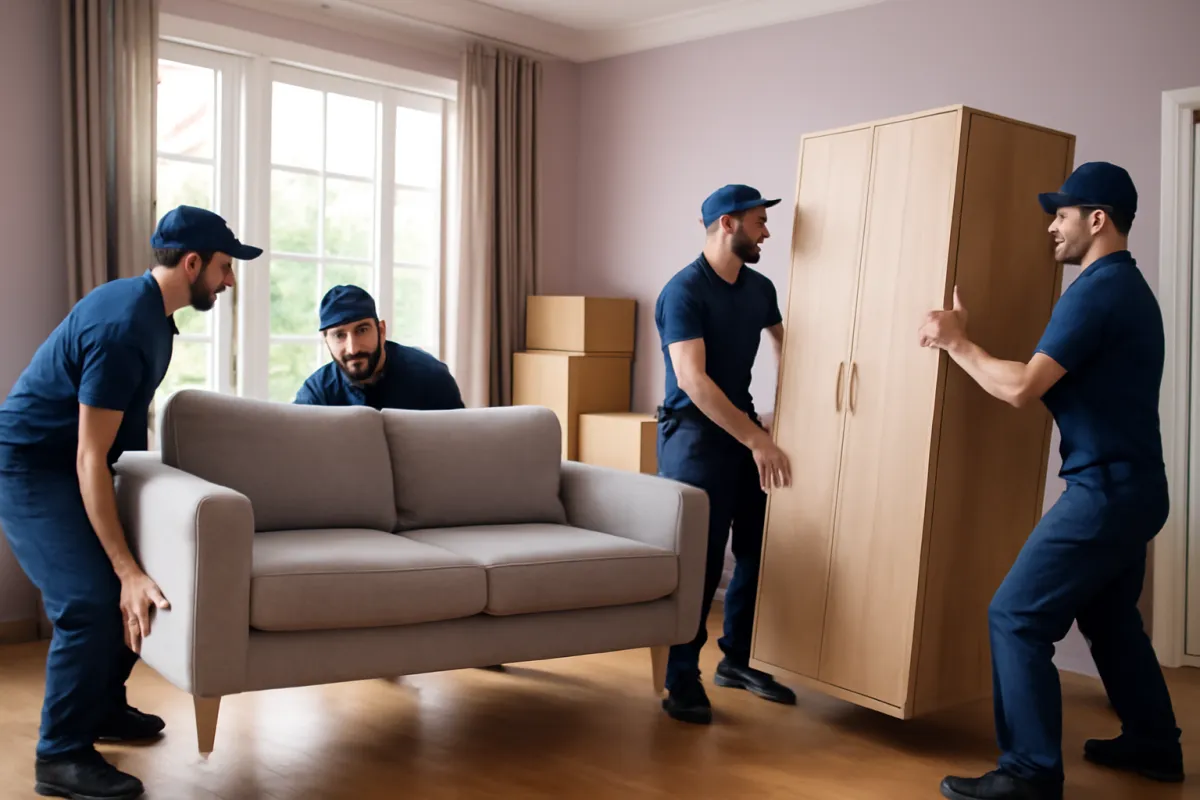
Every move has one piece of furniture that everyone quietly dreads: the sleeper sofa that owns the basement, the dresser that took three people to bring in, the washer at the bottom of a staircase that suddenly looks very narrow. The instinct is to solve it with muscle, and muscle is exactly the wrong tool. Professional crews move heavier pieces than yours every day with less strain than most households spend on one couch, and they do it with technique and about a hundred dollars of gear, not with backs.
This roadmap covers how to move heavy furniture in eight steps: the doorway math that tells you whether a piece fits before you lift it, the disassembly that shrinks the job, and the sliders, dollies, and straps that carry the weight so your spine does not. It works through stairs in both directions, the solo version of the method, and the honest line where hiring a crew beats doing it yourself. It pairs naturally with our truck-loading roadmap for what happens once the piece reaches the driveway, and with our piano-moving walkthrough for the one item that outranks everything else in this roadmap. The companion beside it turns your heaviest piece, your helpers, and your staircase into a lift plan as you read.
Key takeaways
- Heavy furniture is a technique problem: measure the route, shrink the piece, and let sliders, dollies, and straps do the carrying, so hands only take the load at doorways and stairs.
- Two people beat four on most lifts: the high-low carry, one on the top of a tilted piece and one on the bottom, controls weight and sightlines better than a crowd.
- On stairs, the stronger carrier always takes the downhill end, the piece moves one tread at a time, and downstairs is treated as more dangerous than up.
- An illustrative 50 pounds per carrier is comfortable and 75 is the caution line; anything past roughly 300 pounds, or heavy plus a full staircase, is crew territory.
- The most expensive mistakes are free to avoid: measure the diagonal before lifting, empty every drawer, and never put a body downhill of a load without a plan.
Why heavy furniture is a technique problem
Watch a two-person professional crew move a loaded china cabinet and the first surprise is how little lifting happens. The piece is emptied, wrapped, tipped onto a dolly, rolled to the doorway, and walked through in a controlled pivot. Total time under real load: seconds, not minutes. The crew is not stronger than you and a friend. They simply refuse to carry anything the floor can carry for them, and they only accept weight at the few points, thresholds, stairs, and truck ramps, where wheels cannot go.
That refusal is the entire philosophy of this roadmap. Every technique in the eight steps exists to shorten the time your body spends under load: measurement prevents the doomed carry that ends wedged in a door frame, disassembly removes pounds before the first lift, sliders and dollies convert carrying into pushing, and straps turn the remaining lifts into leg work instead of back work. The payoff is not just safety, though strain injuries are the most common way a DIY move goes wrong. It is also speed, and it is the furniture itself: a piece that is rolled and pivoted arrives without the gouges and cracked joints that a strained grip produces. Strength runs out; sequence does not.
How much common furniture pieces weigh
Planning starts with an honest sense of the numbers, because the right technique depends on the weight class. The figures below are illustrative planning weights, not specs; your grandmother’s solid-oak dresser can outweigh a modern one twice its size, which is why Step 1 includes checking each piece yourself.
Illustrative weights of common heavy furniture
Typical planning figures in pounds; actual pieces vary widely by material and build.
Read the chart as weight classes, not exact figures. Up to about 150 pounds is two-person territory with gear; 200 to 300 pounds demands wheels and straps everywhere the route allows; past roughly 300 pounds, and for any piano, the calculation shifts toward a professional crew, especially when stairs are involved.
Two lessons hide in those bars. First, the heaviest common pieces are two to three times the weight of the sofa most people use as their mental benchmark, which is why a plan that worked for the couch fails at the sleeper. Second, weight is only half the difficulty score: a 250-pound refrigerator with flat sides and a dolly path is an easier job than a 150-pound sofa with no grip points on a winding staircase. The steps that follow treat both numbers, the pounds and the awkwardness, as inputs to the plan.
Before you start: gear, helpers, and an honest self-check
Gather the gear first, because every tool on this short list replaces a chunk of bodily effort. Furniture sliders, hard plastic for carpet and felt-backed for hard floors, cost little and move almost anything across a room. A four-wheel furniture dolly or an appliance-style hand truck handles hallways and ramps. A pair of shoulder or forearm lifting straps turns no-grip pieces into leg lifts. Add moving blankets and stretch wrap for protection, a screwdriver and wrench set for disassembly, zip bags for hardware, and work gloves with grip. Everything on the list rents or buys for far less than one repaired floor plank.
Second, count helpers honestly. The method here assumes two healthy adults for every genuinely heavy piece; a third person is valuable as a spotter and door-holder, and stairs make that third person close to mandatory. Solo movers get their own section below, along with its hard limits.
Third, run the self-check that professional crews run on every job. An illustrative comfortable load is up to about 50 pounds per carrier with good technique, roughly 75 is the caution line, and awkwardness, stairs, and long carries all lower those numbers. Anyone with a back, heart, or joint condition should plan around hiring the heavy lifts out, and our moving-cost roadmap prices exactly that. Plan for 30 to 60 minutes per heavy piece, more with stairs, and schedule the heavy work early, before arms are tired and patience is thin.
Step 1: Measure the furniture and every doorway on the route
Before anything is lifted, walk the route with a tape measure and a notepad, because the most demoralizing failure in furniture moving, the piece wedged diagonally in a door frame, is entirely preventable with arithmetic. Measure each heavy piece three ways: height, width, and depth. Then compute the number most people skip, the diagonal, since a piece that will not pass a door upright often passes easily tilted, and the diagonal is what decides it. For a sofa, measure from the back-top corner to the opposite front-bottom corner; that figure against the door’s clear opening is the real test.
Now measure the route: every doorway’s clear width with the door open, hallway widths at their tightest points, stair widths, the headroom on stair turns, and the landing dimensions where a long piece must rotate. Removing a door from its hinges takes five minutes and buys roughly two inches; note which doors need it. Mark the tight spots and decide each piece’s path before moving day, including which pieces leave through a wider back or patio door instead of the front.
An illustrative worked check: a couch measuring 38 inches high and 40 deep, with a 54-inch diagonal, meets a 32-inch doorway. Upright it fails, but tilted on end and curled through seat-first, the passing dimension approaches the 40-inch depth against the door’s diagonal opening, and with legs removed it clears. Watch out for the measurement everyone forgets: the space beyond the door, because a long piece needs swing room on the far side to finish its pivot.
Step 2: Empty and disassemble everything you can
Every pound removed before the lift is a pound nobody carries through the house, so strip each piece to its lightest configuration. Empty all of it: drawers, shelves, cabinets, the sleeper mattress out of the sofa, the fridge defrosted and cleared the day before. A loaded dresser can weigh double its empty figure, and drawers that stay in should be taped or wrapped shut so they cannot launch mid-carry. Books, files, and dishes travel in boxes; furniture travels empty. That single habit prevents more strain injuries than any lifting technique.
Then disassemble. Legs off sofas and tables, headboards and rails off bed frames, mirrors off dressers, doors off wardrobes where hinges allow, shelves and back panels out of modular units. Sectionals split into their sections, and each section moves like ordinary furniture instead of like an architectural feature. Work with a screwdriver and wrench, photograph each piece before it comes apart so reassembly is not archaeology, and drop every screw and bracket into a labeled zip bag taped to the piece it came from, the same hardware discipline our truck-loading roadmap relies on at the other end of the driveway.
The illustrative math makes the case: a 150-pound sofa loses roughly 10 pounds of legs and, more importantly, four inches of passing height, which is frequently the difference between a doorway fight and a clean pivot. Watch out for two traps: particleboard furniture that was assembled in place and may not survive disassembly, which belongs on the sell-or-donate list rather than the truck, and stripped screws forced by a powered driver; hand tools and patience keep the hardware usable at the destination.
Step 3: Protect the piece, the floors, and the doorways
Wrap before you move, because the damage a heavy piece does in transit lands three ways: on the furniture, on the floors, and on the house. Moving blankets go around every finished or upholstered surface, banded on with stretch wrap or tape, with the rule that tape touches blanket and wrap, never wood finish, since adhesive lifts varnish. Corners take a double fold of blanket; they hit first in every collision. Mirrors and glass doors come off where possible and travel padded on both faces, and drawer fronts on pieces that stay assembled get a wrap pass so they cannot swing.
The house gets dressed too. Cardboard or hardboard runners protect the floor along the heavy route, rosin paper or old rugs work on stairs if they are taped utterly flat, and door frames on the tight passages from Step 1 get a folded blanket taped around the jamb. Banister rails and stair-turn walls collect the worst scars in a move, so pad the impact points you identified while measuring. On carpet, sliders need no floor protection; on hardwood and laminate, every heavy piece is either on felt sliders, on a blanket, or on wheels, never dragged bare.
The illustrative economics are lopsided: a dozen rented blankets and a roll of stretch wrap commonly cost less than refinishing a single door casing, and far less than repairing one gouged plank of flooring in a home you are trying to hand over clean. Watch out for the last-minute wrap: protection applied in the doorway, after the carry has started, protects nothing. Wrap at the piece’s parking spot, while it is still calm and accessible, and the carry becomes the boring part.
Step 4: Lift with your legs and carry high-low
Now the technique that governs every lift the gear cannot take. Get close to the piece, feet shoulder-width, and lower yourself by bending knees and hips, not the waist, keeping the back long and the chest up. Grip low and firm, brace, and stand up with the legs doing the work while the piece stays as close to your body as the shape allows. Turn by moving your feet, never by twisting the spine under load, and set weight down the same way it came up, knees first. Every rule in that paragraph exists because its violation is a standard emergency-room story.
For two carriers, the high-low carry is the professional default for tall and long pieces. Tilt the piece back at an angle; one carrier takes the top edge, the other the bottom, and the tilt locks the load between them so it cannot slide. The angle also matches stair pitch, which is why Step 8 depends on this grip. The bottom position bears most of the weight, so the stronger carrier takes it, and the top position steers and calls every move out loud: ready, lift, three steps, door, down. One voice, agreed before the lift, prevents the silent mid-carry improvisation that drops furniture.
Illustratively, a 150-pound sofa in a two-person high-low carry puts roughly 75 pounds on each carrier on flat ground, right at the caution line, which is why the carry distance should be steps, not hallways; the wheels from the next two steps exist to eat the distance. Watch out for the crowded lift: four people on one small piece means nobody can see their feet and everyone assumes someone else has the weight. Two carriers and a spotter beat a crowd.
Step 5: Slide furniture on sliders instead of carrying it
Across any flat run, the room to the hallway, the hallway to the door, the floor beats your arms. Tip the piece one corner at a time, an inch is enough, and slip a slider under each leg or corner: hard-shelled plastic sliders for carpet, felt-padded sliders for hardwood, tile, and laminate. Then push from a low stance with your body weight, slow and steady, steering wide around corners. An illustrative 175-pound dresser that two people would struggle to carry across a bedroom becomes a one-person push, and the felt leaves a polished floor untouched where a bare drag would carve it.
Push rather than pull whenever the geometry allows; pushing keeps the spine neutral and the piece visible, while pulling walks you backward into door frames. Keep the speed boring. A sliding piece carries momentum, and the goal is a piece that stops the moment you do. At thresholds, floor transitions, and the edges of rugs, pause and lift the leading edge over rather than ramming it, because a slider that catches mid-push pitches the piece forward. And sliders never, in any circumstance, go near the top of a staircase; their entire purpose, reducing friction, becomes their entire danger within reach of a stair edge.
Two refinements finish the technique. First, clean the sliders between rooms, since a crumb of grit trapped in felt becomes a stylus on hardwood. Second, on carpet so deep that even hard sliders plow, a blanket under the piece, dragged by two people from the leading edge, does the same job with more control. The watch-out is the unattended slide: a piece parked on sliders is a piece that moves when leaned on, so pull the sliders whenever the piece will sit, especially with children in the house.
Step 6: Roll the heaviest pieces on a dolly
Where the route runs long or the piece runs past roughly 200 pounds, wheels take over. Two tools cover almost every household job. The four-wheel furniture dolly, a carpeted platform on swivel casters, suits big boxy pieces: tip the piece, slide the dolly under its center, settle the weight flat, and steer with two people, one pushing and one guiding the leading corner. The upright hand truck suits appliances and dressers: slide the toe plate under the side that can bear it, strap the piece to the frame, tilt back to the balance point, and walk. The strap is not optional; an unstrapped load on a hand truck is a falling object with a schedule.

Technique keeps the wheels honest. Load so the weight sits centered and low, and for a hand truck let the balance point, not your arms, hold the piece: tilted correctly, the frame carries the load and you merely steer it. Roll slowly across level ground, lead with the wheels through doorways, and on any ramp keep yourself uphill of the load, pushing up and easing down, never below it. An illustrative 250-pound refrigerator on a strapped hand truck asks each of two people for a fraction of what a bare carry would, and it asks their legs, not their backs.
Watch out for the surface change: swivel casters that glide on hardwood dig into gravel and stall on thick carpet, so match the tool to the route and lay hardboard over the soft spots. And know the dolly’s limit, which is the same limit as Step 5’s: wheels end where stairs begin, except for the stair-nosed hand-truck work covered in Step 8.
Step 7: Use lifting straps for the awkward bulky pieces
Some pieces defeat hands entirely: mattresses with nothing to hold, washers with smooth sides, wardrobes too deep to hug. Lifting straps solve the grip problem and move the load to stronger muscles at the same time. The two common systems are shoulder harnesses, where a wide strap runs over each carrier’s shoulders and under the piece, and forearm straps, where a loop rides each carrier’s forearms. Both let two people stand nearly upright while the strap cradles the load, converting a doubled-over back lift into a leg press, and both fold into a pocket and cost an illustrative fraction of one hour of professional labor.
Set them up deliberately. Slide the straps under the piece at points that will balance it, check that the length matches the carriers’ heights, and take a practice lift of one inch to feel the balance before committing to the carry. Height-mismatched carriers should shorten the strap on the taller side, or the load slides toward the shorter person all day. The piece rides low, at shin-to-knee height, so plan the route with that clearance in mind, and keep the high-low voice discipline from Step 4: one caller, short commands, no surprises.
The honest limits matter as much as the technique. Straps shine on flat ground and gentle thresholds and get complicated on stairs, where the tilt changes the geometry and the low ride height meets the stair nose; experienced pairs use them on straight, wide flights, but a strapped hand truck or a crew is the better answer for anything winding. And straps do not reduce the weight, only the awkwardness, so the per-carrier arithmetic from the self-check still governs. A 350-pound sleeper on straps is still 175 pounds a person, which is not a plan; it is a countdown.
Step 8: Take the stairs one tread at a time
Stairs are where every earlier step gets audited, so the discipline is strict. The setup: stairwell cleared and lit, rail-side padded, a spotter below if a third person exists, and shoes with real tread on everyone. The grip is the high-low carry from Step 4 with the piece tilted to the stair angle, and the iron rule of position is that the stronger carrier takes the downhill end in both directions, because the low end holds most of the weight on any staircase.
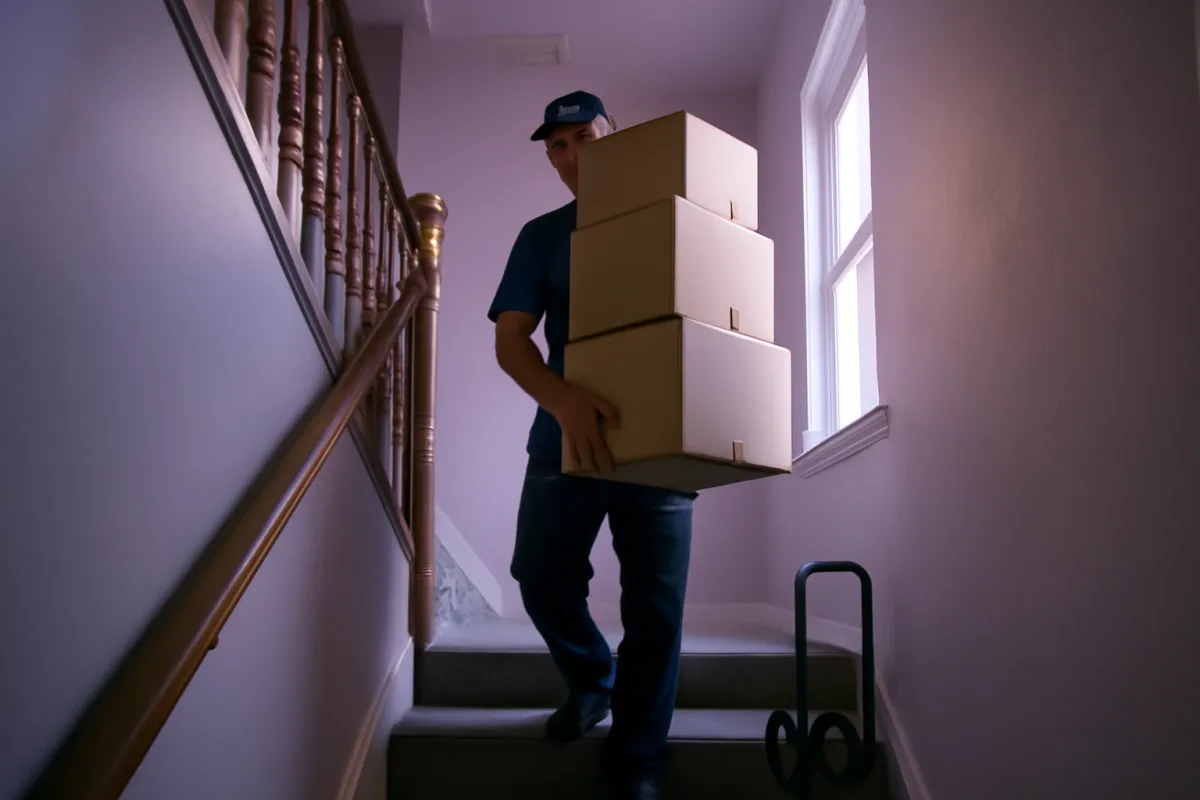
The rhythm is the same up and down: move one tread at a time, on a spoken count, with a full stop on every landing to re-grip and breathe. Going up, the lower carrier powers each step while the upper carrier steers and keeps the piece snug to the staircase line through turns. Coming down, the lower carrier faces up the stairs, walking forward and braced, while the upper carrier’s whole job is preventing the piece from running; gravity is on the furniture’s side going down, which is why descents deserve more respect than climbs. Appliances take the stair variant of Step 6: strapped to a hand truck, eased up or down one step at a time with the frame braced against the operator’s body and a second person always on the downhill side of nothing, spotting from beside the load, never beneath it.
An illustrative 175-pound dresser on a 13-tread flight is 13 small controlled moves, roughly two minutes of actual work, and completely safe done this way. The watch-out is singular and absolute: never put a body where the load would land. If a piece starts to go, it goes; you do not catch it, you get out of its way.
How to move heavy furniture by yourself
Sometimes there is no second pair of hands, and the solo version of this roadmap has one governing rule: slide and roll everything, lift almost nothing. Alone, sliders and the dolly stop being conveniences and become the whole method. Empty and disassemble even more aggressively than Step 2 suggests, because every removable drawer and leg is weight you will not have help with. Work the piece onto sliders one corner at a time, push it across the flat runs with body weight, and use the hand truck with its strap for anything the sliders cannot dignify. Leverage replaces partnership: walk tall pieces corner to corner the way you would walk a water heater, pivoting on one edge at a time, and use ramps over single steps.
The solo mover’s honest limits are lower, and pretending otherwise is the classic solo mistake. Flat-ground work with gear covers most furniture up to the illustrative 200-pound class. Stairs shrink the menu drastically: a careful solo mover can walk a light, balanced piece down a straight flight, but appliances, sleepers, and anything near 200 pounds on stairs is simply not a one-person job, with or without gear. The failure mode is not embarrassment; it is a load you cannot arrest with your one available body positioned exactly where it should never be.
Two solo strategies close the gap. First, split the job in time: move everything you safely can alone, and book a labor-only crew for a single hour to handle the shortlist of dangerous lifts, a booking our moving-cost roadmap helps you price. Second, split the pieces in space: a dresser moved as a shell plus six drawers is seven easy trips instead of one dangerous one. Trips are cheap. Spines are not.
Moving heavy furniture upstairs vs downstairs
The two directions feel like the same job and are not, and knowing the differences sharpens Step 8’s technique. Uphill is a power problem: the lower carrier drives each tread, the work is aerobic, and the main risks are exhaustion and a missed step, so the discipline is pacing, full landing stops, and swapping flat-ground carriers before anyone is spent. Downhill is a control problem: gravity feeds the piece momentum, the lower carrier is braced under the load rather than driving it, and the risk is a piece that starts moving on its own schedule. That is why descents get the slower count, the earlier rope belay around a solid rail for the heaviest items, and the extra insistence that nobody stands in the fall line.
Direction also changes the planning in Step 1. Moving in, heavy pieces should come off the truck early, while the crew is fresh, and go up before the stairwell fills with box traffic; our truck-loading roadmap loads them last precisely so they come off first. Moving out, the heavy pieces come downstairs first for the same freshness reason, and the descent route gets the floor and banister padding from Step 3 before anything else happens that day.
One more asymmetry deserves respect: headroom. Stair turns that a piece cleared going up, tilted one way, can trap it coming down years later when the tilt reverses, which is why the diagonal measurements from Step 1 get re-run for the exit even for furniture that arrived through the same stairwell. Five minutes with the tape measure settles what forty minutes of wedged sofa would otherwise discover.
When to hire movers instead
Every technique in this roadmap has a boundary, and drawing it honestly is part of the method. The clear triggers for hiring: any single piece at or past roughly 300 pounds, any genuinely heavy piece plus a full flight of stairs, narrow or winding staircases with appliances, any lift where you cannot field two healthy adults, and the special cases, pianos and gun safes, that have their own physics; our piano-moving walkthrough explains why that instrument sits in a category of its own even for strong households.
The option most households never price is the middle one: labor-only crews, hired by the hour without a truck. An illustrative two-mover, two-hour booking commonly costs a small fraction of a full-service move and converts every red-flag lift on your list into someone else’s routine Tuesday. Point them at the sleeper, the washer, and the staircase, and keep the boxes, the sliders, and the satisfaction for yourself. Full-service makes sense when the whole inventory is heavy or the timeline is tight, and our moving-cost roadmap breaks down both pricing models, with the tipping etiquette covered in our tipping roadmap.
Run the comparison honestly and the arithmetic usually surprises people. On one side: the crew’s quote. On the other: the real cost of a strained back at the start of a move week, a refrigerator dropped on a landing, a gouged staircase in a home whose deposit you want back. The gear in this roadmap makes most furniture yours to move; the judgment in this section is knowing which pieces never were.
A worked example: three heavy pieces, one flight of stairs
Run the whole method through one illustrative afternoon. The job: a second-floor apartment, moving out, with three heavy pieces, a 150-pound three-seat sofa, a 175-pound solid-wood dresser, and a 200-pound washer, one straight 13-tread staircase, and two healthy adults with a gear kit: sliders, a hand truck, a strap set, blankets, and tools. Total budget: about two and a half hours.
The first 40 minutes never lift anything. Step 1 measures: the sofa’s 54-inch diagonal against a 32-inch door means legs off and a tilted C-curl; the dresser and washer clear on the hand truck. Step 2 strips the job: six dresser drawers out, 60 pounds of clothes now in boxes, sofa legs bagged and taped, washer drum locked and hoses drained. Step 3 wraps all three pieces, pads the stair rail, and lays hardboard on the downstairs hall floor.
The carries take less time than the prep. The dresser shell slides on felt to the stair head, then walks down high-low, one tread per count, stronger carrier below, two minutes of actual load time. The washer goes strapped on the hand truck, eased down step by step with the second person spotting from beside the staircase, five minutes. The sofa, lightest but most awkward, comes last: slid to the door, curled through on end, then down the stairs tilted to the stair angle. Total load-bearing time for the afternoon: under 15 minutes. Illustratively, that is roughly 75 pounds per person at the worst moment, briefly, with wheels or floor carrying everything else, and the staircase wall arrives at handover without a mark. The same three pieces muscled bare-handed is a different story, and usually a shorter one.
Where the moving-day effort goes
The worked example carries a pattern worth seeing as a budget, because heavy-furniture time does not go where beginners expect. The lifting everyone dreads is a sliver; the preparation that makes the lifting boring is the bulk. Illustratively, the afternoon divides like this.
Where the time goes when moving heavy furniture
Illustrative share of total job time across the eight steps. Your mix will differ.
The shares are illustrative, but the shape is the lesson: nearly half the job is preparation that involves no weight at all, and the dangerous under-load portion is a fifth of the time when the method is followed. A move that inverts this chart, long carries and no prep, is the one that ends in strain injuries.
Use the chart as a diagnosis tool on moving day. If the under-load slice of your afternoon is swelling, pieces are being carried that should be sliding, or a doorway fight is underway that Step 1’s tape measure would have prevented. If prep is consuming everything, the disassembly has drifted from shrinking pieces into refurbishing them; drawers out and legs off is usually enough. The proportions flex by household. The ranking should not.
Common heavy-furniture mistakes that cause injuries
Nearly every furniture-moving injury and gouged floor traces back to the same short list, and every entry is free to avoid.
- Lifting before measuring. The wedged-in-the-doorway sofa is not bad luck; it is skipped arithmetic. The diagonal check in Step 1 takes ten minutes.
- Moving furniture full. A loaded dresser doubles its weight and swings its drawers mid-carry. Empty everything, every time.
- Bending at the waist. The stooped lift is the signature back injury of DIY moving. Knees and hips down, back long, load close.
- Twisting under load. Turning the spine instead of the feet while holding weight is how a routine carry becomes a bad month. Feet move; shoulders follow.
- Carrying what should roll. Every hallway walked under load instead of behind a dolly is unnecessary spent strength and unnecessary risk.
- Standing downhill of the load. On stairs and ramps, bodies stay out of the fall line, always. You cannot catch furniture; you can only be missed by it.
- Rushing the stairs. Momentum is the enemy in both directions. One tread per count, full stops on landings, no exceptions for the last piece of the day.
- Skipping the strap on the hand truck. An unstrapped appliance on a tilted frame is a launch in progress. Strap first, tilt second.
The pattern across all eight is the same: the injuries live in the shortcuts, and the shortcuts save minutes on a job measured in hours.
Troubleshooting: when the piece will not fit
What if the piece defeats the doorway despite the measuring? Work the checklist in cost order. Pull the door off its hinges for roughly two inches. Remove the door’s stop trim, a five-minute pry-and-save job, for another half inch. Strip the piece further: feet, back panels, cushions, anything threaded or bracketed. Re-try the angles, especially the vertical C-curl for sofas, with one person guiding each end and the frame padded. Then re-route: a patio slider, a double back door, or a wide window with the sash out has rescued many a sleeper, though anything above the ground floor through a window is professional territory. If every route fails, the piece either sells with the listing photos taken in place, or a specialty crew with hoisting gear takes over.
What if the weight was misjudged mid-carry? Say it out loud and set the piece down at the next flat spot; a controlled abort is a skill, not a failure. Re-split the job, add the strap set, or park the piece and re-plan. What if a slider or dolly meets a floor it is chewing? Stop, lay hardboard or a blanket path, and continue; damage compounds with distance. What if the stairs turn out narrower than the tape suggested, or turn twice where the plan assumed once? That is the moment to price a two-hour labor crew rather than improvise, because winding staircases are where the injury statistics live.
And what if a piece actually starts to fall? One answer, drilled before the first lift: nobody catches it. Carriers release and step out of the line, the spotter is already clear because the spotter was never below the load, and the furniture takes the damage. Furniture is replaceable at prices our moving-cost roadmap can help you weigh. The other cargo on the staircase is not.
Run your own heavy-lift plan
The companion beside this roadmap turns the method into your own numbers. Give it the weight of your heaviest piece, the number of people on the lift, the flights of stairs on the route, and the gear you have on hand, and it returns the illustrative per-person load, the load class that number falls into, a stair-specific read on whether your crew matches the route, and an honest verdict on whether this piece is a technique job or a hire-it-out job. Slide the helper count up and watch a marginal lift become a comfortable one; add a staircase and watch the same weight change categories.
Use it while planning, not mid-carry. Run each heavy piece from your inventory through it the week before, and the output becomes your shortlist: the pieces the sliders and dolly handle, the pieces that need the strap set and a second person, and the one or two entries that belong on a labor crew’s clipboard instead of yours. Pair the plan with the calculator for the salary side of wherever the furniture is headed, and with our truck-loading roadmap so the pieces that survive the staircase also survive the highway. Ten minutes of inputs beats one improvised decision at the top of a flight.
Your heavy-furniture moving checklist
The whole roadmap in the order you will live it.
- Measure every heavy piece, height, width, depth, and diagonal, and every doorway, hallway, and stair turn on the route.
- Gather the kit: sliders for your floor types, a dolly or hand truck with a strap, lifting straps, blankets, stretch wrap, tools, gloves.
- Empty every drawer and cabinet; box the contents; tape or wrap shut anything that stays in.
- Disassemble: legs, headboards, mirrors, shelves, sectionals into sections; photograph first; bag and tape hardware to its piece.
- Wrap the pieces; pad the door frames, banisters, and stair-turn walls; lay floor protection along the heavy route.
- Slide the flat runs on sliders; roll the long runs and the 200-pound class on wheels, strapped.
- Lift only at doorways and stairs: knees and hips, back long, high-low grip, one caller.
- Stairs: stronger carrier downhill, one tread per count, full stops on landings, nobody in the fall line, ever.
- Book a labor-only crew for anything past roughly 300 pounds, pianos, safes, or heavy pieces on winding stairs.
- Reassemble at the destination from the photos, hardware bags in hand, heavy pieces placed before the box wall arrives.
Print it, tape it to the fridge that is about to be moved, and the list runs the day so nobody’s back has to.
The bottom line
How to move heavy furniture comes down to a sentence: measure first, shrink the piece, let wheels and sliders carry the distance, and spend your actual lifting on the few feet where technique, not strength, decides the outcome. Empty and disassemble everything that comes apart, wrap the piece and pad the house, push instead of carry on the flats, roll the 200-pound class on a strapped frame, and take every staircase one tread at a time with the stronger carrier downhill and nobody standing where a dropped load would land. Know the boundaries as well as the techniques: an illustrative 50 pounds per person is comfortable, 75 is the caution line, and 300-pound pieces, pianos, and winding staircases are what labor crews are for. Price that decision with our moving-cost roadmap, give the piano its own plan with our piano-moving walkthrough, and load what you have moved with our truck-loading roadmap. The furniture is heavy either way. The move does not have to be.
This roadmap is general educational material on moving techniques, not safety training, medical guidance, or professional moving advice. The weights, load limits, times, and costs throughout are illustrative planning figures, not measurements of your furniture or ratings for your equipment; real pieces, staircases, and gear vary, and the manufacturer’s instructions for any dolly, strap, or slider you use take precedence over anything written here. Lifting and carrying heavy loads carries genuine risk of serious injury, and stairs multiply it, so work within your own physical limits, stop when a lift feels wrong, and bring in a professional crew for any piece or route you are not fully confident you can handle safely, especially if you have any back, heart, or joint condition.
Frequently asked questions
What is the best way to move heavy furniture?
The best way to move heavy furniture is to stop treating it as a lifting job and treat it as a plan: measure the piece and the route first, empty and disassemble everything that comes apart, protect the piece and the floors, and then let gear do the carrying. Furniture sliders handle the flat runs across a room, a dolly handles hallways and ramps, and lifting straps handle the pieces that have no grip points, so your hands and back only take the load at doorways and stairs. Two people using the high-low carry, one lifting from the top of a tilted piece and one from the bottom, control weight far better than four people crowding a flat lift. Illustratively, a three-seat sofa that runs around 150 pounds becomes a manageable job for two people with sliders and a strap set, while the same sofa muscled bare-handed is how backs and banisters get hurt.
How do you move heavy furniture by yourself?
Alone, your rule is simple: slide and roll everything, lift almost nothing. Furniture sliders under each leg or corner let one person push a dresser or sofa across a room with body weight instead of arm strength, and a hand truck or furniture dolly moves the same piece down a hallway once you can tip it a few inches to work the plate underneath. Empty every drawer, remove legs and shelves, and split anything modular so no single unit is heavier than it must be. The walking technique matters too: push rather than pull, keep the piece moving slowly, and never put your body downhill of a load on any slope. The honest limit is stairs: a solo mover can walk a light dresser down a flight with care, but appliances, sleepers, and anything in the 200-pound class on stairs is a two-person minimum, and pretending otherwise is how solo moves end in urgent care.
How do you move heavy furniture upstairs?
Uphill moves are powered from below. Two people carry the piece tilted in a high-low grip, and the stronger person takes the downhill end, because on stairs the lower carrier holds most of the weight while the upper carrier steers and calls the pace. Climb one tread at a time, pause on landings, and keep the piece tilted to match the stair angle so it hugs the line of the staircase instead of swinging wide at the turns. For appliances, a stair-capable hand truck changes the job: strap the piece to the frame, tilt it to balance, and walk it up one controlled step at a time with a second person spotting below. Clear the stairwell completely first, light it well, and never climb backward without a spotter. If the piece is at the top of the weight chart, an upright piano being the classic example, upstairs work is the strongest argument for hiring a crew.
How do you move heavy furniture downstairs?
Downstairs is more dangerous than upstairs, because gravity is helping the furniture and not you. The piece goes down feet-first and tilted, with the stronger carrier below it, walking forward and facing up the stairs, while the upper carrier keeps the piece from running away and sets the pace out loud. Move one tread at a time and stop fully on each landing; momentum is the enemy, and a heavy piece that starts sliding on a descent cannot be caught. A strapped hand truck works going down as well, eased off each step with the frame braced against your body, and a rope belay around a sturdy rail adds control for the heaviest items. Keep children and pets away, wear closed shoes with real tread, and if the staircase is narrow, winding, or slick, price a two-hour labor crew before you gamble a spine on it.
Do furniture sliders really work on carpet and hardwood?
Yes, and they are the cheapest force multiplier in the whole job, as long as you match the slider to the floor. Hard plastic sliders glide across carpet, where their smooth shell rides over the pile, while felt-padded sliders protect hardwood, tile, and laminate, where a bare plastic edge would scratch. Tip the piece one corner at a time, slip a slider under each leg or corner, and push slowly from a low, braced stance; an illustrative 175-pound dresser that two people struggle to carry becomes a one-person push across a room. The cautions are few but real: keep sliders away from stair edges, lift rather than drag across thresholds and floor transitions where the slider can catch, and clean grit off the felt before it crosses a polished floor. Buy them before moving day; they cost less than repairing one gouged plank.
How much weight can one person safely carry?
There is no single official number for a home move, but a useful illustrative planning band is that most adults handle up to around 50 pounds with sound technique, and the zone from 50 to 75 pounds per person is where strain injuries climb sharply, especially on stairs or long carries. That is per carrier: a 150-pound sofa split between two people is roughly 75 pounds each on flat ground, and more for the lower carrier on stairs, which is why the stronger person takes the downhill end. Awkwardness counts as weight, too; a 40-pound mirror you cannot see around is harder to move safely than a 60-pound box with handles. Work within your own real limits, not a chart's, warm up before the first lift, and let sliders, dollies, and straps carry everything the route allows. Anyone with a back, heart, or joint condition should treat hiring help as the default, not the fallback.
How do you get a couch through a narrow door?
Start with the measurements, not the shoving. Measure the door's clear opening with the door removed from its hinges, which buys roughly two extra inches, then measure the couch's height, depth, and diagonal, because the diagonal is the number that decides most tight fits. Most couches pass a standard interior door tilted vertically on end and pivoted through in a C-shaped curl, seat facing the frame, one person guiding each end. Remove the couch's legs first, take off the door stop trim if a half inch is all you are missing, and protect the frame with a folded blanket. If the diagonal simply exceeds the opening from every angle, the options are a wider route such as a patio slider, a window with professional help, or partial disassembly. Measuring takes ten minutes; a wedged couch can eat an afternoon and a door frame.
When should you hire movers for heavy furniture?
Hire out any lift where the honest answer to what if this slips involves a person underneath it. Common triggers: single pieces at or above roughly 300 pounds, anything heavy that must travel a full flight of stairs, pianos and gun safes in any setting, appliances on narrow or winding staircases, and any move where you cannot field two healthy adults per heavy piece. Labor-only crews are the underused middle option: an illustrative two-hour booking with two movers commonly runs a small fraction of a full-service move, and they handle just the dangerous lifts while you keep the rest of the job. Weigh the quote against the real cost of a strained back, a cracked stair tread, or a dropped dresser, and the crew is often the cheap option. Our roadmap on what movers cost breaks the pricing down piece by piece.