What's in this roadmap
- How storage unit sizes are measured
- The storage unit size chart at a glance
- Storage lockers: smaller than 5x5
- 5x5 storage units: the walk-in closet
- 5x10 storage units: one room’s worth
- 5x15 storage units: the in-between size
- 10x10 storage units: the one-bedroom standard
- 10x15 storage units: two to three rooms
- 10x20 storage units: the small-house size
- 10x25 and 10x30 storage units: full households
- Matching storage unit sizes to home size
- How to estimate the size you need from an inventory
- Ceiling height, cubic feet, and stacking
- Illustrative monthly cost by storage unit size
- The per-square-foot math most renters miss
- What actually fills a unit
- Sizing for furniture and appliances
- Climate control changes the sizing math
- Sizing for a car, motorcycle, or RV
- When to size up and when to size down
- Declutter first: the cheapest square footage is none
- How to pack a unit so the size works
- Common mistakes when picking a storage unit size
- A worked example: sizing a two-bedroom move
- Run your own storage unit sizing
- The bottom line
Short answer: Standard storage unit sizes run 5x5, 5x10, 5x15, 10x10, 10x15, 10x20 and 10x30, the two numbers being floor width and depth in feet. As rough guides, a 5x5 holds a closet's worth, a 5x10 a studio's essentials, a 10x10 a one-bedroom apartment, a 10x15 a two-bedroom, and a 10x20 or larger a whole house. Bigger units cost more per month but less per square foot, so renting two small units is rarely the cheap path.
Storage unit size pictures make the menu look simple, but the numbers behind the photos are what actually decide the rent: 5x5, 5x10, 5x15, 10x10, 10x15, 10x20, and 10x30, and picking the wrong one is the most common way renters waste money on storage. Rent too big and you pay every month for empty air; rent too small and you are back at the counter mid-load, upgrading at the worst possible moment. The sizes themselves are simple, two numbers giving the floor in feet. What is not obvious is what each footprint actually holds, which home sizes map to which units, and how ceiling height, packing, and decluttering can move you a full tier down the price list.
This breakdown walks the whole menu. It covers how storage unit sizes are measured, a full size chart, what genuinely fits in each unit from a locker to a 10x30, how to match unit size to your home and estimate from an inventory, illustrative costs and the per-square-foot math that punishes small units, sizing for vehicles and for climate control, and the mistakes that lead to paying for space you never use. It pairs with our moving-budget roadmap for fitting a storage line into the wider cost of a move, and the calculator handles the salary side of a relocation while you read. The companion beside this article turns your home size, how much of it is going into storage, and your months into a recommended unit and an illustrative cost, live as you read.
Key takeaways
- Standard storage unit sizes run 5x5, 5x10, 5x15, 10x10, 10x15, 10x20, and 10x30, the two numbers being floor width and depth in feet; capacity is really cubic feet once you stack toward the ceiling.
- As rough guides, a 5x5 holds a closet's worth, a 5x10 a studio's essentials, a 10x10 a one-bedroom apartment, a 10x15 a two-bedroom, and a 10x20 or larger a whole house.
- On illustrative rates, bigger units cost more per month but less per square foot: a 5x5 around $3.00 per square foot versus a 10x10 around $1.50, so renting two small units is almost never the cheap path.
- Estimate from an inventory of large furniture and box counts, not from the label: decluttering a third of the load is often worth a full size tier and $30 to $60 a month.
- Round up half a size in judgment, not a full size in rent: leave a modest margin or a walkway on purpose, but do not pay monthly for empty square footage just in case.
How storage unit sizes are measured
Storage unit sizes are quoted as width by depth in feet, so a 10x15 is ten feet wide and fifteen feet deep, 150 square feet of floor. The label describes the floor only, and facilities generally treat the dimensions as approximate: a nominal 10x10 can measure a few inches over or under in either direction depending on the building, which rarely matters for planning but is worth knowing before you cut anything close.
The number the label leaves out is height, and height is where the real capacity lives. Ceilings commonly run somewhere around eight feet, which turns a 100-square-foot floor into roughly 800 cubic feet of stackable volume. Two units with identical floors and different ceilings hold meaningfully different loads. When you compare facilities, ask for the actual ceiling height and the door dimensions, since a roll-up door a foot narrower than the unit changes what furniture can physically enter. Thinking in cubic feet instead of floor area is the single habit that makes every sizing decision in this breakdown easier.
The storage unit size chart at a glance
The fastest way to orient is the whole menu in one table. The rates are illustrative national-typical figures used throughout this breakdown so the math stays consistent; real prices vary widely by market, facility, floor, and season, so treat them as placeholders for the quotes you will collect.
| Size | Floor area | Roughly holds | Illustrative monthly rate |
|---|---|---|---|
| Locker | under 25 sq ft | A few boxes, seasonal items, documents | often under $60 |
| 5x5 | 25 sq ft | A walk-in closet: boxes, a dresser, small furniture | $75 |
| 5x10 | 50 sq ft | A studio’s essentials or one full room | $110 |
| 5x15 | 75 sq ft | A large room plus boxes, or a light one-bedroom | $130 |
| 10x10 | 100 sq ft | A one-bedroom apartment | $150 |
| 10x15 | 150 sq ft | A two-bedroom apartment | $190 |
| 10x20 | 200 sq ft | A three-bedroom home, or a car plus boxes | $230 |
| 10x30 | 300 sq ft | A four-plus-bedroom house | $290 |
Bedroom counts are shorthand, not physics. A minimalist two-bedroom can undercut the chart by a tier and a packrat one-bedroom can overflow it. The sections below take each size in turn, then turn the shorthand into a method you can run on your own inventory.
Storage lockers: smaller than 5x5
Below the standard menu sit storage lockers, small compartments often stacked in banks like oversized gym lockers, with footprints anywhere from a couple of square feet up to just under a 5x5. They exist for loads that do not justify a full unit: a few boxes of documents, seasonal decorations, sports gear, luggage between leases, or the overflow of a small apartment that just needs one closet’s worth of relief.
Lockers are the cheapest absolute rent a facility offers, often under an illustrative $60 a month, but they carry the same quiet trap as every small space: the highest cost per cubic foot on the property. They also frequently sit on upper levels reached by stairs or a lift, which makes heavy boxes unpleasant. A locker is the right call when your load is genuinely tiny and stable, a wrong one when you are trimming a real household load to force it into the smallest label. If you are within a few boxes of needing a 5x5, the 5x5 usually wins on flexibility for a small dollar difference.
5x5 storage units: the walk-in closet
A 5x5 unit gives you 25 square feet of floor, the footprint of a walk-in closet, and with stacking it takes a surprising amount: several dozen small and medium boxes, a dresser, a bookshelf, a desk and office chair, a bicycle, or a dorm room’s worth of belongings between semesters. It is the classic overflow and between-moves size, and at an illustrative $75 a month it is the entry point of the standard menu.
Its limits are furniture-shaped. A sofa, a queen mattress, or a dining table will not go, and even a full bedroom set overwhelms it. The 5x5 works when your load is boxes plus at most one or two compact pieces. Pack it like a puzzle: heavy boxes as the base layer, light boxes to the ceiling, and the items you might want mid-stay at the front. Renters are often surprised that the smallest unit is the worst value per square foot, an illustrative $3.00 against the 10x10’s $1.50, which is exactly why trimming a real household into a 5x5 rarely beats renting the honest size once.
5x10 storage units: one room’s worth
The 5x10 doubles the floor to 50 square feet, a space like a large walk-in pantry or half a small bedroom, and it is the first size that takes real furniture. A typical load is the full contents of a studio or one large room: a queen mattress and frame stood on end, a small sofa or armchair, a dresser, a television, and a few dozen boxes along the remaining wall. At an illustrative $110 a month it is the workhorse for single renters between apartments.
The shape matters as much as the area. Five feet of width means one aisle of furniture and one wall of boxes, loaded back to front, so plan the order: the things you will not touch go in first, and anything you might need sits by the door. Mattresses, box springs, and sofas should ride on end to spend depth instead of width. A 5x10 packed with a plan takes a studio comfortably; packed without one, it fills at half its true capacity and sends you shopping for a bigger unit you did not need.
5x15 storage units: the in-between size
The 5x15 is the menu’s in-between size, 75 square feet in a long, narrow run, and not every facility carries it. It suits a large one-room load or a lightly furnished one-bedroom: a bed, a sofa, a dresser and desk, and a bigger wall of boxes than a 5x10 can take. At an illustrative $130 a month it undercuts the 10x10 by a modest margin while holding most of a small apartment, which makes it the value pick for renters who have already decluttered.
The narrow geometry is the tradeoff. Fifteen feet of depth behind a five-foot width means whatever goes in first is three furniture-lengths from the door, so a 5x15 rewards ruthless load ordering and punishes mid-stay retrieval. If you expect to visit the unit and pull things out, the squarer 10x10 is easier to live with even at a slightly higher rate. If the unit will be sealed until the day you empty it, the 5x15 quietly saves an illustrative $20 a month over the 10x10 for nearly comparable capacity.
10x10 storage units: the one-bedroom standard
The 10x10 is the most commonly rented size on the menu, 100 square feet of floor, roughly half a one-car garage, and around 800 cubic feet under a typical ceiling. It is the size most often matched to the full contents of a one-bedroom apartment: a queen bed, a sofa, a dining set, a dresser, a refrigerator or washer, and boxes stacked along two walls. At an illustrative $150 a month it also marks the point where the per-square-foot price flattens out.
The square footprint is what makes it livable. Unlike the narrow fives, a 10x10 lets you keep a short center aisle and still load both sides, which means mid-stay access without unpacking. Packed densely instead, with furniture disassembled and stacks run to the ceiling, it can absorb a small, decluttered two-bedroom load, which is why it appears on both sides of the two-bedroom boundary in every honest size chart. When an inventory lands between a 5x15 and a 10x10, access usually decides it: sealed until move-out favors the 5x15, visited monthly favors the square.
10x15 storage units: two to three rooms
The 10x15 brings 150 square feet, comparable to a small bedroom itself, and it is the size most often matched to a full two-bedroom apartment: two bedroom sets, a sofa and living room furniture, a dining set, major appliances, and the several dozen boxes a real household generates. At an illustrative $190 a month, it is the first unit where whole-family moves fit without heroics.
Loads at this scale need a plan more than muscle. Disassemble what breaks down, beds, tables, shelving, and stand the flat pieces along the walls; build box stacks by weight with the heavy layer on the floor; and keep one narrow aisle if you will need anything before move-out. The 10x15 is also where the declutter lever starts paying serious money: cut a two-bedroom load by about a third and it drops into a 10x10, saving an illustrative $40 every month. Our 8-step packing method covers the disassembly and box-building side of making a load genuinely smaller.
10x20 storage units: the small-house size
The 10x20 offers 200 square feet, the footprint of a standard one-car garage, and it is the commonly cited match for a three-bedroom home: multiple bedroom sets, full living and dining rooms, appliances, outdoor furniture, and the long tail of garage and closet contents. At an illustrative $230 a month it is the default for family households between houses.
Because it is garage-shaped and often drive-up, the 10x20 is also the smallest standard unit that comfortably stores a car with room to spare for boxes along the walls. That dual use is worth knowing even if you are storing a household, because it explains the demand and pricing for this tier. For the vehicle version of the decision, sizing a unit around a sedan versus an SUV and how to prep the car for months of sitting, our car storage breakdown covers the whole job, and the same logic at recreational-vehicle scale lives in our RV storage breakdown. For a household load, treat the 10x20 like a garage you are packing to the ceiling: heavy furniture around the perimeter, appliances upright, a center aisle if you can spare it.
10x25 and 10x30 storage units: full households
At the top of the menu sit the 10x25 and 10x30, and the 10x30 is the biggest storage unit size on the standard chart at most facilities, 250 to 300 square feet, the capacity of a large one-car garage stretched long. These take the contents of a four-plus-bedroom house: every bedroom set, multiple living areas, appliances, garage contents, and outdoor equipment, with the 10x30 adding margin for the workshop and the riding mower. At an illustrative $290 a month for the 10x30, they are the most expensive units in absolute dollars and the cheapest per square foot, an illustrative $0.97 against the 5x5’s $3.00.
Loads this size are moving-truck scale, so plan them like a truck: load heaviest and least-needed first, build walls of boxes that lock in place, and map where the essential items sit so a mid-stay retrieval does not mean excavating a house. Households storing at this scale are usually bridging a sale-to-purchase gap, and the monthly rate makes the timeline the real cost driver: an illustrative $290 unit across eight months is $2,320, which belongs as a line in the move budget from day one. Our long-distance move plan covers how a storage bridge fits that timeline.
Matching storage unit sizes to home size
Bedroom counts are the shorthand everyone starts from, and used honestly they get you within one tier: a studio maps to a 5x10, a one-bedroom to a 10x10, a two-bedroom to a 10x15, a three-bedroom to a 10x20, and four or more bedrooms to a 10x25 or 10x30. The mapping assumes an averagely furnished home going into storage in full, packed with reasonable care but not heroic density.
The shorthand bends in predictable directions. Furnishing weight moves it: a minimalist apartment drops a tier, a home with a piano, a sectional, and a garage workshop climbs one. Partial moves move it more, since storing half a household halves the footprint. And packing quality is worth most of a tier on its own, because disassembled furniture and ceiling-height stacks spend cubic feet the label never shows. So use the bedroom map to shortlist two adjacent sizes, then let an inventory, the next section’s method, make the final call. Renting on the shorthand alone is how households end up a size too big for years or a size too small on loading day.
How to estimate the size you need from an inventory
The reliable method takes twenty minutes with a notebook. Walk the home room by room and list every large item going to storage: beds by size, sofas and chairs, tables, dressers, appliances, and anything awkward like a treadmill or a grill. Then estimate boxes per room, a bedroom commonly generating something like ten to fifteen and a kitchen more, the way our room-by-room packing checklist walks through. The furniture list decides the floor plan; the box count decides how high the walls of boxes run.

Now match the list against the chart. Lay out the big pieces mentally along the unit’s walls, remembering that mattresses and sofas stand on end and tables come apart, then check that the box count fits the remaining floor in stacks of four or five. If the load clearly fills the smaller candidate with nothing left over, take the larger; if it leaves a wall bare, take the smaller. The inventory also becomes your packing manifest and your insurance record, so the twenty minutes pays three times.
Ceiling height, cubic feet, and stacking
Floor area is the label, but cubic feet are the capacity, and the difference between renters who size well and renters who overpay is usually vertical. At a common eight-foot ceiling, every square foot of floor is eight of volume: a 5x10 is 400 cubic feet, a 10x10 is 800. A household that stacks sturdy boxes four and five high, stands mattresses, sofas, and tabletops on end, and breaks furniture down to flat pieces routinely fits a load one label size smaller than the same household laying things flat.
Claiming the volume safely has rules. Heavy boxes form the base layer, uniform box sizes make stable towers, and light, crushable items ride on top. Nothing stacks on upholstery, and tall stacks lean against walls or furniture, never freestanding in the middle. Leave the vertical space above a walkway empty rather than bridging it. And confirm the real ceiling before counting on it, since heights vary by building and floor, and interior units sometimes carry ducts that shave a foot. Ask, measure, and then let the stacking plan, not the floor label, decide which size you actually need.
Illustrative monthly cost by storage unit size
Price is the reason sizing matters, so here is the whole menu on one illustrative scale. The chart uses the same national-typical figures as the table above, and the honest caveat repeats: real rates swing widely by market, facility, features, and season, so these are placeholders that make the relationships visible, not quotes.
Illustrative monthly rate by storage unit size
One illustrative national-typical rate per standard size, standard non-climate units. Illustrative model, not quotes; real rates vary widely by market, facility, and season.
Each step up the menu adds an illustrative $20 to $60 a month, and every dollar recurs for the whole stay: one tier held for a year is $240 to $720. Sizing accurately is the cheapest storage upgrade there is.
Two things jump out of the shape. Rates climb far more slowly than floor area, the 10x30 offers twelve times the 5x5’s floor for under four times its rate, and every step is small enough monthly to feel harmless while being large enough yearly to matter. Both cut the same way: get the size right before you sign, because the label you choose bills you every month you hold it.
The per-square-foot math most renters miss
Divide each illustrative rate by its floor and the menu turns upside down. The 5x5 runs about $3.00 per square foot, the 5x10 about $2.20, the 5x15 about $1.73, the 10x10 about $1.50, the 10x15 about $1.27, the 10x20 about $1.15, and the 10x30 about $0.97. Small units are the most expensive real estate on the property; the price of convenience is baked into the smallest labels.
The math settles two common dilemmas. First, two small units are almost never cheaper than one right-sized unit: two illustrative 5x10s cost $220 for the same 100 square feet a 10x10 provides at $150, a $70 monthly penalty for splitting. Second, when an inventory lands between sizes, the marginal square footage of the bigger unit is cheap even though the bigger bill is not, so the question is never whether the extra space is a good deal per foot but whether you need it at all. Empty square footage at any price per foot is the only truly wasted spend in storage, which keeps the burden of proof on renting bigger, not smaller.
What actually fills a unit
It helps to see where the space inside a typical household unit really goes, because the split explains most sizing mistakes. The chart below divides the floor of an illustrative packed 10x15 holding a two-bedroom load into what occupies it. The shares are a model, not a measurement, but the shape holds across household units: furniture dominates, boxes take less room than people fear, and access costs real square footage.
Illustrative split of the floor in a packed 10x15
How the floor of an illustrative 10x15 holding a full two-bedroom load divides by use, as shares of the whole. Illustrative model; real splits shift with furnishing weight and packing style.
Furniture is nearly half the floor, which is why disassembling it is the highest-leverage packing move, and why shedding one large piece can matter more than shedding ten boxes.
Read the split as a to-do list. Furniture’s 45 percent share is why disassembly and standing pieces on end shrink loads so effectively. The boxed share stacks vertically, so it responds to ceiling height rather than floor. The awkward 15 percent, appliances, grills, bikes, is the hardest to compress and the first candidate for selling. And the walkway is a deliberate purchase: drop it and you fit more, keep it and you can reach things. Decide which you are buying before you pick the label.
Sizing for furniture and appliances
Large pieces set the floor plan, so size around them first. A queen mattress stands on end within an eight-foot ceiling and spends about a foot of depth against a wall; a sofa on end does the same. Disassembled beds, tables, and shelving travel as flat stacks. Dressers and desks hold their footprint but earn it by carrying boxes on top and linens inside. The rule that falls out: every large piece either stands, flattens, or works for its floor space by holding something.
Appliances are the stubborn tenants. A refrigerator, washer, or dryer is a rigid two-to-three-foot cube that cannot stack under anything heavy, needs to ride upright, and, in the refrigerator’s case, needs its door cracked open against mold. A household with three appliances effectively reserves a 5x3 strip of any unit before a single box lands. When an inventory sits at a size boundary, the appliances often are the boundary: sell or rehome one and a 10x15 load becomes a 10x10 load. Wood, leather, and electronics also raise the separate question of conditions, which the next section takes up.
Climate control changes the sizing math
Size and climate interact, because climate-controlled space carries a premium on every square foot, commonly an illustrative 25 to 50 percent over a comparable standard unit. Conditioning a 10x15 full of patio furniture and tool bins pays the premium mostly on things that never needed it. The money-smart pattern is the split: a small conditioned unit, often a 5x5 or 5x10, for the wood furniture, electronics, photos, documents, and instruments, and a cheaper standard unit, one size smaller than your all-in-one estimate, for the rugged remainder.
Run the split against the illustrative rates and it frequently beats the single big conditioned unit: a conditioned 5x10 plus a standard 10x10 can undercut one conditioned 10x15 while protecting exactly the items that react to heat and damp. Whether your belongings justify the premium at all, what climate control actually regulates, and which materials genuinely need it is its own decision, and our climate-controlled storage breakdown walks that call in full. For sizing purposes the takeaway is narrower: sort sensitive from rugged before you size, because the sort often turns one unit into two smaller, cheaper ones.
Sizing for a car, motorcycle, or RV
Vehicles bring their own arithmetic, because a vehicle’s footprint is fixed and non-negotiable. A typical sedan wants a 10x20; a compact can sometimes manage a 10x15, tightly; an SUV, pickup, or long-bed truck pushes toward a 10x25 or 10x30. Add two to three feet of clearance beyond the bumpers for walking and door swing, and check the door: width and height limits, not floor area, are what actually exclude many vehicles from many units. A motorcycle, by contrast, tucks into a 5x10 with room for gear.
Storing a vehicle well is more than a footprint, though. Drive-up access versus interior corridors, outdoor lots versus enclosed units, and the prep that keeps a battery, tires, and fuel system healthy through months of sitting all shape the choice as much as the label does. Our car storage breakdown covers those options, illustrative costs, and the prep checklist end to end, and our RV storage breakdown does the same for rigs, where height and length rule out standard units entirely and the menu shifts to lots, canopies, and oversized enclosed spaces. If a household load shares the unit with a vehicle, size the vehicle first and treat the walls as the household’s shelf.
When to size up and when to size down
Boundary calls come down to a handful of honest questions. Size up when you will need mid-stay access, since a walkway costs roughly a tenth of the floor; when the load includes rigid, unstackable pieces like appliances; when loading help is limited and heroic packing is unrealistic; or when a growing gap between homes could send more boxes to the unit later. An illustrative $20 to $40 a month buys real slack in those cases, and slack you use is not waste.
Size down when the unit will be sealed until move-out, when your furniture disassembles well, when the ceiling is a full eight feet and your boxes are sturdy enough to stack five high, or when the declutter you keep postponing would genuinely happen with a deadline. The discipline that keeps the call honest is naming the reason: pay for a walkway, pay for appliance floor, pay for uncertainty, but never pay for just in case with no scenario behind it. A reason you can say out loud is a size you will not regret; a vague one is a monthly bill for empty air.
Declutter first: the cheapest square footage is none
Every item you shed before renting is square footage you never pay for, which makes decluttering the highest-return move in the whole sizing decision. The math is direct: storage bills by the month, so a patio set, an old dresser, and a treadmill that push a load from a 10x10 to a 10x15 cost an illustrative $40 a month, $480 over a year, to store furniture that might not resell for that. Selling those pieces flips the line item from cost to cash.
The test for each item is replacement math against the stay. Multiply the months you expect to store by the marginal cost of the size tier the item helps force, then compare against what the item would cost to replace, or fetch, at the other end. Long stays are brutal to marginal items: over a year, almost anything cheap, bulky, and replaceable loses. Run the sort in one pass while building your inventory, sell or donate the losers, and only then match the survivors against the chart. Our moving-budget roadmap has a place for both the storage line and the sale proceeds, and the calculator keeps the bigger relocation math beside it.
How to pack a unit so the size works
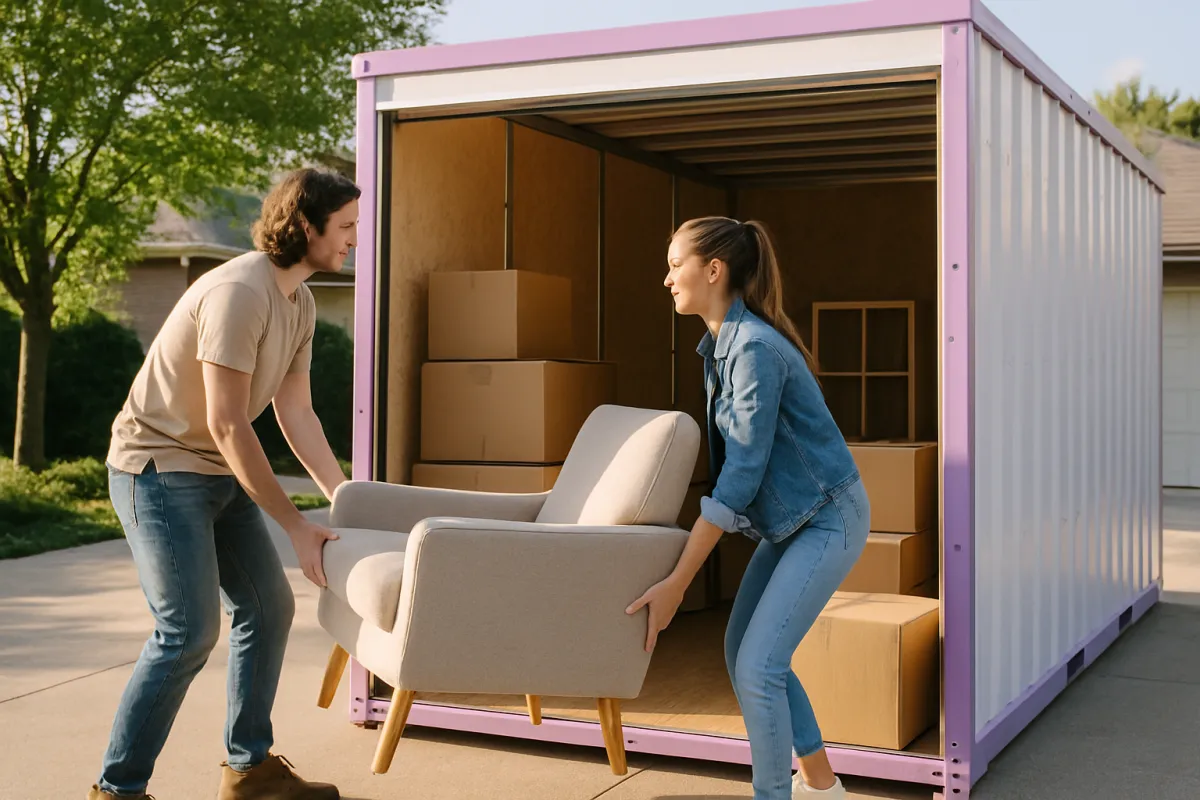
The size you rent only works if the packing claims it. Load in zones, back to front by need: the never-touch layer deep, the maybe layer in the middle, and anything you expect to want inside the door. Build box walls in uniform sizes, heavy on the floor and light on top, and lock them against furniture so nothing leans free. Stand mattresses, sofas, and tabletops on end along the walls, fill every drawer and appliance cavity with soft goods, and keep an aisle only if you decided to pay for one.
Protection is part of density. Furniture pads let pieces touch without damage, which is what allows tight loads; bare wood cannot ride against bare wood. Boxes filled completely stack without crushing, so top off part-full boxes with paper. Keep a copy of the inventory taped inside the door mapping what sits where, and photograph the packed unit before you lock it, both for retrieval and for any insurance conversation. The supplies, box-building, and wrapping technique behind all of this live in our 8-step packing method, and the room-by-room order comes from the packing checklist.
Common mistakes when picking a storage unit size
Most sizing regret comes from a short, repeatable list. The pattern behind nearly all of it is deciding from the label instead of from an inventory, and paying monthly for the difference.
- Renting on bedroom count alone. The shorthand is a shortlist, not an answer; furnishing weight and partial loads move it a full tier either way.
- Buying a size for a one-day problem. Renters grab the bigger unit because loading day feels risky, then hold the extra tier for a year. Solve loading day with packing, not twelve months of rent.
- Ignoring the ceiling. Two units with the same floor and different heights differ by hundreds of cubic feet; ask, and stack.
- Splitting into two small units. The per-square-foot math punishes small labels, so two 5x10s cost meaningfully more than the 10x10 they equal.
- Conditioning the whole load. Paying the climate premium on tools and bins wastes it; split sensitive from rugged and condition only the small unit.
- Forgetting the door. A sofa that fits the floor but not the roll-up door does not fit the unit; check door width and height for the biggest piece.
- Never revisiting the size. Loads shrink as stays resolve; downsizing a half-empty unit one tier saves an illustrative $20 to $60 every remaining month.
Every one of these is avoidable with the inventory method and ten minutes of honest questions, which is exactly the point of running them before the lease, not after.
A worked example: sizing a two-bedroom move
Run the method on one realistic case. A household leaving a two-bedroom apartment has a six-month gap before their next home. The inventory lists two bedroom sets, a sofa and armchair, a dining table and four chairs, a refrigerator and washer, a grill, a patio set, and about fifty boxes. On bedroom shorthand that is a 10x15, and with everything going in as listed, the shorthand is right: the furniture and two appliances fill the walls and the boxes stack the middle, an illustrative $190 a month, $1,140 over the stay.
Then they run the declutter pass. The patio set and grill sell, the armchair is donated, the box count drops to forty after a closet purge, and the load loses about a third of its bulk. The survivors now match the 10x10 profile: one appliance wall, disassembled beds and table standing on end, boxes four high with no aisle since the unit stays sealed until move-in. The rate drops to an illustrative $150, the six-month total to $900, and the sale proceeds offset part of it.
The saving, $240 plus proceeds, is honest but not the headline. The headline is confidence: without the inventory, this household books the 10x15 “to be safe” or gambles on the 10x10 and finds out at the door. With it, they know the 10x10 fits before signing, and they know exactly which items bought the smaller label. That is the whole method: list, sort, shed, then size, in that order.
Run your own storage unit sizing
Everything above collapses into three inputs you already know: how big your home is, how much of it is actually going into storage, and how long the stay runs. Start from the bedroom shorthand to shortlist two sizes, build the twenty-minute inventory to pick between them, run the declutter pass to see whether the load drops a tier, and put the winning size’s rate times your months into the move budget as a real line item.
The companion beside this article runs the arithmetic live. Set your home size, the share of belongings headed to storage, and your months, and it returns the floor area your load implies, the standard unit size that fits it, an illustrative monthly rate and total for the stay, the per-square-foot figure so you can see the small-unit tax, and a sizing note on whether shedding a third of the load would drop you a tier. Move the share slider and watch the recommended label change; stretch the months and watch the total argue for a harder declutter. Pair it with the calculator for the salary side of the relocation, and with our moving-budget roadmap for where the storage line lands among the rest of the move.
The bottom line
Storage unit sizes run a seven-step menu from the 25-square-foot 5x5 to the 300-square-foot 10x30, and the honest mapping is simpler than the labels suggest: a closet’s worth takes a 5x5, a studio a 5x10, a one-bedroom a 10x10, a two-bedroom a 10x15, and a house a 10x20 or larger. Capacity is cubic feet, not floor area, so ceiling height, disassembled furniture, and stacked boxes are worth most of a size tier, and the per-square-foot math means small units carry the highest unit price while empty space at any price is the only real waste. Estimate from an inventory rather than the bedroom count, declutter before you size, split sensitive items into a small conditioned unit when climate matters, and name the reason for any extra space you rent. Do that and the monthly bill matches the load, which is the entire game. For the adjacent calls, our climate-controlled storage breakdown, car storage breakdown, and moving-budget roadmap carry the decision the rest of the way.
The ReloPeak desk publishes this breakdown for general education about how storage sizing works, not as storage, moving, or financial advice, and it endorses no facility, brand, or company. All rates, per-square-foot figures, capacity mappings, and the worked example are illustrative constructions built to show the relationships between sizes, not predictions of what any facility will quote you; actual prices, dimensions, ceiling heights, door openings, and availability differ by market, building, and season. Measure your own belongings, confirm a unit’s real dimensions and lease terms in person, and get current quotes from several local facilities before renting, since the right size for your household can only be settled against your actual inventory.
Frequently asked questions
What are the standard storage unit sizes?
Most facilities rent from a standard menu of storage unit sizes: 5x5, 5x10, 5x15, 10x10, 10x15, 10x20, and 10x30, with the two numbers giving the width and depth of the floor in feet. A 5x5 is 25 square feet, about a walk-in closet, while a 10x30 is 300 square feet, closer to a long garage. Some facilities also offer lockers smaller than a 5x5 and odd in-between footprints, but the seven standard sizes cover nearly every household need. Ceiling heights commonly run around eight feet, so each size holds far more than its floor area suggests once you stack. The right way to read the menu is by what each footprint holds, a closet, a room, an apartment, a house, rather than by the raw dimensions alone.
What size storage unit do I need for a one-bedroom apartment?
A 10x10 storage unit is the size most often matched to the full contents of a one-bedroom apartment: a mattress and bed frame, a sofa, a table and chairs, an appliance or two, and a few dozen boxes, packed with reasonable care. As rough guides often cited, a studio's essentials usually fit a 5x10, while a decluttered one-bedroom that sheds a sofa or an appliance can sometimes squeeze into a 5x15. The honest answer depends on how much furniture you own and how densely you pack, so list your large items before you rent rather than booking on the label alone. If the inventory lands near a boundary, the deciding factors are ceiling height, how well your furniture disassembles, and whether you need to reach anything mid-stay.
How big is a 10x10 storage unit and what fits in it?
A 10x10 storage unit is 100 square feet of floor, roughly half a one-car garage, and with a typical ceiling around eight feet it offers about 800 cubic feet of usable volume. In practice that holds the contents of a one-bedroom apartment: a queen bed, a sofa, a dresser, a dining set, a washer or refrigerator, and boxes stacked along the walls. Packed tightly with disassembled furniture it can stretch to a small two-bedroom's worth, though at the cost of any walkway inside. It is the most commonly rented size because it sits at the point where whole-apartment moves become possible, and on illustrative rates its cost per square foot is lower than any of the smaller units.
What fits in a 5x5 storage unit?
A 5x5 storage unit is 25 square feet, about the footprint of a walk-in closet, and it holds more than most people expect once boxes are stacked toward an eight-foot ceiling. Typical loads are a few dozen small boxes, a dresser or bookshelf, a desk and chair, seasonal decorations, camping gear, or the overflow from a dorm room or small office. It will not take a sofa, a mattress larger than a twin, or a full room of furniture. The 5x5 is the classic between-moves and overflow size: cheap in absolute dollars, though on illustrative rates it carries the highest cost per square foot on the menu, which is the quiet tax on renting small.
What size storage unit holds a two-bedroom or three-bedroom home?
As commonly cited guides, the full contents of a two-bedroom apartment usually call for a 10x15, and a three-bedroom home steps up to a 10x20, with a 10x25 or 10x30 covering four or more bedrooms. The ranges are wide because households differ: a lightly furnished two-bedroom that has been decluttered can drop to a 10x10, while a two-bedroom with a garage's worth of tools and patio furniture can overflow a 10x15. The reliable method is to inventory the large furniture, count boxes by room, and then match the total against the size chart rather than guessing from bedroom count alone. When the estimate lands between sizes, a serious declutter is usually worth one full tier.
How much does each storage unit size cost?
On illustrative national-typical figures, monthly rates commonly run something like $75 for a 5x5, $110 for a 5x10, $130 for a 5x15, $150 for a 10x10, $190 for a 10x15, $230 for a 10x20, and $290 for a 10x30, with real prices varying widely by market, facility, and season. Two patterns hold almost everywhere. Bigger units cost more in absolute dollars but less per square foot, so a 10x10 at an illustrative $1.50 per square foot is half the unit price of a 5x5 at $3.00. And features stack on top of size: climate control, drive-up access, and ground-floor placement each move the rate. Treat every figure as a starting estimate and collect two or three local quotes before you sign.
Should I rent a bigger storage unit than I think I need?
Round up half a size in judgment, not a full size in rent, is the practical rule. An overstuffed unit is genuinely worse than a slightly roomy one: you cannot reach anything without unloading, tall stacks become unstable, and loading day turns into a puzzle. But jumping a full tier just in case adds an illustrative $30 to $60 a month that compounds over a long stay. The better path is to make the estimate honest first: inventory the large items, declutter hard, and plan to stack toward the ceiling. Then choose the size that fits the real load with a modest margin, and reserve extra space deliberately only if you know you will need a walkway to reach things mid-stay.
Does ceiling height matter when choosing a storage unit size?
Ceiling height matters a great deal, because the floor dimensions only tell half the story: a unit's real capacity is cubic feet, and stacking is how you claim it. Most units run somewhere around eight-foot ceilings, so a 10x10 offers roughly 800 cubic feet, not 100 square feet of single-layer floor space. A renter who stacks sturdy boxes high, stands mattresses and sofas on end, and disassembles furniture can often fit a load one label size smaller than a renter who lays everything flat. Ask the facility for the actual height, since it varies, and pack with it in mind: heavy boxes low, light boxes high, and tall furniture upright along the walls.