
What's in this roadmap
- What “one-way” actually means for a truck rental
- Why a one-way price is a flat rate, not a day rate times days
- The reservation guarantee: what it promises and what it does not
- Why the same route can price differently in each direction
- What goes into a one-way quote: the five real inputs
- Truck size and how it changes the one-way number
- Distance and the mileage allowance bundled into the rate
- Days allowed, and what happens if you need more
- Fuel on a one-way move: filling up before you turn it in
- Protection plans on a long one-way drive
- Equipment: dollies, pads, furniture straps, and tow equipment
- Towing a car behind a one-way rental
- Environmental fees, taxes, and the smaller surcharges
- Using the calculator: how this page estimates your one-way total
- A worked example: a 1,000 mile one-way estimate
- A worked example: a 2,500 mile cross-country estimate
- How to get the real quote instead of the estimate
- Booking windows and why early beats late on a one-way
- One-way truck rental versus shipping your belongings
- One-way truck rental versus a one-way portable container
- Common mistakes when estimating a one-way move
- Questions to ask before you lock in a one-way reservation
- Can you add a stop on a one-way route?
- Reading a one-way contract before you sign
- When a one-way rental is clearly the wrong choice
- The bottom line
Short answer: A one-way U-Haul-style rental is priced as a single flat rate per truck size and route, bundling a mileage allowance and a day allowance, not a daily rate times the number of days. Illustratively a 1,000 mile route in a 20 foot truck lands near $1,470 for truck and fuel alone, and near $1,740 with a car towed and an optional protection plan, while a 2,500 mile cross-country move in a 26 foot truck lands near $4,360 with a car trailer added.
A one-way quote looks like a single number, and that is exactly what makes it hard to estimate on your own. Unlike a local rental, where a daily rate and a per-mile charge are both visible and easy to multiply, a one-way flat rate arrives as one figure that already has everything folded into it: the truck, an allowance of miles, and an allowance of days, priced together for your specific route.
This roadmap takes that single number apart. It walks through what actually goes into a one-way quote, why the identical route can price differently depending on which direction you are driving, and how to build your own estimate before you call for the real one. ReloPeak’s broader truck rental roadmap covers local pricing and the full local-versus-one-way comparison in depth; this page stays focused on the one-way number itself, and the calculator turns the same model into your own estimate as you read.
Key takeaways
- A one-way rental is priced as a flat rate per truck size and route, not a daily rate multiplied by days, and it bundles a mileage allowance and a day allowance into that one number.
- The same route can price differently by direction because rental companies have to rebalance their fleet, not because of anything about your specific move.
- Illustratively a 1,000 mile route in a 20 foot truck lands near $1,470 for truck and fuel, and near $1,740 once a tow dolly and protection are added.
- Fuel, towing, protection, equipment, and smaller fees all sit outside the flat rate and have to be added to it separately for an honest total.
- This page's calculator is a planning estimate built from an illustrative model, not a quote. Get the real number from the rental company before you book.
What “one-way” actually means for a truck rental
A one-way rental lets you pick the truck up in one city and drop it off in another, with no obligation to drive it back. That convenience is the entire reason the pricing model is different from a local rental: the rental company has to get that specific truck to wherever the next customer needs it, which is a logistics problem layered on top of simply renting you a vehicle for a few days.
Because of that logistics problem, a one-way rental is not priced the way a local one is. There is no small daily rate plus a per-mile meter running in the background. Instead, the company quotes a single flat number for your specific truck size, origin, destination, and pickup window, built to cover the miles and days a sensible version of your trip would take.
Why a one-way price is a flat rate, not a day rate times days
If you tried to back into a one-way price using a local rental’s daily rate and mileage charge, you would almost always get the wrong number, usually too low. A 1,000 mile drive at a local per-mile rate, multiplied out, frequently prices higher than the real one-way flat rate, because the flat rate is built around the company’s own fleet-positioning needs rather than a simple per-mile meter.
The flat rate also removes a kind of anxiety a local rental carries: you are not watching an odometer tick upward and wondering what the final mileage bill will be. You know the number at booking, and it does not change unless you go meaningfully over the included mileage or day allowance.
The reservation guarantee: what it promises and what it does not
A one-way reservation is typically treated more strictly than a local one, because the company has committed a specific truck to a specific route on a specific date as part of its fleet plan. Some level of guarantee around having a truck available is common in the industry, though the exact terms, any compensation if a guarantee is not met, and the size of truck actually guaranteed versus merely requested can vary and are worth reading in your specific reservation confirmation rather than assuming from this roadmap.
What a reservation generally does not guarantee is the price staying identical if you change your dates or route after booking. A one-way quote is built around a specific origin, destination, and pickup window, and changing any of those three typically triggers a new quote rather than an adjustment to the old one.
Why the same route can price differently in each direction
This is the part of one-way pricing that surprises people the most: the exact same route, same truck size, same week, can cost meaningfully different amounts depending on which direction you are driving. The mechanism is fleet rebalancing. If far more people are moving out of a city than into it during a given season, trucks pile up at the destination end and the company needs to get them moving back, so it prices that direction attractively to encourage bookings. The reverse direction, where trucks are scarce, prices higher because demand for them is real and supply is tight.
This has nothing to do with the distance, the difficulty of the drive, or anything about your specific move. It is a reflection of where other people are moving at the same time you are, which is also why the cheap direction and the expensive direction on a popular corridor can swap depending on the season.

What goes into a one-way quote: the five real inputs
Five things shape a one-way number, and knowing them is what lets you build a reasonable estimate before the rental company gives you the real one. Truck size is the first and largest lever, since the base rate climbs meaningfully at each tier. Distance is the second, since the flat rate scales with the mileage between your origin and destination even though it is not billed per mile the way a local rental is.
Fuel is the third, and it is on you regardless of how the flat rate is built, calculated at whatever the truck’s loaded fuel economy actually is over the real distance driven. Towing a car is the fourth, an optional but common add-on that has its own cost structure entirely separate from the truck rate. And protection, equipment, and smaller fees make up the fifth, rounding out the honest total the same way they do on a local rental.
Truck size and how it changes the one-way number
Truck size affects a one-way quote through two channels at once: a larger truck has a higher base rate built into the flat price, and a larger truck also burns more fuel over the same distance. Both effects point the same direction, so the gap between the smallest and largest tier on a one-way route is noticeably wider than the gap on a single local day.
Illustratively, modeling a 1,000 mile route with no car towed, a 10 foot truck lands near $1,050, a 15 foot truck near $1,270, a 20 foot truck near $1,470, and a 26 foot truck near $1,744. Sizing correctly matters more on a one-way move than on a local one, simply because every dollar of oversizing gets multiplied by a thousand miles instead of twenty.
Illustrative one-way total by truck size, 1,000 mile route
Base one-way rate plus fuel only, no car towed, no add-on protection plan. Illustrative planning frames, not quotes.
Almost $700 separates the smallest and largest tier at 1,000 miles, before a tow dolly, equipment, or a protection plan are added to any of them.
Distance and the mileage allowance bundled into the rate
The mileage allowance bundled into a one-way flat rate is sized to a reasonable route between your origin and destination, typically close to the actual driving distance with some cushion for a sensible route rather than the absolute shortest path. Driving well beyond that, through a long detour or an indirect route, can trigger a mileage overage charge, so the allowance is generous but not unlimited.
The base rate itself climbs with distance in a way that is steep at first and flattens out somewhat on very long routes, which is why the per-mile cost of a long cross-country move often looks better than the per-mile cost of a medium-distance one once you divide the total by the miles. That does not mean long moves are cheap, only that the rate structure rewards distance less harshly than a pure per-mile model would.
Days allowed, and what happens if you need more
The day allowance bundled into a one-way rate scales with distance and is meant to cover a realistic highway pace plus time to load and unload, not a sprint with no margin. Illustratively a 500 mile route might allow around 3 to 4 days, a 1,000 mile route around 4 days, and a 2,500 mile cross-country route around 7 days, calculated from a planning pace of roughly 450 miles of driving per allowed day.
Going over the day allowance typically adds a per-day charge, so building in your real schedule, including a planned rest day or a stop to see family along the route, matters before you book rather than after you are already behind the allowance. If your plan genuinely needs extra days, ask about the per-day overage charge before you commit, since it is usually cheaper to book the time honestly than to pay the overage after the fact.
Fuel on a one-way move: filling up before you turn it in
Fuel on a one-way rental works the same way it does locally: you return the truck at the fuel level it was handed to you at, usually close to full, and anything short of that is refilled by the counter at a premium rate plus a service charge. On a long one-way route this is a real dollar amount, not a rounding error, since a loaded truck’s fuel economy is meaningfully worse than a car’s across any tier.
Illustratively, a 20 foot truck at roughly 9 miles per gallon over 1,000 miles burns around 111 gallons, which at an illustrative $3.60 a gallon is close to $400, nearly a third of the whole one-way total before towing or protection are added. Planning fuel stops along the actual route, rather than assuming you will find one whenever needed, matters more in a large truck than in a car, since not every station can accommodate one safely.
Protection plans on a long one-way drive
The case for an optional protection plan is generally stronger on a long one-way drive than on a short local one, simply because more miles and more days mean more exposure to the kind of incident a plan is meant to cover. As with local rentals, the exact plan names, coverage, and price are set by the rental company and change over time, so read the current plan document rather than trusting a general description of what “protection” means.
Before buying a plan at the counter, check your own auto policy and your credit card’s rental benefits the same way you would for a local rental, since the exclusions that apply to box trucks locally apply on a one-way route too. The stakes are simply higher on a drive that might span several states and several days.
Equipment: dollies, pads, furniture straps, and tow equipment
Equipment needs on a one-way move are usually larger than on a local one, both because the load is often a full household rather than a partial one and because a multi-day drive means the load has more opportunity to shift if it is not well secured. Furniture pads, a hand truck, and furniture straps remain close to non-negotiable, and our truck loading roadmap covers the load order that keeps a long drive’s cargo intact.
If you are towing a car, tow equipment is rented separately from the truck itself and is priced on its own, covered in detail in the next section. Check the ramp and ask about weight limits for both the truck and any tow equipment before you book, since not every combination of truck size and car weight is compatible.
Towing a car behind a one-way rental
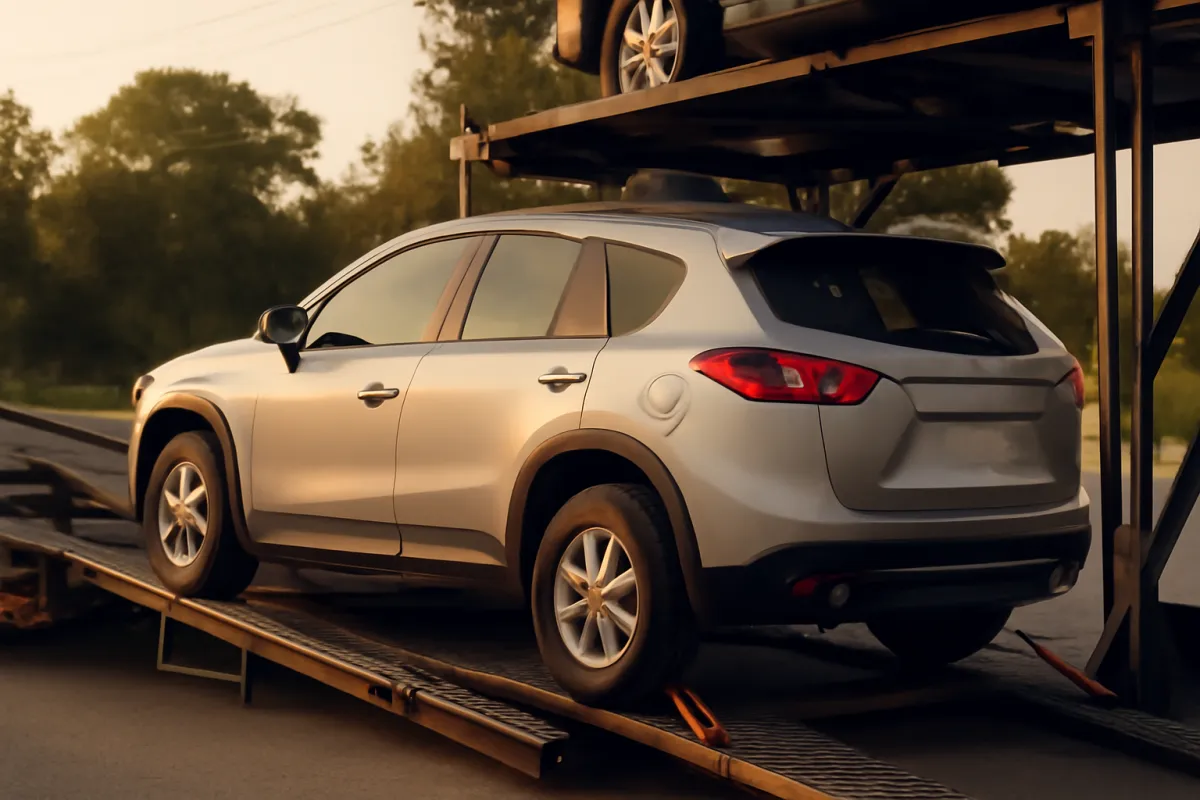
Towing a car is one of the more consequential add-on decisions on a one-way move, both for cost and for how the drive actually feels. A tow dolly lifts the front wheels and is the cheaper option; a car trailer carries all four wheels and costs more but is gentler on the towed vehicle and compatible with a wider range of cars, including some that cannot be towed with their drive wheels on the ground.
Illustratively, a tow dolly on a 1,000 mile route runs near $230 and a car trailer near $350, both scaling with distance beyond a base charge. Compare either against roughly $800 to ship the same car on a commercial carrier over the same distance, and towing wins on cash in almost every case, at the cost of slower stops, reduced fuel economy, and the loss of reversing as a practical option with a dolly attached.
Environmental fees, taxes, and the smaller surcharges
Beyond the base rate, fuel, towing, protection, and equipment, a handful of smaller line items round out a one-way total: an environmental or vehicle license recovery surcharge, applicable local or state taxes, and any processing fee tied to the specific payment method used. None of these are large individually, but they are also not optional, and a quote that looks suspiciously round is usually a quote that has not had them added yet.
Illustratively these smaller items might add up to somewhere near $20 to $40 on a long one-way move, small against the total but worth asking about explicitly when you get your quote, so the written total you compare against another brand actually includes everything rather than only the headline number.
Using the calculator: how this page estimates your one-way total
The calculator on this page works from the same five inputs described above: truck size, distance, whether a car is towed and how, and whether an add-on protection plan is included. It estimates a base one-way rate that scales with both truck size and distance, adds fuel calculated from that truck’s illustrative fuel economy over your distance, adds towing cost if selected, and adds a protection plan cost scaled to the estimated number of rental days.
Every constant inside it, the base rate by size, the fuel economy figures, the tow costs, is an illustrative planning figure built to show how a one-way total is actually assembled, not a live feed from any rental company’s pricing system. Use it to understand which lever, size, distance, or towing, moves your total the most, then take that understanding into the real quote conversation.

A worked example: a 1,000 mile one-way estimate
A 20 foot truck, 1,000 miles, with a car towed on a dolly and an add-on protection plan included. The base one-way rate is illustratively $1,070. Fuel at 9 miles per gallon over 1,000 miles is near $400. The tow dolly over that distance is near $230. A protection plan across an estimated 4 rental days at an illustrative $10 a day is near $40. The total comes to roughly $1,740.
Where an illustrative 1,000 mile, 20 foot one-way total goes
Car towed on a dolly, add-on protection plan included, 4 estimated rental days. Illustrative shares; yours will differ by size, distance, and towing choice.
Fuel is nearly a quarter of this total on its own, more than the tow dolly and the protection plan combined.
A worked example: a 2,500 mile cross-country estimate
A 26 foot truck, 2,500 miles, with a car trailer and an add-on protection plan. The base one-way rate is illustratively $2,505. Fuel at 7 miles per gallon over 2,500 miles is near $1,286. The car trailer over that distance is near $500. A protection plan across an estimated 7 rental days at an illustrative $10 a day is near $70. The total comes to roughly $4,360.
Notice how the shape of the bill shifts at this distance compared to the 1,000 mile example. Fuel climbs toward a third of the total rather than a quarter, because the largest truck’s poor fuel economy compounds over a much longer distance, while the base rate’s share shrinks slightly even though its dollar amount is far larger. This is a pattern worth knowing before you budget a cross-country move: the longer the route, the more fuel deserves your attention relative to the headline rate.
How to get the real quote instead of the estimate
This page’s calculator and worked examples exist to teach the mechanism and give you a planning range, not to replace an actual quote. To get the real number, contact the rental company directly with your exact origin, destination, truck size, and preferred pickup window, and ask for the total in writing, broken into the base rate, included mileage and days, and any add-ons you are considering.
Ask specifically what happens if you go over the mileage or day allowance, what the current protection plan options and prices are, and what the fuel return policy is, since all three are common sources of a final bill that surprises people who only budgeted the headline flat rate. Our moving company comparison roadmap applies the same written-quote discipline to full-service movers, and the habit transfers directly here.

Booking windows and why early beats late on a one-way
One-way availability is a harder constraint than price, because a rental company can only offer a truck that is physically positioned in your city. Popular outbound routes in peak season, typically late spring through early autumn, can sell out of the size you actually want, leaving a caller who waited with a smaller truck than needed or a pickup date several days later than planned.
Booking four to six weeks ahead for a peak-season one-way move is less about getting the best price and more about getting the size and date you actually need, since a late booking frequently means taking whatever is left rather than choosing from the full range. If your dates are flexible, asking about a nearby pickup location can also surface availability the closest branch does not have.
One-way truck rental versus shipping your belongings
An alternative to driving a one-way truck yourself is shipping your belongings through a freight or less-than-truckload service, where your items are loaded into a shared or dedicated trailer and driven by someone else. This removes the driving entirely but usually costs more than a self-driven one-way rental and requires your items to be packed into a format, often a wooden crate or a specific container, that the shipping service can handle.
This option tends to make the most sense when you genuinely cannot or do not want to drive the distance yourself, rather than as a routine cost-saving alternative to a one-way truck. Price it alongside your one-way estimate if driving a large truck a long distance is a real concern rather than an inconvenience, and ask specifically how your items will be packed, handled, and insured in transit before you commit to this option over a self-driven rental.
One-way truck rental versus a one-way portable container
A portable moving container is loaded at your home, picked up by a truck you never drive, and delivered to your new address on its own schedule. It removes the driving problem entirely, at a price that is usually higher in cash terms than a self-driven one-way truck but lower in terms of your own time and risk, since you load the container and someone else transports it.
The honest comparison is your total one-way estimate from this page, including fuel, towing, and protection, against a container company’s quote for the same distance and a reasonable container size for your household, with your own driving time and discomfort priced in at whatever hourly rate feels honest to you. Neither option is categorically right, and the choice usually comes down to how much the actual driving is worth avoiding.
Common mistakes when estimating a one-way move
Pricing only the base rate and ignoring fuel, which on a long route is frequently the second largest line after the truck rate itself. Assuming the day allowance is generous enough for a leisurely pace with sightseeing stops, when it is typically built around a steady highway pace instead. Comparing one direction’s price to the opposite direction’s price as if the route should cost the same both ways, when fleet rebalancing makes that an unreliable assumption.
Forgetting towing or shipping costs entirely when a car is part of the move, which can add several hundred dollars that never appeared in the headline flat rate. And booking late in peak season, which risks losing the size or date you actually need rather than just paying more for the one you get.
Questions to ask before you lock in a one-way reservation
Ask what the exact mileage and day allowances are for your specific quote, not the general range described in this roadmap. Ask what the overage charge is for each, in case your real route or schedule runs longer than expected. Ask what the current protection plan options cost and what they actually cover, and ask what the fuel return policy is and where the nearest return-adjacent fuel stop tends to be.
Ask, finally, whether the quoted price is guaranteed once you book or subject to change if your exact pickup date or location shifts even slightly, since a one-way quote tied tightly to a specific window can move if your plans do. Getting clear answers to all five before you commit is the difference between the number you budgeted and the number you actually pay, and it costs nothing but a phone call to ask every one of them before you sign anything.
Can you add a stop on a one-way route?
A one-way rental is built around a single origin and a single destination, and the mileage and day allowances are sized to that specific pair of addresses. Adding a meaningful detour, such as a stop at a storage facility in a different city or a visit to family well off the direct route, adds real miles that the original allowance was not sized to cover, and it can push a trip that would otherwise land comfortably inside the included mileage into overage territory.
A short stop close to the direct route, a meal, a fuel fill-up, an overnight at a hotel along the way, generally does not meaningfully change the mileage math, since it is already implicitly covered inside the reasonable-route allowance described earlier. The distinction that matters is miles, not time. Spending an extra night near the direct route costs you a day against the allowance but not necessarily extra miles, while driving two hundred miles out of the way to pick something up costs both.
If a genuine detour is part of your plan, the honest approach is to calculate the real total distance including the detour and use that larger number when estimating with the calculator on this page, rather than the direct-route distance between your two main addresses. It is also worth asking the rental company directly whether a planned detour changes your specific quote, since a known, disclosed detour handled at booking is a very different conversation than an undisclosed one discovered through a mileage overage at drop-off.
Reading a one-way contract before you sign
The paperwork handed over at pickup is where the estimate you built becomes a real, binding number, and it is worth reading closely rather than skimming to the signature line. Confirm the truck size matches what you reserved, since a last-minute substitution to a different size changes the math behind the price you agreed to. Confirm the mileage allowance and day allowance printed on the contract match what you were quoted, since these are the two numbers an overage charge is measured against, and a mismatch caught after you drive away is far harder to fix than one caught at the counter.
Check the fuel level noted on the contract against the gauge yourself before you leave the lot, and photograph both, along with the exterior panels and the odometer reading. This is the same discipline that matters on a local rental, and it matters more here because a dispute over pre-existing damage or a fuel level discrepancy on a multi-day drive is harder to resolve after the fact than one from a same-day local rental. Our damage claim roadmap covers why documentation, not memory, is what decides these disputes.
Finally, confirm the drop-off location and its hours before you leave, not after you arrive. A one-way rental is tied to a specific return location as part of the fleet plan behind the price, and arriving at a location that is closed, or at the wrong location entirely, can turn a straightforward return into an unplanned extra day with its own charge attached.
When a one-way rental is clearly the wrong choice
A self-driven one-way rental is not the right tool for every long-distance move, and recognizing when it is not can save more than any amount of careful pricing. A household with no comfortable, confident driver for a large truck over multiple days and several states is a real constraint, not a minor inconvenience, and pushing through it anyway raises genuine safety risk on top of the stress of the drive itself.
A route that crosses mountain passes in winter, or that is simply too long to complete within a comfortable version of the included day allowance, is another case worth reconsidering. Our winter moving roadmap treats a loaded box truck’s handling in snow and ice as a real planning input, and a one-way move scheduled into that kind of weather deserves the same caution a local winter move does, amplified by the distance and the unfamiliar roads.
A deadline with no slack in it, where a lease ends or a job starts within a day or two of the planned arrival, also argues against a self-driven one-way rental, since the format has no built-in buffer for a breakdown, a weather delay, or simply needing an extra rest stop. In any of these cases, a full-service long-distance move or a portable container, both covered in the comparisons above, remove the driving risk entirely at a higher cash cost, which is frequently the right trade once safety and deadline pressure are weighed honestly against the savings.
The bottom line
A one-way U-Haul-style rental is priced as a flat rate per truck size and route, bundling a mileage allowance and a day allowance into one number that does not work the way a local daily-rate-plus-mileage rental does. Illustratively a 1,000 mile route in a 20 foot truck lands near $1,470 for the truck and fuel alone, and near $1,740 once a tow dolly and a protection plan are added, while a 2,500 mile cross-country move in a 26 foot truck with a car trailer lands near $4,360. Fuel is consistently the second largest line after the base rate and grows in importance the longer the route gets. Size the truck to your real belongings, ask for every allowance and overage charge in writing, and use the calculator on this page to see how size, distance, and towing each move your own total before you call for the real quote. For the full local-versus-one-way comparison and the mechanics of local pricing, see our moving truck rental roadmap.
ReloPeak publishes this roadmap as general education about how one-way truck rental pricing is commonly structured across the national market, not as a quote, an endorsement, or an official price list for any specific company. Every dollar figure, mileage allowance, day allowance, and fuel economy band in it was chosen to illustrate the shape of a one-way bill rather than to predict yours, and real one-way prices vary by route, direction, date, demand, and current promotions. Confirm your exact allowances, fees, and total with the rental company before booking, confirm your own insurance coverage with your insurer and your card issuer, and read the rental agreement in full before signing.
Frequently asked questions
How much does a one-way U-Haul-style rental cost?
It depends on truck size, distance, and the route, because one-way pricing is a single flat rate rather than a daily rate times days. Illustratively, modeling the kind of structure national truck rental brands commonly use, a 1,000 mile route in a 20 foot truck might land near $1,470 for the truck and fuel alone, and near $1,740 once a tow dolly and an optional protection plan are added. Those are illustrative planning frames, not quotes, and the real number for your route and date should come from the rental company directly.
Why is a one-way U-Haul-style rental more expensive in one direction than the other?
Rental companies run a fleet-rebalancing problem behind the scenes: trucks need to end up where the next renter needs them, not just where the current renter is finished with them. A route running against the seasonal flow of trucks, for example out of a city many people are leaving toward one fewer people are moving to, is typically priced lower to encourage bookings, while the reverse direction on the same road can price meaningfully higher. This is a structural feature of one-way pricing, not a pricing error, and it can make the same move cost quite differently depending on which way you are going.
Does a one-way U-Haul-style rental include free mileage?
Yes, a one-way flat rate is built to include a mileage allowance sized to a reasonable route between your origin and destination, along with a number of rental days meant to cover a sensible driving pace plus loading and unloading time. Driving meaningfully more miles than the allowance, for example by taking a long detour, can trigger an overage charge, so the allowance is generous for the direct route but not unlimited.
How many days do you get for a one-way truck rental?
The day allowance scales with distance and is meant to cover realistic highway driving plus time to load and unload, not a sprint. Illustratively a 500 mile route might allow around 3 to 4 days, a 1,000 mile route around 4 days, and a 2,500 mile cross-country route around 7 days. These are illustrative planning ranges built from a reasonable daily driving pace, not a specific company's published allowance, so confirm the exact day count attached to your actual quote.
What is included in a one-way quote besides the truck itself?
The flat rate covers the truck, its included mileage allowance, and its included day allowance. It typically does not include fuel, which you buy and return the tank full for, protection plans, equipment like a dolly or furniture pads, tow equipment if you are bringing a car, or smaller fees like an environmental surcharge. Pricing a one-way move accurately means adding all of these to the flat rate rather than treating the flat rate as the whole cost.
Is it cheaper to tow a car or ship it separately on a one-way move?
In cash terms, towing is usually cheaper. Illustratively a tow dolly on a 1,000 mile route runs near $230 and a car trailer near $350, against roughly $800 to ship the same car on a commercial car carrier. Towing adds real cost and real driving difficulty of its own, including reduced fuel economy and a longer stopping distance, so the cash savings should be weighed against your comfort driving a loaded truck with a car behind it for the full distance.
Can this calculator replace a real U-Haul-style quote?
No. It is built to teach the mechanism, truck size, distance, fuel, towing, and protection, so you understand what drives a one-way total up or down, and to give you a reasonable planning estimate before you call. The real quote depends on live inventory, your specific route, your exact dates, and current promotions, none of which this page has access to, so always get the actual number from the rental company before you book or budget against it as final.