
What's in this roadmap
- What a 2-bedroom move actually costs
- Why a 2-bedroom sits between the small and the big movers
- The local hourly model for a 2-bedroom apartment
- Local 2-bedroom cost by crew size and hours
- The long-distance model: weight times distance
- How much a 2-bedroom household weighs
- Illustrative 2-bedroom cost by distance
- The local vs long-distance crossover
- DIY truck rental vs full-service for a 2-bedroom
- Moving pods and containers for a 2-bedroom
- When full-service earns its premium on a 2-bedroom
- Renters insurance and your 2-bedroom move
- Where a full-service 2-bedroom bill goes
- Packing services for a 2-bedroom apartment
- Binding vs non-binding estimates on a mid-size move
- Valuation coverage and tipping on a 2-bedroom move
- What drives a 2-bedroom move cost up
- Comparing a 2-bedroom to the rest of the home-size ladder
- The gap between leases: storage in transit for a 2-bedroom
- The cheapest time of year to move a 2-bedroom
- Red flags: rogue movers and deposit scams on a mid-size move
- How to cut a 2-bedroom move cost
- A worked example: one 2BR local, one 2BR long-distance
- The bottom line
Short answer: Illustratively, a local 2-bedroom move runs roughly $550 to $1,100 with a two or three-person crew for four to six hours, while a long-distance move prices on weight times distance: a roughly 5,000-pound two-bedroom household runs near $4,400 at 500 miles, $6,000 at 1,000 miles, and $10,900 at 2,500 miles full-service, with a container near $3,500 and an honest DIY total near $2,000 at 1,000 miles.
How much do movers cost for a 2-bedroom apartment? It sits in the awkward middle of the home-size ladder: too much furniture for the smallest crew and the shortest hourly job, not yet the full-day, multi-room project a house becomes. That middle spot is exactly where quotes get confusing, because a 2-bedroom is the size where a household first has to seriously weigh full-service against a container against a rented truck, rather than defaulting to whichever is simplest.
This roadmap prices a 2-bedroom move specifically: the local crew-hour math, the long-distance weight-times-distance model and what a two-bedroom household actually weighs, the full spectrum from full-service to container to DIY, packing add-ons sized for this home, and a worked example that runs one 2-bedroom move locally and one long-distance. It sits between our 1-bedroom roadmap and our 3-bedroom roadmap, and alongside our broader moving-cost roadmap, which prices every home size side by side. The calculator prices your own crew, miles, and strategy live while you read.
Key takeaways
- A local 2-bedroom move is billed by the crew-hour, and illustratively runs roughly $550 to $1,100 for a two or three-person crew working four to six hours plus travel.
- Long-distance pricing runs on weight times distance instead: a roughly 5,000-pound two-bedroom household prices near $4,400 at 500 miles and near $10,900 at 2,500 miles full-service.
- A 2-bedroom household commonly weighs around 5,000 pounds illustratively, the engine behind every long-distance quote.
- A container commonly costs 35 to 45 percent less than full-service, and DIY costs less still, near $2,000 at 1,000 miles once fuel and the road are honestly counted.
- Full packing service adds roughly $700 illustratively for a home this size, and a binding estimate protects a two-bedroom shipment just as it protects a larger one.
What a 2-bedroom move actually costs
Start with the direct answer, then earn it across the rest of this roadmap. Illustratively, a local 2-bedroom move commonly lands somewhere around $550 to $1,100, priced as a two or three-person crew working four to six hours plus a travel fee. A long-distance move of the same home is a different order of magnitude because it is priced on weight and miles instead: near $4,400 at 500 miles and climbing to near $10,900 at 2,500 miles full-service, all illustrative.
Those two figures look unrelated because they are. The local number is a labor purchase measured in hours; the long-distance number is a freight purchase measured in pounds and miles. The rest of this roadmap takes both machines apart so the number you budget is one you built from your own rooms, your own miles, and your own strategy, not an average published for an apartment that is not yours.
Why a 2-bedroom sits between the small and the big movers
A 2-bedroom is the pivot point on the home-size ladder, and it helps to see why before the numbers arrive. A studio or one-bedroom is a quick local job for two people; a three-bedroom house is a full-day project for a larger crew with a garage and an attic to account for. A 2-bedroom has genuinely grown past the first category, with a second bedroom’s worth of furniture and often a dedicated living and dining split, but it has not yet grown into the second, which is why a crew of two or three, rather than three or four, usually handles it.
That middle position cuts both ways on strategy, too. A 2-bedroom is light enough that container and DIY options are genuinely competitive on labor, unlike a house where the physical toll of self-loading climbs fast, but heavy enough that a full day of friends-and-a-truck is no longer the obvious default the way it often is for a first apartment. The choice of strategy matters more here than at either end of the ladder, which is the thread this roadmap follows.
The local hourly model for a 2-bedroom apartment
A local move of any size is a labor purchase, billed by the hour, per crew, with the clock running from arrival until the last box is down. The core unit is the mover-hour, and companies commonly charge somewhere around $55 per mover per hour illustratively. For a 2-bedroom that usually means a two-person crew for a lighter unit and a three-person crew once the second bedroom, a dining set, and a fuller living room enter the picture.

Two mechanics shape the local bill on a mid-size move. Minimums: most companies bill at least three or four hours regardless of how quickly the job goes, which rarely bites a 2-bedroom since the job commonly runs that long anyway. Travel charges: crews bill for reaching you, either as a flat fee or as double drive time, and that fee is a meaningful share of the total on a job this size. Neither is a scam, but both belong in any comparison between quotes.
Local 2-bedroom cost by crew size and hours
Because local billing is hourly, the honest way to estimate a local 2-bedroom move is crew size times hours times rate, plus the travel fee. The table below walks the common combinations on this roadmap’s illustrative model, so you can see where your own apartment is likely to land before a single quote arrives.
| Crew | Hours | Illustrative local cost |
|---|---|---|
| 2 movers | 4 hrs (light 2BR, little furniture) | ~$550 |
| 2 movers | 5 hrs (typical 2BR) | ~$660 |
| 3 movers | 5 hrs (fuller 2BR) | ~$935 |
| 3 movers | 6 hrs (2BR, stairs, or a tight street) | ~$1,100 |
The practical lesson repeats at every home size but shows clearly here: everything boxed, labeled, and staged near the door converts directly into fewer crew-hours, and on a two or three-person crew those saved hours are worth proportionally more than they are on a four-person crew splitting the same savings further. The calculator runs this same crew-hours-rate arithmetic live on your own numbers.
The long-distance model: weight times distance
Cross a state line, or travel more than roughly 50 to 100 miles, and the pricing model changes species entirely, the same shift our out-of-state roadmap covers in full for every home size. Long-distance moves price on two multiplied inputs, how much your belongings weigh and how far they travel, not on hours. The core of the bill is the linehaul charge, and on this roadmap’s illustrative model that works out to roughly $0.55 per pound in base handling plus about $0.65 per pound for each 1,000 miles of distance.

A 2-bedroom household weighs meaningfully more than a one-bedroom, so the long-distance total climbs faster per mile than the smallest apartment’s does, but the underlying formula does not change. The same structure that prices an 8,500-pound three-bedroom prices a 5,000-pound two-bedroom, which is why surveying carefully still pays: every pound shed before the quote is subtracted from a bill that only grows from there.
How much a 2-bedroom household weighs
The number that drives every long-distance quote is your shipment weight, and internalizing the ballpark for a two-bedroom home is worth more than any single price. A typical 2-bedroom household commonly weighs around 5,000 pounds illustratively, sitting above a one-bedroom’s roughly 2,600 pounds and below a three-bedroom’s roughly 8,500. A couple without much accumulated furniture can come in lighter; a 2-bedroom with a home office, a second living area, or a garage’s worth of overflow can run heavier.
When a mover surveys your apartment, by video walkthrough or in person, they are estimating exactly this number, because the scale at the weigh station eventually settles the argument on a non-binding move. Ask directly what weight or cube figure a quote assumes, and make sure it reflects both bedrooms, any closets or storage units attached to the lease, and a garage or balcony storage area the surveyor might glance past.
Illustrative 2-bedroom cost by distance
Distance is the second multiplier, and seeing it laid out for one household explains why a cross-country move costs so much more than a short hop even on a mid-size home. The bars below apply this roadmap’s illustrative full-service model to a single 5,000-pound two-bedroom household at four common distances.
Illustrative 2-bedroom move cost by distance
One 5,000-pound two-bedroom household, full-service. Illustrative totals, not quotes.
Each block of miles adds roughly $0.65 per pound, so a 5,000-pound household keeps climbing steadily with the map, steeper than a one-bedroom's curve and gentler than a house's.
Read the chart the same way as any home size: a base handling charge sits under every move, and on top of it the linehaul adds a nearly constant amount per block of miles. A 2,500-mile move of a two-bedroom is not a little more than a 500-mile one, it runs roughly two and a half times as much, because the distance multiplies a weight that does not change.
The local vs long-distance crossover
Somewhere between across-town and across-the-country, a 2-bedroom move flips from the hourly machine to the freight machine, and the crossover is worth understanding because quotes get confusing right around it. Local rules typically apply within a metro area or roughly under 50 to 100 miles depending on the company and the state. Beyond that, or across a state line, most movers switch to weight-based long-distance pricing.
The practical consequence is that a 2-bedroom move of, say, 150 miles can be quoted either way depending on the company, and the two structures can produce meaningfully different totals for the identical job. Because a two-bedroom’s base handling charge is spread over a mid-size weight, a short long-distance move sometimes looks pricier than expected next to an hourly quote for a similar distance. Ask each company which model it is using and collect quotes structured both ways when the distance sits in that ambiguous middle band.
DIY truck rental vs full-service for a 2-bedroom
The most consequential choice on a 2-bedroom move is still how much labor you buy, and the dollars at stake are real enough to take seriously without yet being house-sized. Full-service means a crew packs, loads, drives, and unloads. DIY means a rented truck and your own hands the whole way, end to end.
Illustratively, a 2-bedroom household moving 1,000 miles runs near $6,000 full-service on this roadmap’s model and near $2,000 as an honestly counted DIY move once fuel at truck consumption rates, the counter insurance, equipment, and a night or two of lodging are included. That is roughly a $4,000 spread on one move, paid entirely in your own back, your own days, and the logistics of driving a box truck you do not normally drive. For a two-bedroom’s worth of furniture, DIY is physically demanding but genuinely doable for a household with the time and the help.
Moving pods and containers for a 2-bedroom
Between full-service and DIY sits the container, and a 2-bedroom is close to the size where this option earns its keep most clearly. A company drops a container in your driveway, you load it on your own schedule over a few days rather than one date, and the company drives it to the new address where you unload.
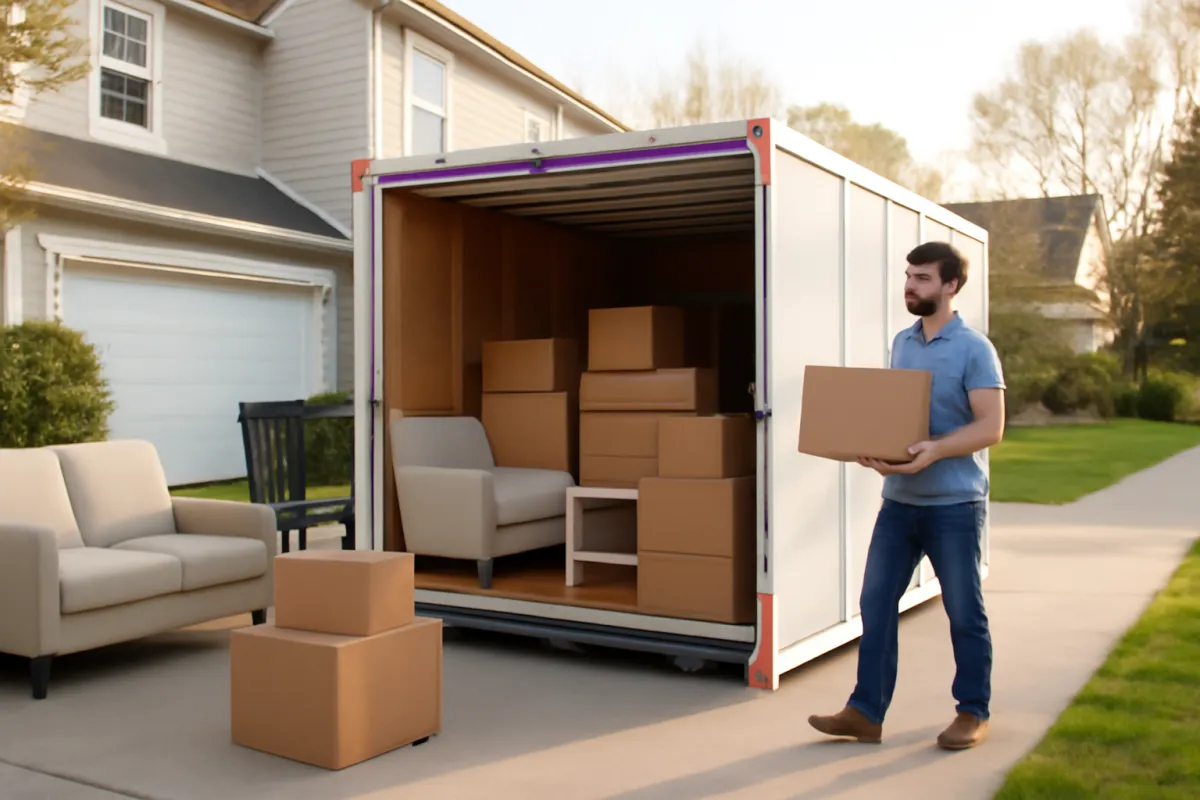
Illustratively, on this roadmap’s model, a 2-bedroom household moving 1,000 miles runs near $3,500 by container, sitting between the $6,000 full-service figure and the $2,000 DIY figure. The container wins on schedule flexibility, since it can sit in the driveway for days rather than demanding a single loading date, and it wins on logistics, since you never drive the long-haul vehicle yourself. What it does not do is remove the physical loading labor, which still falls to you or to hired labor-only help at each end.
When full-service earns its premium on a 2-bedroom
The DIY and container figures above make full-service look like an expensive habit, and sometimes it is. But a 2-bedroom household sits at the point on the size ladder where the labor finally gets heavy enough that the premium buys something real rather than just convenience. A mattress, a sofa, and a dresser from a second bedroom add genuine lifting risk that a studio’s lighter inventory never raises, and two adults loading a 5,000-pound household alone, after work, on a tight timeline, is a different proposition than the same job on a one-bedroom.
Full-service is the right call when the move date cannot flex, when an employer is covering the bill, when anyone in the household has a back, joint, or heart condition that makes heavy lifting unwise, or when the distance is long enough that the drive itself becomes the harder half of a DIY move. It also carries defined liability coverage in a way a container or a borrowed truck does not, which matters more once the shipment includes two bedrooms of furniture and electronics rather than one. Weigh the premium against what a bad outcome, an injury, a missed closing date, a damaged piece with no real recourse, would actually cost, not just against the sticker price of the cheaper options.
Renters insurance and your 2-bedroom move
Valuation coverage from the mover is not the same thing as renters insurance, and a 2-bedroom move is a good moment to confirm both are in place rather than assuming one covers the other. Valuation only protects belongings while the mover physically has them, from pickup to delivery, and it ends the moment the truck leaves. Renters insurance, by contrast, covers your belongings in the new apartment going forward, against fire, theft, and water damage, and on a household with two bedrooms of accumulated belongings the gap between no coverage and basic coverage is larger in dollar terms than it is on a studio.
Many renters let a policy lapse between apartments without noticing, because the old policy is tied to the old address and the new lease does not always demand proof on day one. The gap is easy to close: confirm the policy carries over or start a new one before move-in day rather than after, since a policy cannot cover a loss that already happened. Our roadmap on renters insurance cost and coverage prices this decision for a household settling into a new home.
Where a full-service 2-bedroom bill goes
A full-service invoice reads like a wall of unfamiliar line items, so it helps to see the anatomy in proportion before negotiating any of it. The shares below are illustrative for a long-distance 2-bedroom move with packing service included; your own mix will differ with distance and how much packing you buy.
Where a full-service 2-bedroom move cost goes
Illustrative share of a long-distance 2-bedroom invoice. Your mix will differ.
The transport block is set by weight, distance, and season; the labor and packing blocks respond to your own preparation and how much you self-pack.
The proportions explain the negotiating strategy. The transport block answers to only three levers: weigh less by decluttering, move a different week to dodge the peak, or switch strategy toward a container or DIY. The labor block responds to your own effort at both ends. The packing block is the most compressible of all, since your own hands substitute for professional packing on anything unbreakable.
Packing services for a 2-bedroom apartment
Packing is the shadow budget of any move, and on a 2-bedroom it is a real line item because there are two bedrooms, a kitchen, and often a second living or dining area to wrap. Full packing service, where the crew boxes the entire apartment, commonly adds around $700 illustratively on this roadmap’s model. Partial packing, limited to the kitchen and anything genuinely fragile, can often be bought for less while still protecting the pieces most likely to break in transit.
Materials are a separate purchase that gets spent whoever packs: boxes, tape, paper, and wrap for a home this size commonly total around $150 to $220 illustratively. One caveat still applies regardless of size: movers can decline liability for boxes you packed yourself, so let the crew pack anything genuinely fragile and expensive even if you handle the rest, since the released-value default pays a token amount per pound on anything damaged.
Binding vs non-binding estimates on a mid-size move
The difference between a binding and a non-binding estimate matters on a 2-bedroom move just as much as it does on a house. A binding estimate commits the mover to a fixed price for the inventory it lists. A binding not-to-exceed estimate is better still, since you pay the estimate or the actual weight-based cost, whichever is lower. A non-binding estimate commits the mover to nothing, and the final charge is recalculated from actual scale weight after loading.

Non-binding quotes can grow on a 2-bedroom move for the usual reasons: a phone survey misses a second bedroom’s closet or a storage area, and the shipment weighs more than anyone guessed. The defense is identical regardless of size: insist on a video or in-home survey, get binding or not-to-exceed terms in writing, and treat the lowest sight-unseen quote in your stack as marketing rather than a price. Gathering two or three quotes against the same stated inventory is what makes any single number meaningful.
Valuation coverage and tipping on a 2-bedroom move
Two add-ons are worth deciding deliberately on a move this size. First, valuation coverage: the free default, released value protection, pays just 60 cents per pound per item, which on a 5,000-pound shipment caps the mover’s total exposure near $3,000 regardless of what your belongings would actually cost to replace. Full-value protection, offered at an added cost that commonly runs 1 to 2 percent of declared shipment value illustratively, obligates the mover to repair, replace, or pay current value instead. Our roadmap on moving insurance and valuation coverage prices this decision in full.
Second, tipping. The common convention runs roughly $5 to $10 per mover per hour, or 10 to 20 percent of the labor portion, both illustrative. On a five-hour local 2-bedroom move with a three-person crew, that commonly works out to $25 to $50 per mover. Hand cash to each mover directly rather than a lump sum to one person, and more for brutal stairs or extreme heat.
What drives a 2-bedroom move cost up
Beyond weight and distance, a predictable set of factors pushes a 2-bedroom bill toward the top of its range. Access is the big one: stairs, a long carry when the truck cannot park near the door, and an elevator reservation that runs long all add crew-hours locally and accessorial fees on a long-distance move. A second-floor walkup with no elevator can meaningfully extend a job that would otherwise finish in under five hours.
The recurring cost drivers read as a short checklist. Stair-carry fees, commonly $50 to $100 per flight beyond the first. Long-carry fees when street parking forces the truck far from the door. Bulky-item fees for anything oversized, a large sectional, a washer and dryer if your 2-bedroom includes them, or a treadmill, often $100 to $500. The defense is disclosure: tell the surveyor about every stair and tight street so the fees land on the comparable estimate rather than the delivery-day bill.
City apartments add a driver all their own: building logistics. A freight elevator reservation that only runs during a two-hour window, a loading dock shared with other tenants, or a building that requires a certificate of insurance from the moving company before it will allow access can each add time or paperwork that a single-family home never requires. A 2-bedroom unit on a high floor with a slow passenger elevator and no freight option turns a planned four-hour local job into a six-hour one, because every trip down to the truck competes with other residents for the same car. Call the building management office for both the old and new address before booking a crew, and pass whatever hours and requirements they give you straight to the mover so nobody discovers the rule on moving morning.
Comparing a 2-bedroom to the rest of the home-size ladder
Seeing a 2-bedroom next to the other common home sizes makes the scale of this move concrete. On this roadmap’s illustrative long-distance model, a 1,000-mile full-service move prices a studio near $2,200, a one-bedroom near $3,100, a two-bedroom near $6,000, and a three-bedroom near $10,200, a ladder our broader moving-cost roadmap prices in full, with the 1-bedroom and 3-bedroom roadmaps covering the two neighboring rungs in depth.
The jump from a one-bedroom to a two-bedroom is larger in dollars than any jump before it, because a second bedroom adds a full set of furniture rather than a marginal item or two. That pattern matters if a roommate is moving out, a household is shrinking, or a family is about to grow: budgeting for the apartment you are moving into today is only half the planning, and it is worth glancing at the neighboring rung before committing to a strategy built only around today’s inventory.
The gap between leases: storage in transit for a 2-bedroom
A 2-bedroom move sometimes runs into a scheduling gap smaller apartments dodge more easily: the new lease does not start the day the old one ends, or a long-distance delivery window lands a week or two after the truck leaves. A two-bedroom household has too much to live out of a car or a friend’s spare room for that stretch, so the belongings need somewhere to wait.
Movers price the solution as storage in transit, where the carrier holds your loaded shipment in a warehouse and delivers it once the destination is ready, billed as a monthly storage charge plus handling in and out. On a 5,000-pound shipment that handling is not trivial, since the crew effectively loads and unloads the household an extra time, and a two-week gap can add a few hundred dollars illustratively to a bill that was already sized for a two-bedroom. The defense is planning rather than paying: line the two dates up as closely as the calendar allows, disclose any likely gap to the surveyor so the charge lands on the comparable estimate, and price a short-term furnished landing at the destination against the storage-plus-handling number, since sometimes a brief sublet beats paying a carrier to warehouse a household for a month. Our true cost of relocating roadmap prices this and every other cost beyond the truck in one place.
The cheapest time of year to move a 2-bedroom
Moving has a rush hour, and a 2-bedroom move inside it costs meaningfully more than the same job in the quiet window, the same seasonal pattern that governs every home size. Demand peaks in summer, when leases roll over and the weather cooperates, and again at every month’s end, when leases everywhere expire on the same few days. A 2-bedroom move booked into that peak competes with every other apartment and house move in the city for the same limited crews, a pattern our cheapest-time-of-year roadmap prices month by month.
A mid-month, midweek move in the off-season commonly buys the identical crew and truck at a lower price, and the spread is real: illustratively, off-peak timing often saves 10 to 30 percent against a peak-season, month-end Saturday. On a $6,000 long-distance move, that is several hundred to well over a thousand dollars for changing nothing but the date, which is a larger absolute saving than the same percentage buys on a smaller apartment.
Red flags: rogue movers and deposit scams on a mid-size move
A 2-bedroom home carries enough belongings that the hostage-load scam has real leverage, and the pattern is grimly consistent: a rogue operator, often reached through a broker or a too-good online quote, loads your household, and then the price changes. The new number can be multiples of the quote, and the leverage is total, because they hold everything you own while the law moves slower than a moving van. Pay, or your belongings vanish into a warehouse at daily storage rates while the demand grows.
The red flags repeat with almost comic reliability, and every one is checkable before loading day. A quote dramatically below all others, delivered without any survey. A demand for a large cash deposit up front. No verifiable physical address, or a rented mailbox where the depot should be. Trucks that arrive unmarked or wearing a different company’s name. The avoidance protocol is unglamorous: verify the carrier’s USDOT and, for a long-distance move, MC number and complaint history, insist on a written binding estimate from a video or in-home survey, never sign blank or incomplete documents, photograph your inventory before it loads, and pay by credit card rather than cash so a dispute is possible if the price changes after loading.
How to cut a 2-bedroom move cost
Everything above converges on a short list of levers that actually move a mid-size bill. Declutter before the survey or the crew arrives, because every pound or crew-hour shed is subtracted directly from a base that scales with weight on a long-distance move. Self-pack everything unbreakable to skip most of the roughly $700 full-packing add-on, letting a crew handle only the genuinely fragile pieces.
The rest of the list stacks quickly. Get two or three quotes on the identical inventory and date so the numbers actually compare. Move off-peak if your date has any flexibility, for a potential 10 to 30 percent saving. Choose the strategy honestly: a container often beats both pure DIY and full-service on a load this size if schedule flexibility matters more than minimizing either cost or labor. And disclose every stair and tight street up front so access fees land on the comparable estimate rather than a delivery-day surprise. Our moving-budget roadmap turns these levers into a single number before the first quote arrives.
A worked example: one 2BR local, one 2BR long-distance
Time to run one two-bedroom household through everything above. Both scenarios use this roadmap’s illustrative model, the same math the companion beside this article runs live on your own numbers.
First, a local move, 14 miles across town. A three-person crew at $55 per mover per hour bills $165 hourly; five hours of loading, driving, and unloading a mostly self-packed 2-bedroom runs $825 in labor, plus a $110 travel fee, landing near $935 all in. Add a flight of stairs and a tight parking situation and it can nudge past $1,100. Second, the same 2-bedroom moving 1,200 miles to a new city. Full-service on the weight model, $0.55 per pound in handling plus $0.65 per pound per 1,000 miles, puts the linehaul core near $6,650 for a 5,000-pound household; self-pack and add roughly $180 of materials and it lands near $6,830 all in. Choose a container instead and the same 1,200-mile move commonly lands near $3,900 plus a few hundred dollars of labor-only help at each end, or an honestly counted DIY truck rental near $2,440, trading thousands of dollars for your own weekend of loading.
Two honest prices for one household: near $935 across town, and anywhere from about $2,440 DIY to $6,830 full-service across the country, depending entirely on how much labor you choose to supply yourself. The calculator runs the same crew, distance, and strategy choices live on your own numbers.
The bottom line
Movers cost for a 2-bedroom apartment exactly what the machine you buy from charges: locally a labor purchase measured in crew-hours, commonly $550 to $1,100 illustratively, and long-distance a freight purchase measured in weight times distance, near $6,000 at 1,000 miles and near $10,900 at 2,500 miles for a 5,000-pound household. A container or a DIY truck rental can cut that long-distance figure by a third to two-thirds, trading dollars for your own labor and days. The levers are the same ones every home size uses: declutter before the survey, self-pack what you can, get quotes from verified carriers, time the move off-peak if any date flexes, and choose a strategy honestly against the labor you actually have. Price the lighter end of the ladder with our 1-bedroom roadmap, the heavier end with our 3-bedroom roadmap, and let this one make sure the middle of the list costs what it should.
This roadmap is published by the ReloPeak desk for education, not as a quote and not as professional advice. Every rate, weight, and dollar figure here is illustrative, written to show how a 2-bedroom move is priced rather than what your particular move will bill; real costs swing with the season, the metro, the carrier, the fuel market, and the year. Before booking, verify any carrier’s USDOT and, for a long-distance move, MC registration and complaint history yourself, gather current surveyed estimates on your own inventory and route, and consult a qualified moving or insurance professional for questions a specific shipment raises.
Frequently asked questions
How much do movers cost for a 2-bedroom apartment?
A local 2-bedroom move is billed by the crew-hour, and illustratively a two or three-person crew working four to six hours, plus a travel fee, commonly lands near $550 to $1,100. A long-distance 2-bedroom move prices on weight times distance instead: on this roadmap's illustrative model, roughly $0.55 per pound in handling plus about $0.65 per pound for each 1,000 miles, a 5,000-pound two-bedroom household runs near $4,400 at 500 miles and near $10,900 at 2,500 miles full-service. Containers and DIY truck rentals cost meaningfully less because you supply the labor. Every figure here is illustrative, so gather quotes on your own inventory and date.
How much does it cost to move a 2-bedroom apartment long-distance?
Long-distance pricing drops the crew-hour clock and prices on a linehaul charge instead, your shipment's weight multiplied by the miles it travels. As an illustrative model, full-service interstate pricing works out to roughly $0.55 per pound in base handling plus about $0.65 per pound for each 1,000 miles. A two-bedroom household near 5,000 pounds runs near $4,400 at 500 miles, near $6,000 at 1,000 miles, near $7,600 at 1,500 miles, and near $10,900 at 2,500 miles on that model. A container commonly costs 35 to 45 percent less, and a DIY truck rental less still once fuel and the road are counted honestly.
What is the average cost of movers for a 2-bedroom home?
There is no single average, because a 2-bedroom move is really two different products priced by two different machines. A local 2-bedroom move is bought by the crew-hour and commonly runs several hundred to just over a thousand dollars illustratively, while the same home moved across the country is bought by weight and distance and can run into five figures. The honest way to read any published average is to ask which model produced it and how far the move travels. Treat averages as a starting frame and replace them with surveyed quotes on your own inventory and route.
How much does a 2-bedroom household weigh for a move?
Movers estimate weight from a survey of your rooms, and a typical 2-bedroom household commonly lands near 5,000 pounds illustratively, sitting above a one-bedroom's roughly 2,600 pounds and below a three-bedroom's roughly 8,500. A sparsely furnished unit or a couple without much accumulated furniture can come in lighter, while a 2-bedroom with a home office, a garage's worth of overflow, or a second living area can run heavier. That weight is the single biggest input to a long-distance quote, which is why decluttering before the survey pays off twice.
Is it cheaper to rent a truck, use a container, or hire movers for a 2-bedroom move?
Each rung trades money for labor. On this roadmap's illustrative model for a 1,000-mile 2-bedroom move, full-service runs near $6,000, a portable container near $3,500, and an honestly counted DIY truck rental near $2,000 once fuel, counter insurance, and road nights are included. The container usually lands in between because you load it yourself but someone else drives it, while DIY keeps both jobs and both savings. The right rung depends on how much physical labor and how many free days your household actually has, not just the sticker price.
How much do packing services add to a 2-bedroom move?
Full packing service for a 2-bedroom home, where the crew boxes the entire apartment, commonly adds around $700 illustratively on this roadmap's model, more than a small apartment because there are two bedrooms and often a second living area to wrap. Materials, boxes, tape, paper, and wrap, are a separate line that gets spent whoever packs, commonly $150 to $220 for a home this size. Partial packing, limited to the kitchen and anything genuinely fragile, can often be bought for less while still protecting the pieces most likely to break.
When is the cheapest time to move a 2-bedroom apartment?
Moving has a rush hour, and a 2-bedroom move inside it costs meaningfully more than the same job in the quiet window. Demand peaks in summer, when leases turn over and school calendars free families, and again at every month's end, when leases everywhere expire on the same few days. A mid-month, midweek move in fall or winter commonly buys the identical crew and truck at a lower price, and the spread is real: illustratively, off-peak timing often saves 10 to 30 percent against a peak-season, month-end Saturday.
How do I avoid moving scams on a 2-bedroom move?
A 2-bedroom home carries enough belongings that the hostage-load pattern has real leverage, so the same checks that protect a house apply here. The red flags are checkable before loading day: a quote given without any survey, a demand for a large cash deposit, no verifiable physical address, and trucks that arrive unmarked or under a different company's name. The defenses are identical regardless of size: verify the carrier's USDOT number and, for a long-distance move, its MC number, insist on a written estimate, never sign blank paperwork, and pay by credit card rather than cash.