What's in this roadmap
- What shipping a car actually means
- Broker versus carrier, the fact that explains everything
- How to tell whether you are talking to a broker or a carrier
- How the quote and dispatch process actually works
- Why a lowball quote often means nobody picks up your car
- Open versus enclosed transport
- Door-to-door versus terminal-to-terminal
- What actually drives the price
- Distance and the declining per-mile rate
- Vehicle size, weight, and whether it runs
- Season, snowbird routes, and timing
- Route popularity and the load board reality
- Illustrative car shipping costs by distance
- Where your car shipping payment goes
- Deposits, payment terms, and what you owe on delivery
- Insurance, cargo coverage, and your own policy
- Preparing the car for pickup
- Documenting the condition before the truck arrives
- Personal items in the car and why weight rules matter
- The bill of lading at pickup
- Delivery, inspection, and how a claim works
- Realistic timelines from booking to delivery
- Red flags and how to vet a company
- A worked example, an illustrative cross-country shipment
- Run your own car shipping math
- The bottom line
Short answer: Ship a car by collecting quotes, knowing most companies are brokers who post your job to a load board for carriers to accept, choosing open or enclosed transport (enclosed commonly costs 40 to 60 percent more), prepping and photographing the car, then signing the bill of lading at pickup and delivery. Illustratively the per-mile rate falls with distance, from roughly $1.30 a mile on a 500-mile hop to under $0.50 coast to coast.
A car is the one thing in a long-distance move that cannot ride in the truck with everything else, and it is the line item most people price last and understand least. You can drive it, which costs fuel, hotels, food, wear, and several days of your life, or you can hand it to a company that specializes in moving vehicles. The second option is where the confusion starts, because the industry you are about to enter looks nothing like hiring a mover, and the quotes you collect will behave in ways that make no sense until you know how the business is actually structured underneath.
This article walks the whole transaction: the broker-and-carrier split that explains almost every strange thing about car shipping, open versus enclosed transport and what the premium really buys, door-to-door versus terminal service, everything that moves the price, how a quote becomes a dispatched truck, insurance and who covers what, the prep and documentation that protects you, the bill of lading at both ends, and what a realistic timeline looks like. It sits alongside our out-of-state move roadmap and our long-distance move plan for the wider job, and the calculator handles the salary side of a relocation while you read. The companion beside this article turns your distance, transport type, and vehicle into an illustrative shipping estimate.
Key takeaways
- Most companies you find are brokers, not carriers: they post your job to a load board where truck owners choose whether to accept it, which explains the deposit, the shifting quote, and the wait for dispatch.
- Total cost rises with distance while the per-mile rate falls, from roughly $1.30 a mile on a 500 mile hop to under $0.50 a mile coast to coast in an illustrative model.
- Enclosed transport commonly costs something like 40% to 60% more than open and is worth it for high-value, low-clearance, or freshly painted cars, not for an ordinary commuter.
- A quote far below the others is usually not a bargain: if carriers will not take the load at that number, your car simply does not move.
- The bill of lading signed at pickup and delivery is the document that decides any damage claim, so photograph the car thoroughly first and never sign it in the dark.
What shipping a car actually means
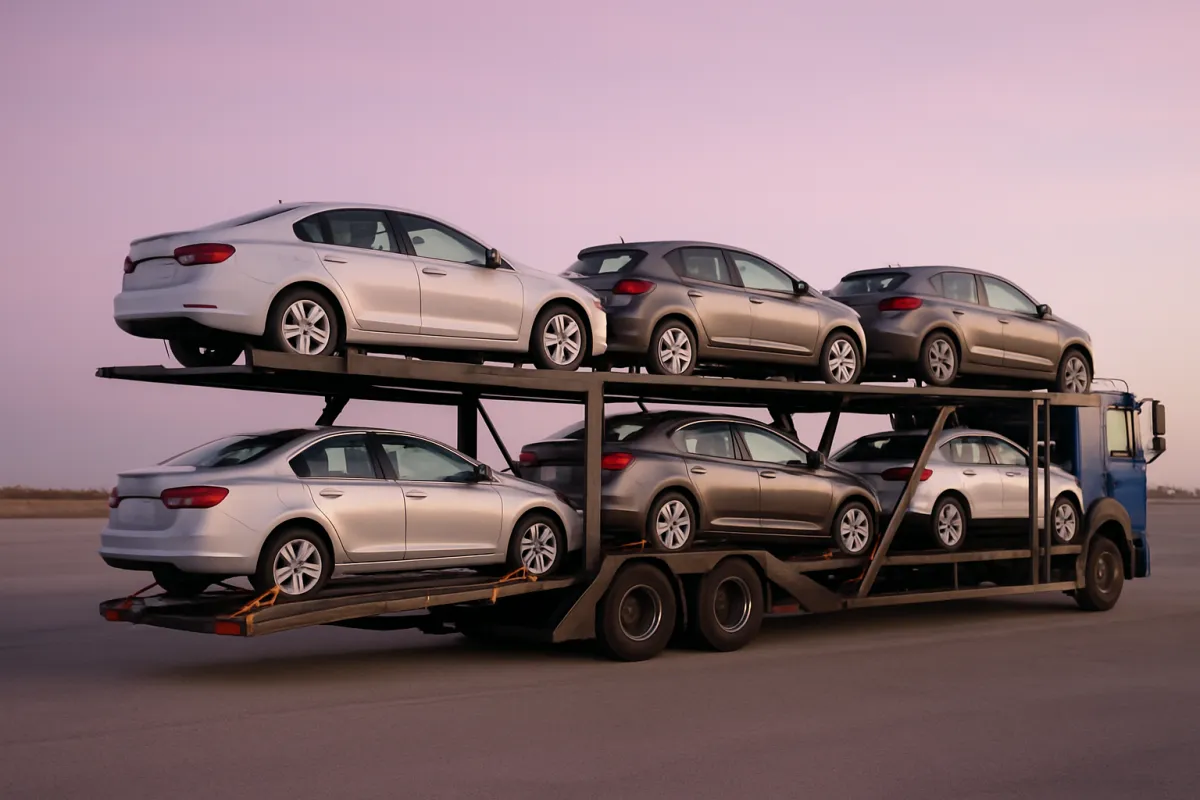
Shipping a car means paying a trucking operation to load your vehicle onto a multi-car trailer and drive it to another city while you travel separately. The familiar version is the two-level open carrier you pass on the interstate with seven to ten cars strapped to its decks. That truck is running a route, and your car is one slot on it. Understanding that single fact reframes the entire pricing conversation: you are not buying a private delivery, you are buying a position on a truck that is going somewhere anyway, and the price reflects how well your car and your route fit into that truck’s economics.
The alternative shapes exist too. A single-car flatbed or a small enclosed trailer will move one vehicle, and both cost substantially more per mile because there is no other cargo to share the trip. Rail is used for some corridors and by manufacturers, but it is rarely available to an individual moving one car. For nearly everyone reading this, the realistic choice is a slot on a multi-car carrier, either open to the weather or inside an enclosed trailer, arranged either directly with a truck owner or through an intermediary.
Broker versus carrier, the fact that explains everything
Here is the structural fact that almost no first-time shipper knows. The great majority of companies that appear when you search for car shipping are brokers. A broker owns no trucks and moves no vehicles. It takes your booking, your details, and usually a deposit, and then posts your job onto a central load board that carriers subscribe to. Drivers and dispatchers browse that board looking for cars that fit their route and their remaining deck space, and they accept the loads whose offered payment makes the trip worth running.
A carrier, by contrast, is the operation that owns the truck and employs the driver. Some carriers take direct bookings from the public, but most fill their decks from the load board rather than from their own marketing, because a truck running from one metro to another needs to fill eight slots quickly and cannot wait for eight individual customers to find its website.
Neither role is dishonest. Brokers exist because matching one car to one truck across a continent is a real coordination problem, and a good broker has the reach to find a truck already heading your way. The trouble is that most consumers do not know the split exists, so they interpret broker behavior as carrier behavior and get confused or angry when the two do not match.
How to tell whether you are talking to a broker or a carrier
You can usually settle this in one phone call, and you should. Ask directly: do you own the trucks that will carry my car, or will you post my car to carriers? An honest operation answers plainly. Most will say they are a broker, and many will say so proudly, because breadth of network is their actual product.
Interstate auto transporters and the brokers who arrange those shipments are required to register with the federal motor carrier regulator, and each registered operation carries an identifying number. That registry is public and searchable, and it distinguishes between authority to operate as a carrier and authority to operate as a broker. Rather than repeat any specific figures here, look the company up yourself in the official registry, confirm the number it gives you matches the name it trades under, and check whether the authority listed is carrier, broker, or both. Verify the current requirements at the source, since registration rules and the details shown can change.
Other tells help. A carrier will talk in terms of its own routes and truck availability. A broker will talk in terms of finding you a truck. A company that quotes instantly for any route on any date is almost certainly brokering, because no single fleet covers every lane. None of this disqualifies anyone. It simply tells you who is responsible for what, which matters enormously when something goes wrong.

How the quote and dispatch process actually works
The sequence trips people up because two different prices are involved. First you request quotes and receive numbers, often within minutes, from several companies. You pick one and book, frequently paying a deposit. At that moment nothing has been scheduled with any truck. Your job now goes onto the load board with an offered payment attached, which is your total minus the broker’s fee.
Then you wait for dispatch. A carrier running your lane sees the listing and decides whether the offered payment justifies the stop. If it does, the load is accepted, you get assigned a driver and a pickup window, and only then does anything real exist on a schedule. If it does not, the listing sits, and either the offered payment gets raised or your car keeps waiting.
This is why the honest question to ask any broker is not just what will this cost, but what amount will actually be posted to carriers. A quote is a proposal about what drivers will accept. A dispatch is proof that one did. Until dispatch happens, you have a hope rather than a booking, and the companies that are clearest about this distinction are usually the ones worth using.
Why a lowball quote often means nobody picks up your car
Once you understand the load board, the industry’s most common complaint explains itself. Someone quotes a number well below everyone else. The customer books, pays a deposit, and then waits. And waits. Days pass with no assigned carrier. Eventually a call comes explaining that market conditions have changed and a few hundred dollars more will get the car moving.
Nothing mysterious happened. The offered payment was below what drivers on that route would accept, so no driver accepted it. The low quote was never a price the market would clear at; it was a number that won the booking. The customer is now emotionally and financially committed and is likely to agree to the increase.
The defense is simple. Collect several quotes and look at the shape of the distribution rather than the lowest number. When four quotes cluster in a range and one sits far below them, the outlier is the anomaly to distrust, not the bargain to grab. Ask what happens if no carrier accepts, how long the company waits before raising the offer, and whether the deposit is refundable if dispatch never occurs. Get the answer in writing. Our note on hiring a moving company applies the same discipline to household movers, where suspiciously low estimates behave in a comparable way.
Open versus enclosed transport
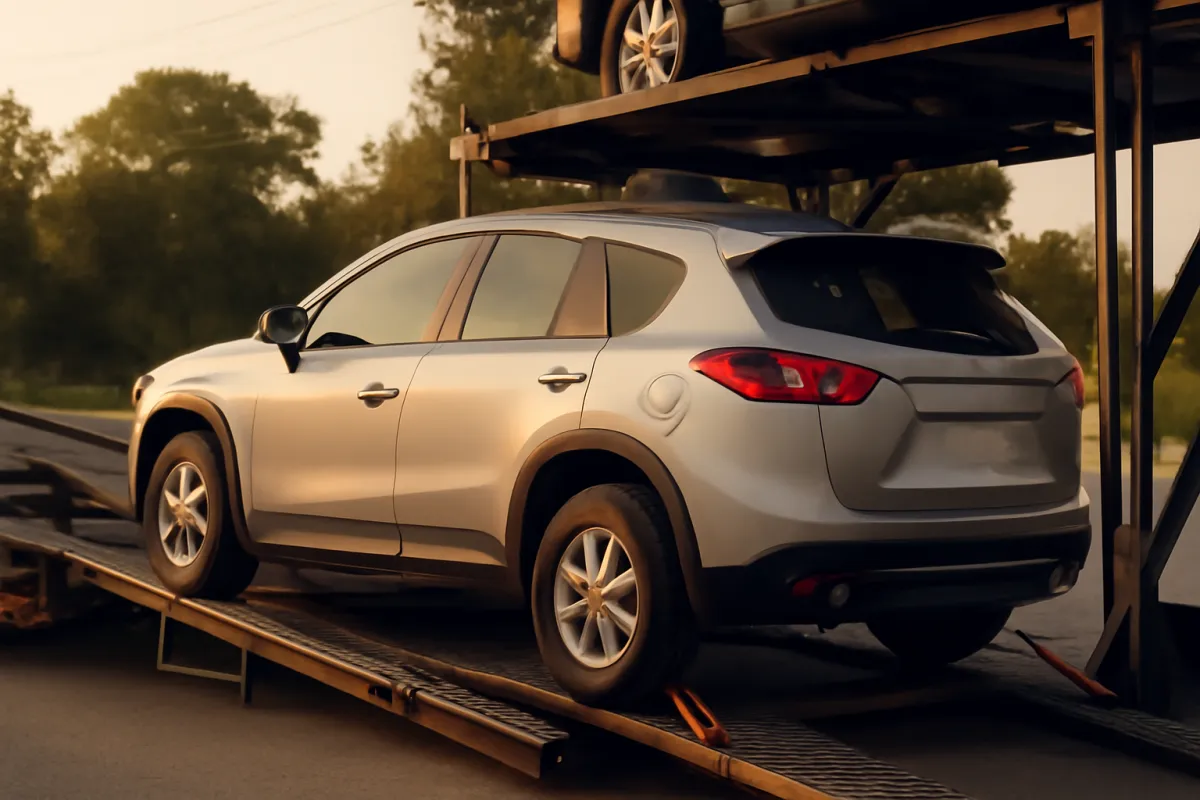
Open transport is the default and the overwhelming majority of what moves. Your car rides on an exposed deck, secured with wheel straps or chains, along with seven to ten other vehicles. It is exposed to rain, sun, road grit, and the occasional stone thrown up by traffic, exactly as it would be if you drove the route yourself. This is also how almost every new car reaches a dealership from the factory, which is a useful sanity check when the upsell arrives.
Enclosed transport places the car inside a covered trailer, typically alongside two to six others rather than ten. It blocks weather, road debris, and view, and enclosed trailers usually carry hydraulic lift gates or low-angle ramps that suit cars with minimal ground clearance. Drivers on enclosed equipment tend to specialize in higher-value vehicles and handle them accordingly.
The premium is real. Enclosed commonly runs something like 40% to 60% more than open on the same route, so an illustrative $1,050 open cross-country run becomes roughly $1,575 enclosed. That premium makes sense for a classic, an exotic, a show car, a freshly restored or repainted vehicle, or any car whose paint repair would cost more than the difference. It does not make sense for a six-year-old commuter that already lives outside in a driveway.
Door-to-door versus terminal-to-terminal
Door-to-door is the standard service and means the driver comes as close to your address as a large truck legally and physically can. That last part matters. A ten-car carrier cannot enter most residential streets, cul-de-sacs, or apartment complexes, so in practice door-to-door often means meeting the driver at a nearby wide road, a shopping center lot, or another spot with room to maneuver. Expect to be flexible about the exact meeting point, and expect a phone call an hour or two ahead rather than a precise appointment.
Terminal-to-terminal means you drop the car at a storage yard on the origin end and collect it from another yard on the destination end. It can shave a modest amount off the price and it can add flexibility on timing, since the car can sit at the terminal until a truck comes through. The tradeoffs are that you handle both ends of the ground transport yourself, the car may sit outdoors for days, and storage fees can start accruing if you are slow to collect.
For most relocations door-to-door wins on convenience for a small difference in price, and the terminal option is most useful when your schedule and the truck’s schedule genuinely cannot meet. If the car will need somewhere to sit on either end of the move, our breakdown of car storage options covers the choices and what each costs.
What actually drives the price
Five factors do nearly all the work, and knowing them lets you predict roughly where a quote should land before you receive one. Distance sets the base. Vehicle size and weight scale it. Whether the car runs under its own power adds a surcharge if it does not. Season and timing shift the whole market up or down. Route popularity determines how many trucks are competing for your business, which may be the least visible factor and one of the strongest.
Underneath all five sits a single logic: a carrier is deciding whether your car earns its slot. A big vehicle displaces more weight and sometimes two slots. An inoperable car needs a winch and extra minutes. A pickup twenty miles off the interstate costs the driver an hour. A route with little return freight means the truck may run partly empty on the way back. Each of those either raises the payment a driver requires or lowers the chance anyone accepts at your price.
That is also why the same car on the same date can quote differently in two directions on the same route. Traffic is not symmetric, and price follows the direction trucks are struggling to fill.
Distance and the declining per-mile rate
Distance is the headline variable, but it does not scale linearly, and expecting it to is the most common budgeting mistake. Every shipment carries fixed work regardless of length: arranging the pickup, loading and strapping the vehicle, completing inspection paperwork, unloading, and completing it again. On a 400 mile run that overhead is spread thinly across few miles, so the per-mile figure looks high. On a 2,800 mile run the same overhead spreads across many more miles and the per-mile figure drops sharply.
The illustrative pattern is straightforward. A regional run near 500 miles might work out around $1.30 a mile, a 1,000 mile run closer to $0.80, an 1,800 mile cross-country move near $0.58, and a full coast-to-coast trip under $0.50. The totals rise while the rate falls. Practically, this means very short shipments often feel like poor value and are the cases where driving the car yourself deserves a serious look, while long moves are where shipping competes best against fuel, lodging, meals, and several days of driving.
Vehicle size, weight, and whether it runs
Carriers are constrained by weight as much as by space. An auto transport rig loaded with ten vehicles runs near legal limits, so a heavy vehicle genuinely costs the driver capacity. A compact sedan is the baseline. A midsize crossover or small SUV commonly adds something like 10% to 20%. A full-size pickup, three-row SUV, or van commonly adds 20% to 35%, and an unusually tall or long vehicle may take a specific deck position or two slots, which raises it further.
Modifications matter for the same reason. Lift kits, roof racks, oversized tires, and aftermarket spoilers change the dimensions the driver has to plan around, so disclose them when you request quotes rather than at pickup, when the driver may simply refuse the load.
Whether the car runs is a separate line. An inoperable vehicle that will not start, steer, or brake needs a winch and a driver equipped to use it, and it takes noticeably longer to load and secure. An illustrative surcharge for a non-running vehicle is something in the range of $150 to $250, and the pool of carriers willing to take it is smaller, which lengthens the wait for dispatch. Be honest about the car’s condition up front. A driver who arrives expecting a running car and finds a dead one can decline the pickup entirely.
Season, snowbird routes, and timing
Auto transport has a seasonal rhythm, and if your route sits on one of the seasonal corridors it moves your price more than almost anything else you control. The best known pattern is the snowbird migration: heavy southbound demand into warm-weather states as cold weather approaches, then heavy northbound demand in spring as the same vehicles return. On those corridors, the busy direction commands higher prices and the empty direction can be unusually cheap, because trucks would rather carry something back than run empty.
Summer is the general peak for household relocation, which pulls car shipping demand up with it, and it coincides with the college calendar in both directions. Late winter outside the snowbird lanes is often the softest market. Weather adds its own friction: mountain passes, ice, and storm closures slow transit and occasionally strand loads.
If your dates have any flexibility, ask two or three companies what the same route looks like a few weeks earlier or later. Sometimes the answer is nothing meaningful. Sometimes a two week shift is worth a couple of hundred dollars. Our winter moving article covers the wider seasonal tradeoffs when the whole move, not just the car, has to happen in the cold months.
Route popularity and the load board reality
The invisible factor is how much truck traffic already runs your lane. Major metro to major metro along an interstate corridor is easy: many carriers run it, competition is real, and your car gets picked up quickly at a fair price. A rural origin, a mountain town, or a destination far from any interstate is a different problem, because a driver has to leave the efficient route, burn hours, and possibly return empty to rejoin it.
The practical consequence is that geography, not just mileage, sets your price and your wait. Two shipments of identical distance can differ substantially if one runs city to city on a busy corridor and the other runs from a small town to another small town. If you live well off a major route, ask whether meeting the driver at a large lot near the nearest interstate would reduce the price. Frequently it does, and the drive there is far shorter than the shipment.
This is also why timing and route interact. A quiet lane in a busy season may still move fast, and a busy lane in a soft season may be cheap in one direction and expensive in the other.
Illustrative car shipping costs by distance
The chart below shows an illustrative cost ladder for a standard running sedan on open transport, door to door, across four distance bands. Every figure is a placeholder chosen to show the shape of the pricing rather than to predict a quote, since the real number depends on your specific lane, dates, and vehicle.
Illustrative open-transport cost by distance
A standard running sedan on an open carrier, door to door, at four distance bands. Illustrative model, not a quote; real prices vary by lane, season, vehicle, and how full the trucks are that week.
The total roughly doubles from the shortest band to the longest while the distance grows more than fivefold, which is the declining per-mile rate made visible: about $1.30 a mile at 500 miles against under $0.50 a mile coast to coast.
Layer the other factors on top of that base. Enclosed transport multiplies it by roughly 1.4 to 1.6. A midsize crossover adds something like 10% to 20%, a full-size truck or large SUV 20% to 35%. A non-running vehicle adds an illustrative $150 to $250. A guaranteed or expedited pickup window commonly adds $200 to $400 because it asks a driver to reshuffle a route. Our full cost of an out-of-state move sets those numbers beside the rest of the relocation, and the calculator covers the income side of the decision.
Where your car shipping payment goes
It helps to see what the money buys, because the split explains why brokers behave the way they do and why the posted carrier payment matters more than the headline quote. The chart below divides an illustrative door-to-door open-transport payment into its parts.
Illustrative split of a car shipping payment
How an illustrative door-to-door open-transport payment divides, as shares of the whole. Illustrative model; the real split shifts with the lane, the company, and whether you booked direct with a carrier.
Roughly seven of every ten dollars reaches the truck. That is why a quote cut well below the market does not simply squeeze a middleman: it cuts the carrier payment below what drivers will accept, and the car stops moving.
Deposits, payment terms, and what you owe on delivery
The payment structure follows directly from the two-party arrangement. Typically you pay a deposit to the broker at booking or at dispatch, illustratively somewhere in the $100 to $250 range, which is the broker’s fee or a portion of it. The remaining balance is paid to the driver at delivery, and many carriers want that balance in cash, a cashier’s check, or a money order rather than a personal card, because the driver has no way to chase a reversed payment once the car is unloaded.
Ask three questions before you pay anything. When is the deposit charged, at booking or only once a carrier is dispatched? Under what conditions is it refunded, particularly if no carrier ever accepts the load? And what forms of payment will the driver accept at delivery, so you are not scrambling for a money order on the morning the truck arrives?
Deposit-only-on-dispatch is the friendlier structure and worth seeking out, because it aligns the company’s incentive with actually getting your car moved rather than with collecting bookings. Read the cancellation terms with the same attention. Our moving budget roadmap has more on staging deposits and final payments so a large delivery-day balance does not surprise you.
Insurance, cargo coverage, and your own policy
This is the part people assume and should verify. A carrier hauling vehicles is required to hold cargo coverage for the vehicles on its truck, and that policy is the primary protection for damage that happens in transit. It belongs to the carrier, not to the broker, which is another reason knowing who is who matters.
Ask for the certificate of insurance before pickup, and read three things on it: the coverage limit, whether the limit applies per vehicle or across the entire load, and what is excluded. Common exclusions include acts of nature, damage from items left inside the car, mechanical failures unrelated to handling, and pre-existing damage. Some policies carry a deductible the customer bears.
Your own auto policy is a separate question with an answer that varies by insurer and state. Some policies extend some coverage to a vehicle in the custody of a transporter, and some do not. Call your insurer, describe the situation specifically, and ask what applies. Do not cancel coverage on the car while it is in transit, since it needs to be insured the moment it is back on a road. Personal belongings inside the vehicle are essentially never covered by either policy, which is one more reason to empty the car.
Preparing the car for pickup
Preparation is cheap, takes an afternoon, and is what makes a later damage claim provable. Wash the car first, and do it for a specific reason rather than tidiness: a clean exterior makes existing scratches, chips, and dents visible, and a dirty car hides exactly the marks that later become arguments. Photograph it clean, in good light, and from every angle.
Then work through the mechanical list. Leave the fuel tank around a quarter full, enough to load, unload, and reach a gas station, but not so much that you are paying to haul fuel weight. Check that the battery holds a charge and that the tires are properly inflated, since a flat tire at delivery is a problem nobody wants to own. Note any existing fluid leaks and tell the driver, because a leaking car placed on an upper deck can drip onto the vehicle below.
Disable or provide instructions for any alarm system. An alarm that triggers repeatedly at three in the morning in a truck stop parking lot creates real problems for a driver who cannot get into the car. Fold in the mirrors, retract or remove the antenna, and remove or secure any loose exterior accessory such as a bike rack, spoiler, or roof box. Finally, leave only one key with the driver and keep your spare.
Documenting the condition before the truck arrives
Treat this as the insurance policy you actually control. Photograph the entire exterior in daylight: each panel straight on, all four corners, the roof, the hood, the trunk, the wheels and rims, the windshield and every window, the front and rear bumpers, and the underside of the front air dam if the car is low. Take close-ups of every existing scratch, chip, dent, or crack, with something for scale where it helps.
Photograph the interior too, including the odometer reading and the dashboard with the ignition on. Mileage disputes are rare but not unheard of, and a timestamped odometer photo settles them instantly. Video helps as well: a slow walk around the car narrating what you see captures things stills miss.
Confirm your photos carry timestamps, and back them up somewhere other than the phone you are carrying across the country. The point of all this is not paranoia. It is that a claim is decided by comparing the car’s condition at two moments, and you are the only person with an interest in documenting the first one properly.
Personal items in the car and why weight rules matter
Nearly every carrier restricts what you can leave in the car, and the restriction is not arbitrary. Auto transport rigs run close to legal weight limits with a full deck, and unlogged cargo can push the truck over at a weigh station, which exposes the driver to a fine and delays every car on the trailer. Household goods also fall outside the carrier’s operating authority for vehicle transport, which is a licensing issue rather than a preference.
The common allowance is a modest amount of weight in the trunk only, often something in the neighborhood of 100 pounds, kept below the window line so it is not visible and does not obstruct the driver’s view of the interior. Some carriers permit nothing at all. Ask before you load anything.
Whatever you leave is uninsured. Cargo coverage protects the vehicle, not the contents, so a stolen laptop or a damaged box is simply your loss. Remove toll transponders and parking passes so they do not accumulate charges along the route, take out garage remotes and spare keys, and clear the glovebox of registration documents and anything with your address on it. If you need to move belongings as well as the car, our packing roadmap covers the right way to move them.
The bill of lading at pickup
When the driver arrives, the two of you complete a bill of lading, which serves as both the transport contract and the condition report. The driver walks the car and marks existing damage on a vehicle diagram, and you walk it with him. This is the single most consequential ten minutes of the transaction.
Do not delegate the inspection. Point out every mark you found during your own documentation and confirm each one appears on the form. If the driver’s markings are vaguer than what you can see, ask for specificity. Never sign a blank or partially completed form on a promise it will be filled in later, and never accept a pickup so rushed you cannot read what you are signing.
Once both of you have signed, photograph every page of the signed copy immediately, and keep a physical copy if you are given one. Note the driver’s name, the carrier’s name, the truck number, and a direct phone number. The bill of lading is what turns your photographs into evidence, because it establishes what both parties agreed the car looked like at the moment it left your hands.

Delivery, inspection, and how a claim works
Delivery repeats the pickup ritual in reverse, and the temptation to hurry is strongest exactly when hurrying costs the most. Inspect the car thoroughly before you sign anything and before you hand over the balance. Compare what you see against your pickup photographs, panel by panel, and walk the whole car including the roof and the wheels.
Insist on daylight or good lighting. A delivery at night in a dim parking lot is where damage goes unnoticed, and once you have signed a clean delivery bill of lading you have documented that the car arrived undamaged. If the driver’s schedule pushes toward a night delivery and you cannot see the car properly, ask to meet in the morning instead.
If you find new damage, note it on the delivery bill of lading before signing, in writing, specifically, and have the driver acknowledge it. Photograph the damage and the annotated document. Then contact the carrier promptly to open a claim against its cargo policy, and notify the broker as well if you booked through one. Claims are resolved on documentation, which means the pickup form, the delivery form, and your photographs decide the outcome far more than the conversation does.
Realistic timelines from booking to delivery
Two clocks run in sequence and people usually plan for only the second. The dispatch clock runs from booking until a carrier accepts your load, commonly one to seven days depending on how well your price matches your route. A popular lane at a market price can dispatch within a day or two. A rural pickup at an optimistic price can sit for a week or longer.
The transit clock starts when the car is loaded. A multi-car carrier making pickups and deliveries along the way commonly covers something like 400 to 500 miles a day, well below what you would drive yourself, because the driver must stop to load and unload other vehicles and is bound by hours-of-service rules. On that basis, an 1,800 mile move is roughly four days of driving, and a 2,800 mile coast-to-coast run is closer to seven.
Add the two together for the number that matters. An 1,800 mile shipment booked at a market price often means about three days to dispatch plus four days in transit, so a week from booking to your driveway is a fair planning assumption. Build slack into your own arrival plans, arrange a ride or a rental for the gap, and treat any promised exact date with healthy skepticism unless you paid for a guaranteed window. Our long-distance move plan covers sequencing the car alongside the household goods so you are not stranded at either end.
Red flags and how to vet a company
A short list of warning signs catches most of the trouble. A quote dramatically below every other quote you received is the first, for the reasons the load board makes obvious. A large deposit demanded at booking rather than at dispatch is the second, because it collects money before anything has been arranged. Pressure to decide immediately, or a price that expires in an hour, is the third.
Refusal to answer whether the company is a broker or a carrier is disqualifying on its own. So is an unwillingness to provide a registration number you can look up, or to send a certificate of insurance before pickup. Vague answers about the pickup window, or a promise of a precise date and hour without a guaranteed-window fee, both suggest a company telling you what you want to hear.
On the positive side, look for clear written terms, a stated cancellation and refund policy, a named point of contact, and willingness to explain the carrier payment. Read reviews with attention to how complaints were handled rather than the star average, and give weight to complaints about the specific failure mode this article describes: quotes that rose after booking, or cars that sat undispatched.
A worked example, an illustrative cross-country shipment
Put the pieces together on one shipment. Suppose you are moving roughly 1,800 miles and shipping a midsize crossover that runs fine, on open transport, door to door. The base for a standard sedan on that distance band is an illustrative $1,050. The crossover adds about 15%, bringing it to roughly $1,208, which works out near $0.67 a mile. You book at that price rather than at a $780 outlier quote from a company that would not say whether it was a broker.
You pay a $200 deposit at dispatch, leaving about $1,008 due to the driver on delivery in a cashier’s check. Dispatch takes three days. Transit at roughly 450 miles a day is about four days, so the total window is about a week from booking. You wash the car, photograph every panel, empty it, leave the tank a quarter full, disable the alarm, and hand over one key.
At pickup you and the driver mark two existing door dings and a windshield chip on the bill of lading, and you photograph the signed form. At delivery you inspect in daylight, find nothing new, sign, and pay. Total: about $1,208, against several days of driving, fuel, two hotel nights, and meals if you had done it yourself. Whether shipping wins that comparison depends on what your time is worth, which is a calculation our true cost of relocating breakdown works through in more detail.
Run your own car shipping math
The decision becomes concrete once you put in your own numbers. Start with your distance band, since that sets the base and tells you whether the per-mile rate will feel high or low. Choose open or enclosed honestly, based on what the car is worth and what repainting a panel would cost, not on how attached you feel to it. Add your vehicle size, and be honest about whether it runs.
The companion beside this article does that arithmetic. Pick your distance, transport type, vehicle size, and running condition, add the deposit you expect to pay, and it returns an illustrative all-in estimate, the implied per-mile rate, the balance due to the driver at delivery, the transit days at a realistic carrier pace, and the total window once dispatch time is included. Change the transport type and watch the premium appear. Change the distance and watch the per-mile rate fall while the total climbs.
Use it to sanity-check the quotes you collect rather than to replace them. If every real quote lands far above the illustrative estimate, your lane is probably unpopular or your dates fall in a peak. If one lands far below, you now know exactly what that usually means. Pair it with the calculator for the salary side of the move, and with our out-of-state move roadmap for everything the car is only one part of.
The bottom line
Shipping a car is a simple transaction wrapped in an industry structure nobody explains. Once you know that most companies are brokers posting your job to a load board where carriers choose whether to accept it, the confusing parts stop being confusing: the deposit exists because the broker is selling coordination, the quote can change because a quote is a proposal rather than a booking, and a suspiciously low number means your car will sit rather than move. Price is driven by distance at a falling per-mile rate, vehicle size and weight, whether the car runs, the season, and how busy your lane is. Open transport is right for most cars and enclosed earns its 40% to 60% premium only for vehicles whose paint is worth protecting. Everything that protects you happens in two ten-minute windows: the inspection at pickup and the inspection at delivery, both recorded on a bill of lading that decides any claim. Wash the car, photograph it exhaustively, empty it, verify the cargo coverage, and refuse to sign in the dark. Do that, and the car arrives as an unremarkable line item in a move rather than the part that went wrong. For the rest of the job, our out-of-state move roadmap, long-distance move plan, and moving budget roadmap carry it from here.
This article is published by the ReloPeak desk as general relocation education, not as automotive, insurance, legal, or transport advice, and it endorses no particular broker, carrier, or platform. Every dollar figure, percentage, per-mile rate, and timeline appearing above is illustrative, chosen to demonstrate how auto transport pricing behaves rather than to forecast what you will be quoted; actual prices, surcharges, deposit terms, insurance limits, and transit times differ by lane, season, vehicle, company, and market conditions, so gather real quotes and read the paperwork you are asked to sign. Registration requirements for interstate transporters and brokers change over time and are administered federally, so verify any company’s current status in the official public registry rather than relying on descriptions here, and confirm with your own insurer what your policy does and does not cover while a vehicle is in a transporter’s custody.
Frequently asked questions
How much does it cost to ship a car?
There is no single price, because the number is built from distance, vehicle size, transport type, route, and timing. As an illustrative model for a standard running sedan on an open carrier, a regional hop of around 500 miles might land near $650, a 1,000 mile run near $800, a 1,800 mile cross-country move near $1,050, and a full coast-to-coast trip near $1,300. Notice that the total rises with distance while the per-mile rate falls, from roughly $1.30 a mile on the short run to under $0.50 a mile coast to coast, because the fixed work of loading, paperwork, and pickup is spread over more miles. Treat every figure here as a placeholder for the shape of the pricing rather than a quote, and collect several real quotes on your own route before you budget.
What is the difference between a car shipping broker and a carrier?
A carrier owns the truck and physically moves your car. A broker owns no truck; it takes your booking and posts the job to a load board where carriers with space on a route decide whether to accept it at the price offered. Most companies a search turns up are brokers, which is not inherently a problem, since brokers have the reach to find a truck already heading your way. What matters is knowing which one you are dealing with, because it explains the deposit structure, why a quote can change before dispatch, and who to call when the truck is late.
Is enclosed car transport worth the extra cost?
Enclosed transport puts your car inside a covered trailer rather than on an open deck, protecting it from weather, road debris, and view. It commonly runs something like 40% to 60% more than open transport, so on an illustrative $1,050 open cross-country run the enclosed version might land near $1,575. For an ordinary daily driver that premium is usually hard to justify, since open carriers are what nearly every new car rides on from the factory. For a classic, exotic, low-clearance, or freshly restored vehicle, or for a car whose paint would be expensive to repair, the extra cost is reasonable insurance.
How long does it take to ship a car?
Two clocks run, and people usually forget the first. The dispatch clock is the time between booking and a carrier actually accepting your load, commonly anywhere from one to seven days depending on how well your price matches the route. The transit clock is the driving itself, which on a multi-stop carrier commonly covers something like 400 to 500 miles a day once loaded. Put them together and a 1,800 mile move often means roughly four days of transit inside a total window closer to a week, while coast to coast can stretch past ten days.
Does my car insurance cover it while it is being shipped?
The carrier is required to hold cargo coverage for vehicles on its truck, and that policy, not yours, is the primary protection for damage that happens in transit. Ask for the certificate of insurance before pickup and read what it excludes, since deductibles, act-of-nature exclusions, and per-vehicle limits vary. Your own auto policy may or may not extend to a car in someone else's custody, so call your insurer and ask that specific question rather than assuming. Personal belongings left inside the car are almost never covered by either policy.
Can I leave personal items in the car when I ship it?
Most carriers either prohibit it or limit you to a small amount of weight in the trunk, often something in the range of 100 pounds and below the window line. The reason is not fussiness: auto transport trucks run close to legal weight limits, and unlogged cargo can push a rig over at a weigh station and expose the driver to a fine. Items in the car are also outside the cargo policy, so a stolen laptop is simply gone. Strip the car of anything you would miss and treat it as freight, not as luggage.
Why did my car shipping quote change after I booked?
This is the single most common complaint, and the broker-and-load-board structure explains it. A broker can quote any number it likes, but a carrier has to voluntarily accept the load at the price offered. If the quote sits below what drivers on that route will take, no one accepts it, the car sits, and eventually you are asked for more money to get it moving. A quote noticeably below every other quote you received is a warning sign rather than a bargain. Ask whether the price is the amount that will actually be posted to carriers.
What is a bill of lading and why does it matter so much?
The bill of lading is the inspection and transport document the driver completes with you at pickup and again at delivery. It records the vehicle condition, marking existing scratches, dents, and chips, and both of you sign it. If damage appears later, the difference between the pickup and delivery copies is what decides the claim, which makes it the most important piece of paper in the whole transaction. Inspect carefully, do not sign a blank or vague form, photograph the signed copy, and never let a delivery driver rush you through it in the dark.