What's in this roadmap
- Why utilities are the moving task with a hard deadline
- Before you start: what you need on hand
- Step 1: Inventory what the new home actually needs
- Step 2: Find out who supplies each utility
- Step 3: Book the internet install first
- Step 4: Schedule the start before you schedule the stop
- Step 5: Clear the deposit and the identity checks
- Step 6: Photograph the meters at both addresses
- Step 7: Confirm the stop and leave a forwarding address
- A worked example: an illustrative two-bedroom move
- What actually shows up on a first utility bill
- Transfer or new account: which one you are really getting
- Deposits, credit checks, and the letter of good standing
- Gas safety: the part of this you never do yourself
- Renting versus owning: who sets up what
- What is included in rent, and what only looks included
- Timing the sequence backwards from move-in day
- What setting up utilities costs, illustratively
- Run your own utility timeline
- Common mistakes when setting up utilities
- Troubleshooting: utility setup edge cases
- Your utility setup checklist
- The bottom line
Short answer: Set up utilities when you move in seven steps: work out what the new home needs and who supplies it, book internet first because it commonly needs a technician and an illustrative two-week lead time, start service at the new home before stopping the old with a deliberate overlap of a day or two, ask about deposits and request a letter of good standing to reduce them, then photograph every meter at both addresses.
The moving day that goes wrong is rarely the one with the broken sofa. It is the one that ends at eight in the evening, in a home you now own or rent, with the truck gone, the boxes stacked, and no power. No lights, no heat, no hot water, no way to charge the phone you need to sort it out with. Nothing about the move itself failed. What failed was a phone call that should have happened eleven days earlier and did not, because utilities sit on every moving checklist as a single line item and get treated like one.
This roadmap treats them as the job they actually are: seven steps, roughly two hours of real work spread over a few weeks, ending with a home that has power, heat, water and a working connection on the day you walk in. It sits alongside our moving checklist, which sequences the whole move, and our change of address roadmap, which handles the paperwork side of the same week. The salary calculator prices the income side of a relocation, and the companion below turns your own move date into a call-by date.
Key takeaways
- Start the new home's service before you stop the old one, and overlap deliberately. On an illustrative $300 monthly utility total, two days of overlap costs about $20, against a night with no heat if you get the order wrong.
- Book the internet first. It is the only one that commonly needs a technician and an appointment slot, so an illustrative two-week lead time on internet sets the schedule for everything else.
- What the new home needs is not obvious. It changes with the heating type, with whether water and trash are municipal or folded into rent, and with whether the building has one internet option or five.
- Deposits are usually the output of a credit check, not a fixed fee. A letter of good standing from a previous provider can reduce or waive one, and it costs a phone call to request.
- Photograph every meter at both addresses on the day. It is the single best defence against a disputed final bill, and it takes under two minutes.
Why utilities are the moving task with a hard deadline
Almost every task on a moving list is elastic. You can pack late and pack badly and still be packed. You can defer the change of address, update the bank next week, unpack the kitchen in month two. The consequences arrive slowly and they are recoverable. Utilities are not like that. They have a specific date attached, the date you first sleep in the place, and they either work on it or they do not.
The second thing that makes them different is that you cannot fix them at the last minute. A moving company can often be found on short notice at a price. A provider cannot compress the physical work of getting an engineer to your street, and an appointment book that is full is simply full. That converts a small administrative task into a scheduling constraint, which is a different kind of thing and deserves a different place in the plan.
The third thing is that the failure is loud. Arriving to a dark house at the end of the most tiring day of the move is the moment people remember, and it colours everything afterwards. Nobody remembers which box the towels were in. Everybody remembers the night the heating did not come on.

Before you start: what you need on hand
Gather this once and the calls take a fraction of the time. Most of the friction in setting up utilities is not the decision making, it is being asked for a piece of information you have to go and find while somebody waits on the line.
- The full new address exactly as the provider will hold it, including the unit or apartment designation. A missing unit number is the most common reason a connection is scheduled to the wrong meter.
- Your move-in date, and the date you hand back the keys at the old place. These are different dates and both matter.
- Identification: a government-issued ID and your Social Security number or equivalent, which is what a credit check runs against.
- Your current account numbers at the old address, which speed up both the stop and any transfer.
- The lease or closing paperwork, or at least the landlord or agent's contact details, since some providers ask for proof you are entitled to the address.
- A payment method, and a forwarding address for the final bills.
Time and difficulty: budget about two hours of actual work in total, split into a research block of roughly thirty minutes and a set of calls or online forms that run ten to twenty minutes each. Difficulty is low. The only thing that makes it hard is starting too late.
Step 1: Inventory what the new home actually needs
Do not assume the new place needs the same set of services as the old one. This is the step people skip, and it is the one that produces the surprises. Walk through the home, or ask whoever is showing it, and answer four questions.
First, how does it heat? Electric heating means there may be no gas account at all, and a much larger electricity bill in winter. Natural gas means a second metered account and a second setup. Oil or propane means neither a utility account nor a meter, but a delivery relationship and a tank with a level you should check before you take possession.
Second, where does the water come from and where does waste go? Municipal water and sewer means an account, often billed by the city rather than a company, and sometimes attached to the property rather than to you. A well and a septic system mean no water bill at all and a maintenance responsibility instead.
Third, what happens to trash and recycling? In some places it is a municipal service funded through local taxes and requires nothing from you. In others it is a private contract you arrange yourself, and in a rental it is frequently the landlord’s account.
Fourth, what internet is actually available at that address? Not in the city, at that address. This is the question with the widest range of answers, and the one most likely to determine whether you can work from home in week one.
Watch out for the appliance trap. A home with a gas cooker and a gas water heater still needs gas even if the heating is electric, and people who read the thermostat and stop there discover this while trying to make coffee.
Step 2: Find out who supplies each utility
The answer varies more than most people expect, and it varies by service. For electricity and natural gas, many addresses are served by a single regulated utility with no choice attached, so the task is identification rather than comparison: find out who it is and open an account. Some markets separate the wires and pipes from the supply and let you choose a supplier while the delivery company stays fixed, and some do not. Rather than assuming either way, check what the arrangement is at your specific address before you spend an evening comparing offers you may not be able to accept.
The most reliable source is the property itself. Ask the landlord, the seller, the agent, or the neighbours who supplies each service, since they are answering from experience rather than from a directory. A previous bill is even better if anyone will show you one, because it names the provider, the account structure, and the rough size of the bill in one document.
Failing that, the local government’s website usually names the water, sewer and trash arrangements directly, since those are frequently municipal. For electricity and gas, the state or provincial utility regulator publishes who serves which territory. Both are primary sources, which beats a search result promising to connect all your utilities in one call.
Internet is the one where comparison genuinely pays, because availability is address-specific and often plural. Check what is physically available at the address, then compare on the installation lead time as well as the price, because a slightly better monthly rate three weeks out is worse than a slightly worse one that can be installed before you move.
Watch out for third-party concierge services that offer to set up everything for you. Some are legitimate and some are lead-generation operations that will sell your details onward. If you use one, verify afterwards, directly with each provider, that the account exists and the date is right.
Step 3: Book the internet install first
Internet is the constraint. Every other service in this process is a database change: somebody flips your account on, sometimes remotely, sometimes with a visit that does not need you present. Internet frequently needs a technician inside the property, on a day you are there, with equipment, and appointment books fill up. That makes it the first call rather than the last, which is the reverse of how most people sequence it.
Illustrative lead time to arrange each utility
Planning cushions in calendar days before move-in, not published provider policies.
Bars are scaled against the longest allowance, the fourteen-day internet cushion. These are planning numbers chosen to show the shape of the problem: one service with a real appointment queue, and four that are mostly account administration. Confirm actual timings with each provider, since they vary by area and by season.
The shape of that chart is the whole argument. If you work from the shortest lead time and call everybody a few days out, you will get four services on time and miss the one that matters most for anyone working remotely. If you work from the longest, everything else fits comfortably inside it.
Book the earliest slot you can get that is on or before your move-in day, and take a morning appointment if you are offered one, since a morning that slips still lands the same day. Ask what equipment arrives, whether it is posted ahead or brought by the technician, and whether you can self-install, because a self-install kit removes the appointment constraint entirely and turns the fourteen days back into three.
Watch out for the building factor. In apartments and condos, the technician may need access to a communications room, which means the building manager needs to know they are coming. Ask about that when you book rather than on the day.
Step 4: Schedule the start before you schedule the stop
Here is the sequencing rule that prevents the dark house: arrange the start dates at the new home first, confirm them, and only then arrange the stop dates at the old one. Doing it in the other order is how people end up with a stop that lands before a start, which is a gap, and a gap is a night without power.
Then overlap on purpose. Set the new home’s services to begin one or two days before you arrive, and the old home’s to end one or two days after you leave. The overlap does three things: it absorbs a start date that slips, it lets you clean and check the old place with the lights on after the truck has gone, and it means the first thing you do in the new home is not diagnosing a fault.
The economics are not close. On an illustrative $300 monthly utility total, a day of service costs roughly $10, so two days of overlap is about $20. Compare that with a night in a hotel, an emergency call-out, or a day of lost work because the connection did not happen. Nobody has ever regretted the twenty dollars.

Write both dates down for every service on the same sheet, because the mistake is almost never a wrong date in isolation. It is two right dates in the wrong order, which only shows up when you can see them together. Our moving budget roadmap has the same argument about costs: the individual numbers are usually fine, and the total is what surprises people.
Watch out for weekends and public holidays. A Friday move-in with a Monday connection date is a common and entirely avoidable version of this failure, and it is also the version that is hardest to fix, because the people who could fix it are not working either.
Step 5: Clear the deposit and the identity checks
Opening a utility account is a credit event more often than people expect. The provider is extending you a service now and billing for it later, which makes you a borrower in a small way, and many of them run a credit check to price that risk. The output of the check is usually not an approval or a refusal but a deposit: pay this now, get it back later.
Deposits are typically expressed as a multiple of an estimated monthly bill rather than as a flat fee. Illustratively, on a $115 electricity share of a $300 monthly total, a one to two month deposit lands somewhere around $115 to $230, and the estimate itself depends on the size of the home and its heating type rather than on you. They are generally refunded or credited to the account after a period of on-time payment, so treat a deposit as money parked rather than money spent, and note the date it becomes refundable.

The lever most people never use is the letter of good standing. Call your previous provider and ask for a letter, or a payment history letter, confirming you held an account and paid on time. Many providers will reduce or waive a deposit on the strength of one from a comparable service, and the request costs a phone call. Ask before you open the new account rather than after, because reversing a deposit already taken is harder than not paying it.
Watch out for whose name the account goes in. If two people will split the bills, decide now who is the account holder, because it is that person’s credit history the check runs against and that person’s name the payment record attaches to. Splitting accounts between two people, one taking electricity and the other internet, builds a record for both.
Step 6: Photograph the meters at both addresses
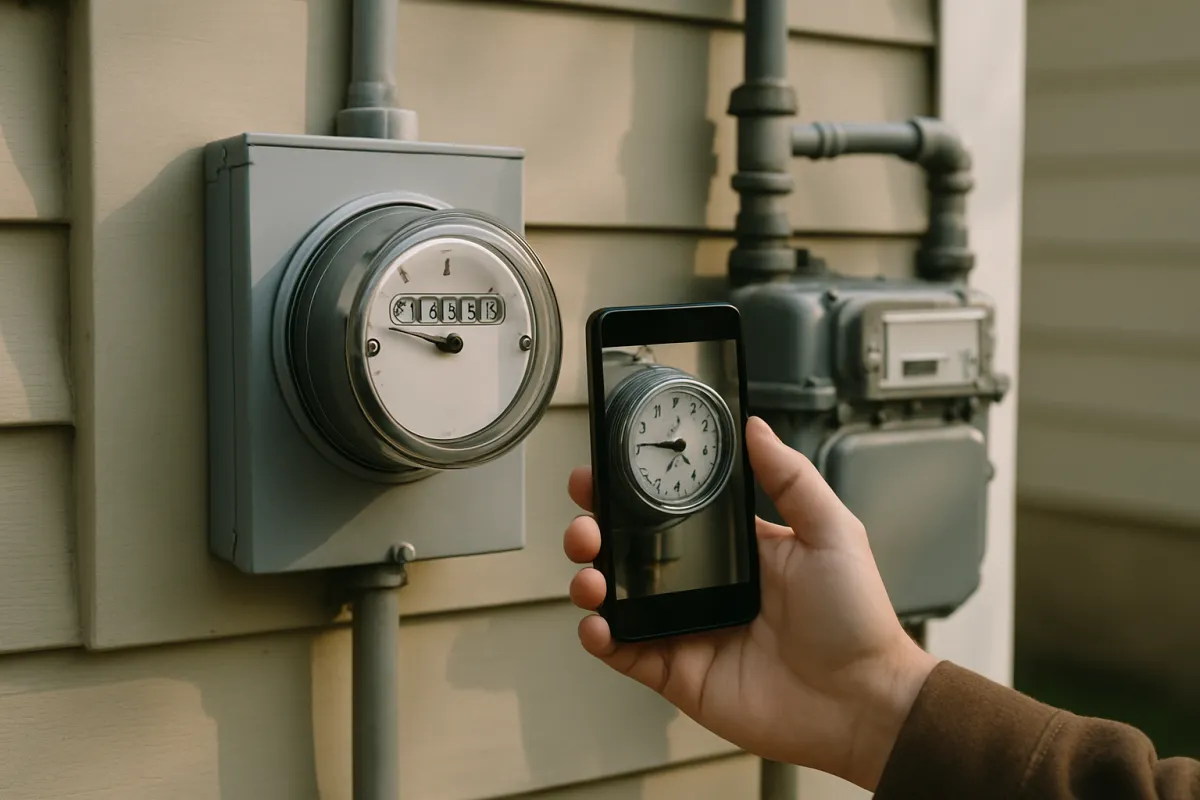
This is the two-minute habit that resolves the most expensive argument in the whole process. On the day you hand back the keys at the old address, read every meter you have: electricity, gas, water. On the day you take possession of the new one, do exactly the same. Write the numbers down, and photograph each meter.
Photograph the whole unit, not just the digits. A frame that includes the meter’s identification number alongside the reading is the difference between evidence and a picture of some numbers, particularly in a building with several meters in one cupboard. Most phones record the date and time automatically, which supplies the other half of what you need. Take a second shot closer in if the first is hard to read, and keep both.
Then give the readings to the providers when you open and close the accounts, rather than waiting for an estimated bill and disputing it later. An account opened with a reading you supplied and photographed starts clean. An account opened without one starts with an estimate, and every estimate is a future disagreement waiting for a trigger.
The worked case is common enough to plan for. A previous occupant leaves, the meter is not read, the account rolls over on an estimate, and a bill arrives covering a period that includes weeks before you had keys. With a dated photograph from the day you took possession, that is a short conversation. Without one, it is your word against an estimate, and estimates tend to win.
Watch out for meters you cannot reach. If a meter is inside a locked cupboard, in a basement you do not have access to, or behind a gate, ask on the day rather than discovering it at the first bill. If you genuinely cannot get a reading, note that in writing to the provider on the day, with the reason, and ask them to record the date.
Step 7: Confirm the stop and leave a forwarding address
The last step is the one that gets abandoned because the move is over and everyone is tired. Moving out does not stop a utility account. The account is a contract, and it keeps running, and it keeps billing, and the bills keep arriving at an address you no longer read.
Confirm three things for each service at the old address. That the stop is recorded, with the exact date you handed back the keys. That the final reading on file matches the one you took and photographed. And that they have a forwarding address for the final bill, which is often the single most important piece of mail from the move, because it is the one that closes the account and releases any deposit.
Get confirmation in writing where you can: an email, a reference number, a screenshot of the closure page. A phone call with nobody’s name attached is the weakest form of this, and it is the one that most often turns out never to have happened. Our change of address roadmap covers the wider forwarding question, and mail forwarding is a useful backstop here, though it is a bridge rather than a substitute for telling each provider directly.
Then set a reminder for six weeks out to check that each final bill actually arrived and each deposit was returned or credited. That is the moment the process is genuinely finished, and it is roughly a month after everyone has stopped thinking about the move.
Watch out for the automatic renewal. Some services, particularly internet and private trash contracts, have terms that continue past your move and early-termination provisions attached. Read what you agreed to before you assume that leaving the address ends the relationship.
A worked example: an illustrative two-bedroom move
Take a household moving from one two-bedroom rental to another twenty miles away, with a move-in date on a Saturday. Their illustrative monthly utility total is $300: $115 electricity, $75 internet, $50 natural gas, $45 water and sewer, $15 trash. The new place heats with gas, has a gas cooker, municipal water and sewer, city trash included in local taxes, and two internet options at the address.
Working backwards from move-in Saturday, the internet install goes in the calendar first, around fourteen days out, which is the Saturday two weeks before. They take the earliest morning slot offered on the Thursday before the move, so that a slipped appointment still lands before they arrive. Gas goes in about a week out, electricity about five days, water and sewer about four. Trash needs nothing, because the city collects it.
Every start date at the new home is set for the Thursday, two days early. Only then do they call the old address’s providers and set the stops for the Monday after the move, two days late. The overlap is four days of double service in total across the two ends, which on a $10 daily run rate is about $40, and it buys a lit new home on arrival and a lit old home to clean.
The electricity account triggers a credit check and a deposit of about $230, roughly two months of the electricity share. They call the previous electricity provider first, get a payment history letter, and the deposit is reduced. On the Saturday they photograph three meters at the old address and three at the new one, send both sets in, and get an emailed reference number for each closure. Six weeks later the final bills arrive at the forwarding address and the deposit is credited.
Total time spent: under two hours across three weeks. Total avoidable cost: nothing, because nothing failed. That is what a successful version of this looks like, and it is undramatic by design. Run your own version in the companion below, and pair it with the salary calculator if the move also changes what you earn.
What actually shows up on a first utility bill
The first bill after a move is the one people misread, because it is rarely a clean month. It usually covers a partial period, sometimes carries a connection or account-opening charge, and may include the deposit as a separate line rather than as part of the balance. Reading it as if it were a normal month produces a lot of unnecessary alarm.
Where an illustrative $300 monthly utility total goes
One household, two-bedroom home, gas heat. Illustrative shares, not quotes.
Shares sum to 100% of an illustrative $300 month. The mix moves a long way with heating type: an all-electric home shifts most of the gas share into electricity and drops the second account entirely, while a home with a well and septic system removes the water line and adds maintenance instead.
Two things follow from that mix. The first is that internet, at a quarter of the total, is the largest line you can genuinely shop, since the metered services are frequently a single provider. The second is that the electricity share is the one that swings hardest with season and heating type, which is why a deposit sized on it can look surprisingly large in a home with electric heat.
Read the first bill for structure rather than for the total. Check the period it covers, check the opening reading against your photograph, find the deposit if there is one, and identify anything labelled as a one-time charge. Once those are accounted for, the remainder is your actual run rate, and that is the number worth carrying into the household budget.
Transfer or new account: which one you are really getting
There are two different transactions hiding behind the phrase “setting up utilities”, and knowing which one you are in changes what you should ask for. A transfer is the same provider moving your existing account to a new address. A new account is a different provider starting from zero.
A transfer is strictly better when it is available. It keeps your account number, your payment history, and usually your deposit status, which means no fresh credit check and no new deposit. Ask for it by name: say you are moving within the service area and want to transfer the account rather than close and reopen. Providers do not always volunteer this, and the default path on a website is often closure and creation, which quietly throws away the thing that was valuable.
A new account is what you get when the provider does not serve the new address, which is most moves of any distance. Everything resets: identity check, credit check, possible deposit, and no credit for the years of on-time payments you made elsewhere. This is precisely where the letter of good standing from step five does its work, because it is the only way to carry your record across a provider boundary.
There is a third case worth naming: same address, different occupant. When you move into a home where the service is already live, some providers will change the name on the account without an interruption, which is easier than a disconnection followed by a reconnection. Ask whether the service is currently on and whether a name change is possible, since it can remove a scheduling constraint entirely.
Deposits, credit checks, and the letter of good standing
It is worth understanding the mechanism, because it makes the deposit predictable rather than arbitrary. A utility bills in arrears: you consume first, pay later. That gap is credit, and providers manage the risk of it the way lenders do, by checking your history and asking for security when the history is thin or poor.
Thin history is the common case rather than bad history. A first-time account holder, somebody who has always lived in bills-included accommodation, a recent arrival to the country: none of them have done anything wrong, and all of them will typically be asked for a deposit, because there is nothing on file to price. That is worth knowing in advance so it lands as an expected cost rather than an insult.
Three things reduce it. A letter of good standing or payment history from a comparable provider, which is the strongest and the most overlooked. A guarantor or co-signer, where the provider allows it. And in some cases enrolment in automatic payment, which reduces the provider’s risk and occasionally the deposit with it. Ask which of the three are available before you accept the number.
Also ask the exit question at the start: under what conditions is the deposit returned, after how long, and is it refunded or credited against the bill? Write the answer down with the date. Deposits that are never reclaimed are a real and quiet cost of moving, and the reason is almost always that nobody recorded when it became refundable. Our roadmap on getting your security deposit back makes the same case for the rental deposit, and the discipline transfers exactly.
Gas safety: the part of this you never do yourself
Everything else in this process is administration and can be got wrong at the cost of money and inconvenience. This part is different, so it gets its own section.
Do not restore gas service yourself. If the gas is off at a property you are moving into, whether at the meter or at an appliance, that is work for the utility or a qualified technician, and it is not a job to attempt because a video makes it look simple. The same applies to relighting a pilot on an appliance you are unfamiliar with: in many cases it is deliberately a service call, because doing it wrong can leave unburnt gas in a space.
If you smell gas at any point, before, during or after a move, treat it as an evacuate-and-call situation rather than a troubleshooting exercise. Leave the property. Do not operate light switches, appliances, or anything else that could produce a spark, and do not stay inside to open windows first. From outside, call the gas emergency number or emergency services. This holds regardless of whose account it is, whether you have moved in yet, or how minor it seems.
When a new gas account requires someone to be present for a safety check or a meter turn-on, that appointment is not an inconvenience to be worked around. It is the point. Be there, let them in, and let them check the appliances if they offer. A first-day safety check on a home you have never lived in is worth an hour of your time.
One practical note for anyone taking possession of a property that has been empty: ask when the gas was last used and whether anything was left connected. An appliance disconnected badly by a previous occupant is not visible from the thermostat, and the person qualified to tell you is the person turning the supply back on.
Renting versus owning: who sets up what
The split between what you arrange and what somebody else arranges is one of the biggest sources of confusion, and it varies by tenancy rather than by law you can look up once. Ask explicitly, in writing, which services are in the landlord’s name and which are in yours before move-in day.
In a typical rental, electricity and internet are the tenant’s accounts and trash is frequently the landlord’s, particularly in a multi-unit building with shared collection. Water and sewer split both ways: some landlords keep it in their name and recover it through rent or a separate charge, some pass it to the tenant, and some buildings are not individually metered at all and apportion it by a formula. Gas usually follows the heating: if the tenant controls the thermostat, the tenant usually holds the account.
Buying changes the question rather than removing it. As an owner you hold every account, and there is one more task: the transfer of service at closing, which is a date coordination problem with a seller you may never meet. The convention is that the seller’s service ends and yours begins on the closing date, and the practical version is that you call the providers with your closing date once it is firm, and again if it moves.
Two other cases are worth naming. Serviced or bills-included accommodation removes almost all of this, and the price of that convenience is that you have no control over the rate and build no payment history. And a house-share where one person holds every account concentrates both the risk and the credit record on one person, which is worth deciding deliberately rather than by who called first.
What is included in rent, and what only looks included
“Utilities included” is one of the least standardised phrases in renting, and the gap between what a listing implies and what a lease says is where the budget surprises live. Before you sign, get a list, in the lease, of exactly which services are included and which are not.
The frequent partial inclusions are water, sewer, trash and sometimes heat, and the frequent exclusions are electricity and internet. A listing that says utilities included and means water and trash, on a home with electric heating, has excluded the largest line in the winter. Using the illustrative $300 mix above, a lease that includes water and trash covers $60 of it, leaving $240 for the tenant, which is not what most people picture when they read the phrase.
Watch for the middle category: services that are technically included up to a cap, or included but recovered through a monthly charge that is not called rent. Both are legitimate arrangements and both need to be read, because a cap on heat in a cold climate is a variable cost wearing a fixed cost’s clothing.
Ask one more question of any inclusion: who holds the account? An included service in the landlord’s name means you have no payment record from it, no ability to shop it, and no standing to call the provider when something goes wrong. That is fine as long as you know it, and it matters for the letter of good standing later, since a service you never held cannot vouch for you. Our neighborhood roadmap makes a related point about pricing a home as the whole monthly number rather than the headline rent.
Timing the sequence backwards from move-in day
The reason this process fails is almost never ignorance of the tasks. It is that the tasks were sequenced forwards from the day someone thought about it, rather than backwards from the day that matters. Build the calendar in reverse.
Put move-in day on the sheet. Count back fourteen days and write “book internet install”. Count back seven and write “open gas account”. Five, “open electricity”. Four, “water and sewer”. Three, “confirm trash arrangement”. Then mark the two days before move-in as the start date for every metered service, and the two days after your key handover as the stop date at the old address. That is the whole schedule, and it fits on an index card.
Where the calendar does not allow it, compress in a known order rather than at random. Internet keeps its lead time, because it is the one with a physical queue. Electricity is next, because it is the service you cannot spend a night without. Gas follows, water and sewer after that, and trash last, since a week of unresolved trash arrangements is an inconvenience and a night without power is not.
If you are already inside every window, call anyway and say the move date out loud. Services that need no visit are frequently connected within a day or two, and the worst outcome of calling late is the one you already have. What you should not do is decide that because you have missed the ideal timing, the calls can wait until after the move.
What setting up utilities costs, illustratively
There are three separate cost buckets and they behave differently, which is why a single number for “setting up utilities” is not a useful thing to look for.
The first is one-time charges: account-opening or connection fees, and installation charges for internet. These vary widely by provider and by whether physical work is needed, and some are waived on promotional terms while others are not, so this is a bucket to ask about explicitly rather than to estimate. Ask, for each service, whether there is a charge to open the account and whether a visit adds one.
The second is deposits, which are not really a cost at all but a timing effect, since they are typically refunded or credited. Illustratively one to two months of an estimated bill, or roughly $115 to $230 on the $115 electricity share used throughout this roadmap. Budget the cash-flow effect at move-in even though the money comes back later.
The third is the overlap, which is the only bucket this roadmap actively recommends spending. Two days at each end on an illustrative $300 monthly total is roughly $40, and it is the cheapest insurance in the whole move. Set against a moving crew’s day rate, which our hiring a moving company roadmap covers, it disappears entirely.
The fourth thing people call a cost is not one: the ongoing bill. That is not a setup cost, it is the run rate of living there, and it belongs in the household budget rather than in the moving budget. Conflating the two is what makes moving costs look worse than they are and household costs look better.
Run your own utility timeline
The companion below takes your move date, your illustrative monthly utility total, how much overlap you want and whether the internet needs an install visit, and returns the day to start calling, the number of accounts to open, and what the overlap actually costs on your numbers. It uses the same arithmetic as this roadmap: a daily run rate derived from the monthly total, an overlap priced at that daily rate, and a deposit estimate sized on the electricity share.
Use it as a scheduling tool rather than a quote. The lead times built into it are planning cushions, and the only authority on how long a connection takes at your address is the provider serving it. What the companion is good for is showing you, quickly, whether you are comfortably inside the window or already late, which is the question that determines what you do this afternoon.
Change one input at a time and watch what moves. Turning the install visit off collapses the lead time and usually turns a panic into a routine week. Raising the overlap from zero to two days changes the cost by a rounding error and changes the risk profile completely, which is the point the numbers are there to make.
Common mistakes when setting up utilities
- Scheduling the stop before the start. Both dates look right in isolation. Written on one sheet, the gap is obvious, and the gap is a night without power.
- Leaving the internet until last. It is the only service with a genuine appointment queue, so it belongs first in the sequence and often does not fit in the last week.
- Assuming the new home needs the same services as the old one. Heating type, well versus municipal water, and trash arrangements all change the list, and the appliance you forgot is usually the cooker.
- Not taking meter readings. Two minutes on the day removes the most common billing dispute of the whole move, and no amount of arguing afterwards replaces a dated photograph.
- Forgetting the unit number. A connection scheduled to the building rather than to your apartment is a real failure mode, and it looks like a successful booking until the day.
- Treating the deposit as a fee. It is usually a credit outcome, it is usually refundable, and it is frequently reducible with a letter you have not asked for yet.
- Assuming moving out closes the account. It does not. The stop is a separate instruction, and the final bill needs somewhere to go.
Troubleshooting: utility setup edge cases
What if I move in and there is no power at all? First check the obvious before assuming a scheduling failure: the main breaker, any isolation switch at the meter, and whether the property has a prepayment arrangement that needs topping up. If those are fine, call the provider with your account number and the start date you were given, since the most common cause is a start date recorded for a different day than the one you agreed. If there is no account at all at that address, say you have just taken possession and ask for an emergency or same-day connection, which is a different queue from a standard one.
What if the previous occupant’s account is still active? This is common and often good news, because a live service can sometimes be changed into your name without an interruption. Call the provider, explain that you have taken possession on a given date, and give them your meter reading from that day. Do not simply use the service on somebody else’s account without telling anyone, because the reading you did not take on day one is the reading you will wish you had.
What if the address does not appear in the provider’s system? New builds, converted properties and newly subdivided units often lag behind the address databases. Ask the provider what they need to create the address record, which is usually the property’s identifier from the local authority, the developer, or the landlord. Start this early, because it adds days rather than hours and it cannot be rushed on move-in day.
What if I am moving into a home with a prepayment meter? Ask before you arrive whether one is fitted, how it is topped up, and whether there is a debt attached to it from a previous occupant. Debt attached to a meter is a question to raise with both the provider and the landlord immediately rather than after you have paid it down, and the answer is address-specific enough that it is worth asking rather than assuming.
What if my move date slips? Call every provider with the new date as soon as you know it, and treat it as five short calls rather than an ordeal. The one to prioritise is the internet appointment, since rebooking it may mean going back into the queue, and the earlier you move it the more of the queue is still available.
What if I am renting short term while I look for somewhere permanent? Keep the setup light: prefer arrangements with services included, avoid long internet contracts with early-termination provisions, and be deliberate about whose name any account goes in. Our roadmap on renting first when relocating covers the wider version of that decision.
Your utility setup checklist
- Confirm the heating type, water and sewer arrangement, trash arrangement and available internet at the specific address.
- Identify the provider for each service from the property, the local authority, or the utility regulator, not from a search advertisement.
- Gather ID, Social Security number or equivalent, old account numbers, lease or closing paperwork, and a forwarding address.
- Book the internet install first, taking the earliest morning slot on or before move-in day.
- Ask about building access if the install needs a communications room.
- Set every start date at the new home one or two days before you arrive.
- Only then set every stop date at the old home one or two days after you leave.
- Request a letter of good standing from your previous provider before opening the new account.
- Record any deposit, its amount, and the date it becomes refundable.
- Read and photograph every meter at both addresses on the day, including the meter identification.
- Send the readings to the providers when opening and closing each account.
- Get written confirmation, an email or a reference number, for every stop.
- Give each old provider a forwarding address for the final bill.
- Never restore gas service or relight an unfamiliar pilot yourself; on any smell of gas, leave and call from outside.
- Set a reminder six weeks out to check final bills arrived and deposits were returned.
The bottom line
Setting up utilities when you move is not complicated, it is just badly sequenced by almost everyone who does it. The fix is three rules. Work backwards from move-in day instead of forwards from today, which puts the fourteen-day internet install first rather than last. Start the new home’s service before you stop the old one, and overlap by a day or two, because roughly $20 of double service on an illustrative $300 month is the cheapest thing you will buy during the entire move. And photograph every meter at both ends on the day, because that is what turns a final bill from a negotiation into a receipt. Do those three things, ask for a letter of good standing before you accept a deposit, and leave the gas work to the people qualified to do it. Sequence the rest of the move with our moving checklist, price it with our moving budget roadmap, and let this one make sure the lights are already on when the truck pulls away.
This roadmap is published by the ReloPeak desk as general education about a relocation task, not as legal, financial, or safety advice for your specific property. Every dollar figure here, the $300 monthly total and its shares, the deposit range, the daily run rate and the overlap cost, is illustrative and chosen to show how the pieces relate; your own bills, providers, deposits and lead times will differ, and none of it is a quote. Which services are regulated, which are competitive, who supplies your address and what a connection costs all vary by location and change over time, so confirm every date, charge and requirement directly with the provider serving your address before you rely on it. Gas work is the exception to everything else here: leave it to the utility or a qualified technician, and treat a smell of gas as an emergency rather than a task.
Frequently asked questions
How do I set up utilities when I move?
Work backwards from your move-in date rather than forwards from today. Start by listing what the new home actually needs, which depends on how it heats, whether water and trash come from the city or are folded into rent, and whether the building has one internet option or several. Then find out who supplies each one at that specific address, since electricity and gas are frequently a single regulated provider with no choice attached, while internet and sometimes trash are competitive. Book the internet install first because it is the only one that routinely needs a technician and a real appointment slot, then set the start dates at the new home a day or two before you arrive and only afterwards schedule the stops at the old one.
How far in advance should I set up utilities before moving?
Two weeks is a sensible general target for the whole set, and the internet is what drives that number rather than the metered services. As an illustrative planning allowance, an internet install with a technician visit is worth arranging around two weeks out, natural gas about a week, electricity around five days, water and sewer about four days, and trash about three. Those are planning cushions rather than published policies, and the real lead time varies by provider, by season, and by whether anybody needs access to the property. If you are inside the window, call anyway rather than assuming you have missed it, because same-week connections are common for services that do not need a visit.
Should I turn utilities on before or after I move in?
Before, and deliberately overlap. Set the start date at the new home one or two days ahead of the day you arrive, and set the stop at the old home one or two days after you leave. The cost of that overlap is small: on an illustrative $300 monthly utility total, a day is roughly $10, so two days of overlap costs about $20. The cost of getting it wrong is a night in a home with no heat, no lights, and no hot water at the end of a moving day, plus whatever it takes to get somebody out to fix it. The overlap is cheap insurance and it also gives you a working home to clean the old place in.
Do I need a deposit to set up utilities?
Sometimes, and it depends on your credit history with that type of service rather than on the move itself. Many providers run a credit check when you open an account, and the result decides whether a deposit is required and how large it is. Deposits are commonly set as a multiple of an estimated monthly bill, so illustratively one to two months on a $115 electricity share works out around $115 to $230, and they are typically refunded or credited after a period of on-time payment. If you have been a customer elsewhere, ask your previous provider for a letter of good standing or a payment history letter, since some providers will waive or reduce a deposit on the strength of it.
Can I transfer my utilities to a new address instead of starting over?
Only if the same provider serves both addresses, which is common for a move across town and rare for a move across a state line. A transfer keeps your account number, your payment history, and often your deposit status, so it is worth asking for by name rather than defaulting to closing one account and opening another. When the provider is different at the new address you are opening a genuinely new account, which means a fresh identity check, a possible deposit, and no credit for the years you paid on time elsewhere. That is exactly the situation where a letter of good standing from the old provider earns its keep.
What meter readings should I take when I move?
Take a reading and a photograph at both ends on the day, and get the whole meter in the frame rather than only the digits. At the old home, read every meter on the day you hand back the keys; at the new home, read them on the day you take possession. A photograph carries a timestamp and shows the meter identification alongside the numbers, which is what turns a disagreement about a final bill into a two-minute conversation. This single habit is the best defence there is against being billed for somebody else's usage at either address.
What happens if I forget to cancel utilities at my old address?
You keep being billed, and the bill keeps arriving at an address you no longer read. That is why the stop is a separate task from the start rather than something that happens automatically when you move out, and why a forwarding address for the final bill matters as much as the stop date itself. If it has already happened, call the provider with the date you actually left and the meter reading you took, and ask for the account to be closed effective that date. A photograph of the meter taken on the day you left is what makes that request straightforward rather than a negotiation.
Is there anything I should not do myself when setting up gas?
Yes, and this is the one safety line in the whole process. Do not restore gas service yourself, do not open a closed gas valve, and do not attempt to relight a pilot on an appliance you are unfamiliar with, because that is work for the utility or a qualified technician. If you smell gas at any point, treat it as an evacuate-and-call situation rather than a troubleshooting exercise: leave the property, do not operate switches or anything that could spark, and call the gas emergency number or emergency services from outside. Everything else in this process is administration, and this part is not.